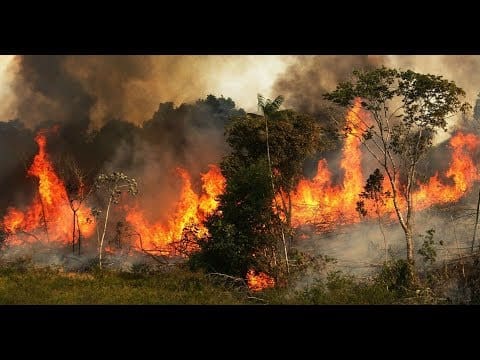
“Annual deforestation in Brazil’s Amazon has fallen to its lowest level since at least 1988, when systematic satellite monitoring began. According to satellite estimates from Brazil’s National Institute for Space Research, 3,335 square kilometers of the forest were cleared between August 2025 and July 2026, down 42 percent from the previous year and 27 percent below the previous record low in 2012,” reports The Doomslayer.
Ecuador’s Chocó rainforest is expanding.
A study released last year found that the Amazon rainforest is more resistant to drought than previously thought.
An ancient lost city was found in the Amazon in 2024, bigger than the cities of the Maya in Mexico.
Trees in the Amazon are getting bigger and more robust, due to higher levels of carbon dioxide.
Most of the world’s forests are expanding. Reforestation is offsetting the effects of global warming in parts of the U.S.
The amount of vegetation on the Earth has increased for each of the last 30 years.
Deforestation has also fallen by about 8 percent in Brazil’s neighbor, Peru. Peru has the second-largest share of the Amazon rainforest in the world, after Brazil, which contains most of the Amazon basin. Amazon rainforest covers 60 percent of Peru, which contains 13 percent of the entire Amazon basin. Only 5% of Peru’s 35 million people live in its vast rainforest, a huge area bigger than Texas.


Get Console Level Smoothness On Budget Gaming PCs https://losslessscalings.pages.dev