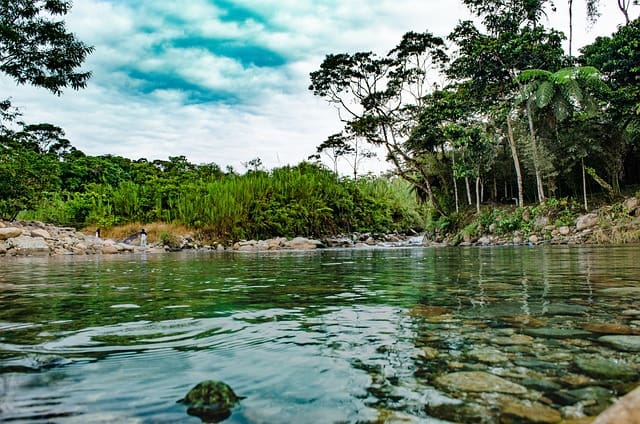
“Another rainforest study finds that the Amazon may be more drought-resistant than previously assumed. The researchers argue that most studies of Amazon drought response focus on forests where groundwater lies deep underground, making them more vulnerable to lower levels of rainfall. Their study instead examined forests with shallow water tables—which make up a third of the Amazon—and found that even during a severe drought, tree mortality did not increase and tree biomass continued to rise,” notes The Doomslayer.
The British Ecological Society explains:
The intensity and frequency of severe droughts in the Amazon region have increased in the recent decades. These extreme events are associated with changes in forest dynamics, biomass and floristic composition. However, most studies of drought response have focused on upland forests with deep water tables, which may be especially sensitive to drought. Palms, which tend to dominate the less well-drained soils, have also been neglected…
Our results indicate that forests growing over shallow water tables—relatively under-studied vegetation that nonetheless occupies one-third of Amazon forests—are remarkably resistant to drought. These findings are consistent with the hypothesis that local hydrology and its interactions with climate strongly constrain forest drought effects, and has implications for climate change feedbacks.
Its study focused on “central-southern Amazonia, where the landscape is dominated by shallow water table forests (SWTF).” It “compared vegetation dynamics before and following the 2015–2016 El Nino drought, the hottest and driest on record for the region (−214 mm of cumulative water deficit).” It “observed no change in stand mortality rates and no biomass loss in response to drought in these forests.”
Deforestation in slowing down in the Amazon. “Around 5,800 square kilometers of the forest were cleared this year, down from 6,500 in 2024 and over 20,000 in 1988.” Ecuador’s Chocó rainforest is expanding.
An ancient lost city was recently found in the Amazon, bigger than the cities of the Maya in Mexico.
Trees in the Amazon are getting bigger and more robust, due to higher levels of carbon dioxide.
Most of the world’s forests are expanding. Reforestation is offsetting the effects of global warming in parts of the U.S.
The amount of vegetation on the Earth has increased for each of the last 30 years.



https://shorturl.fm/Z8zfe
https://shorturl.fm/udHYd