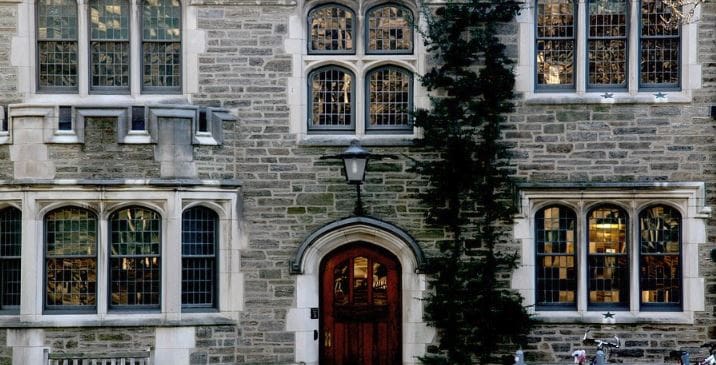
“A college endowment is supposed to last forever, supporting students, professors and research in perpetuity. Instead, many cash-strapped schools are draining their nest eggs just to stay alive. Faced with multi-million dollar deficits, Hiram College in rural Ohio borrowed from its $56 million endowment. The 1,000-student liberal arts school — which boasts a statue of US President James Garfield, who worked as a janitor there to pay his tuition — eventually pulled more than $47 million from the fund. It even tapped money that donors had explicitly set aside for specific purposes, not for balancing the budget,” reports Bloomberg News:
Hiram is now working with the state attorney general’s office and is hashing out a repayment plan, a spokesperson said. The school is also notifying its donors about the draw from the endowment, both in writing and through in-person conversations.
David Haney, Hiram’s president from 2020 to 2023, said he was surprised to learn about the loans when he took office. He considers them a risky bet that many smaller schools feel forced to take in an era when US student enrollment has started to decline. Colleges need to focus on cutting expenses instead, he said.
“What a lot of these small colleges do is they think that things are going to turn around,” Haney said. “‘If we just invest in new athletic facilities, everything is going to be fine.’ In most cases, that doesn’t happen. To me, that’s why borrowing from the endowment and taking out debt is not the way to go about it.”
Hiram is far from alone. Nearly 200 private colleges borrowed from restricted endowment funds in 2025, up from about 130 in 2021, according to estimates from higher-ed consulting firm Perspective Data Science. Other colleges have avoided loans but are drawing more from their endowments each year than advisors consider sustainable. Analysts liken both strategies to borrowing from a 401(k) — it may help in the short-term but carries long-term risks, such as downgrading a school’s credit rating.
Colleges have been raiding scholarship funds to pay their bills, reports The Wall Street Journal:
When Natalie Strouse’s husband of 20 years died of cancer, she honored his memory by creating a scholarship in his name at the college where she taught accounting. Each year, she helped select a student to receive a few thousand dollars at Notre Dame College, a small Catholic school outside Cleveland. But in 2024, the college closed. Strouse wanted to re-establish the scholarship at another institution. She asked Notre Dame for the $30,000 endowment, which under the terms of the gift could only be used to support the scholarship.
Not possible, she said an administrator informed her. The money was gone. “She told me they used it to pay the bills,” Strouse said. “I consider it theft.”
Ohio’s attorney general last year filed a complaint against 14 Notre Dame College officials, over how they improperly used more than $2 million of restricted endowment funds for purposes never intended by donors.
As The Journal notes, “Higher education is in real financial trouble…College leaders are cutting programs, laying off faculty—and digging into endowments to pay operating expenses….schools are covering day-to-day bills with funds that donors gifted for other purposes, without the donors’ knowledge or consent.” They are fleecing “thousands of philanthropists who have donated billions of dollars to colleges and universities across generations.” “Nearly 200 private colleges borrowed from restricted endowments in 2025, up from 131 in 2021.” Schools used most of the money for operating expenses.




websitem için çok işime yaradı teşekkür ederim
aramalarım sonunda buraya geldim ve kesinlikle işime yarayan bir makale oldu. teşekkür ederim