
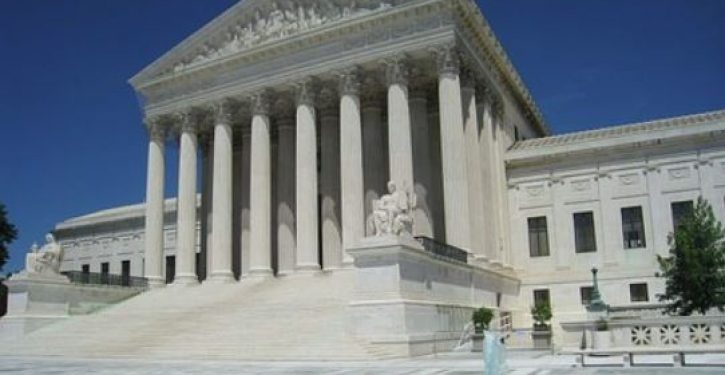
The Supreme Court ruled Monday morning that President Donald Trump can fire high-ranking bureaucrats, even when they serve on commissions that are often referred to as “independent agencies.”
In its 6-3 decision in Trump v. Slaughter, the court allowed Trump to fire a member of the Federal Trade Commission. The Court ruled that “The FTC’s for-cause removal provision is contrary to the separation of powers enshrined in the Constitution.”
The ruling states that officers in the executive branch, who “derive their offices from [the president’s] appointment,” must “remain accountable to the President,” meaning “those officers must be removable by the President.”
Trump removed Rebecca Slaughter, a former aide to Democratic New York Sen. Chuck Schumer, from the Federal Trade Commission (FTC) in March 2025. The president alleged that keeping Slaughter as a commissioner would be “inconsistent with [the] administration’s priorities.” (RELATED: SCOTUS Allows Trump Firing Of Ex-Schumer Aide From FTC — For Now)
Chief Justice John Roberts delivered the majority opinion, joined by Justices Samuel Alito, Neil Gorsuch, Brett Kavanaugh, and Amy Coney Barrett. Justice Clarence Thomas joined in part. Justice Sonia Sotomayor wrote the dissenting opinion, joined by Justice Elena Kagan and Justice Ketanji Brown Jackson.
🚨 In a 6-3 vote, the Supreme Court ruled that the President may fire FTC commissioners at will, overruling Humphrey’s Executor and holding that the FTC’s for-cause removal protections violate the Constitution’s separation of powers. pic.twitter.com/2vTfnyyC7R
— SCOTUS Wire (@scotus_wire) June 29, 2026
The court also released its decision on Trump v. Cook, a similar case regarding the firing of Lisa Cook from the Federal Reserve Board of Governors.
The court ruled that Trump cannot fire Cook while litigation continues. Trump attempted to fire Cook after Federal Housing Finance Agency Director Bill Pulte referred her to the Department of Justice over allegations she falsified mortgage documents. (RELATED: SCOTUS Doesn’t Seem To Buy Trump’s Reasons For Rushing To Fire Lisa Cook)
The court denied the government’s motion because the Federal Reserve was created by Congress, and therefore has its own method of removal. The executive branch cannot remove Federal Reserve governors at will, the court ruled, because doing so would represent “interpretive leap out of step with the statute Congress enacted and our Nation’s tradition of central banking protected from political interference.”


