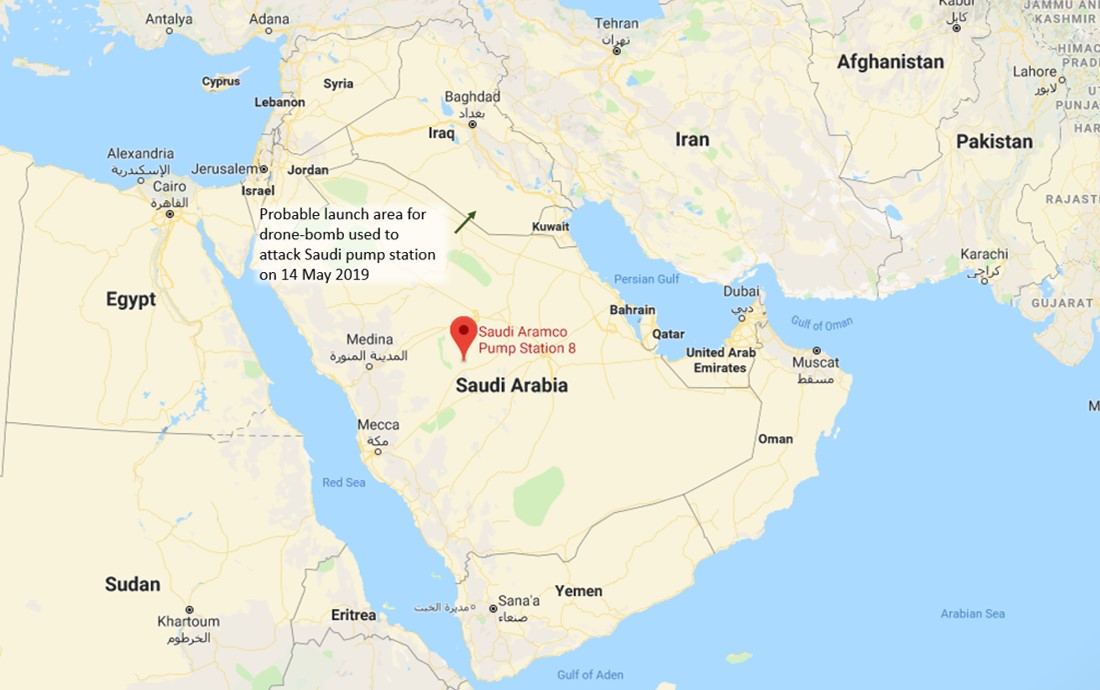
“Syria is set to provide a route for Iraqi crude exports to avoid the hazardous Strait of Hormuz, with a stream of trucks being lined up to haul oil overland to a port on the Mediterranean Sea. The Iraqi government asked Syria to help with the export of crude in addition to existing flows of fuel oil, Yousef Qiblawy, chief executive officer of the state-owned Syrian Petroleum Co., said.”
“The vast majority of Iraqi oil production and export comes from the southern region connected to the Persian Gulf….Around 90% of Iraq’s oil production originates from southern oil fields.” Historically, “nearly 94% of Iraq’s oil exports” moved “through the Persian Gulf via southern maritime terminals such as the Basra Oil Terminal and Khor al-Amaya….Iraq has limited northern export capacity through the Iraq-Turkey Pipeline to Ceyhan and small overland trucking routes to Jordan and Syria, but these handle only a small fraction of total output.”
Worldometer notes that “Iraq has proven oil reserves of 145,019,000,000 barrels (as reported in 2025) (#5 in the world), representing 8.2% of the world’s total. As of 2025 production rates, Iraq has roughly 91 years of proven oil reserves left.”
Gulf oil producers are attempting to bypass the dangerous Strait of Hormuz. Oil tankers have to pass through that narrow waterway to carry oil from the Persian Gulf to the rest of the world. Iran temporarily cut off most shipping through the Strait of Hormuz, by planting mines in the Strait, and by firing missiles and rockets at oil tankers in and around the Strait of Hormuz.
The Iran War temporarily reduced the flow of oil to the rest of the world from the Persian Gulf, driving up oil prices worldwide. But growing oil production in Brazil and Argentina kept oil prices from rising more, by making up for some of the lost oil.
And more oil is now passing through the Strait of Hormuz, due to U.S. Navy protection of oil tankers. “Crude oil exports from the Middle East through and around the strait have recovered significantly, returning to roughly 92% of pre-war baseline levels by late September. U.S. Central Command (CENTCOM) forces and Navy assets have actively escorted, guided, and monitored commercial tankers through a southern shipping corridor hugging the coast of Oman.”
Less oil will need to pass through the Strait of Hormuz in the future. Le Monde reports that the United Arab Emirates is expanding a pipeline to the Gulf of Oman which is expected to carry 3.6 million barrels per day by next year —nearly the UAE’s entire current oil output. “Saudi Arabia is considering expanding its pipeline to the Red Sea, and Iraq has signed an agreement with Syria to revive a pipeline to the Mediterranean. A study from Goldman Sachs estimates that 60 percent of the Gulf’s pre-Iran War oil exports could be protected from disruptions in the Strait of Hormuz by the end of 2028,” reports The Doomslayer.
Oil production in Brazil has risen from 3 million barrels per day in 2022 to about 4.5 million barrels per day in 2026.
The South American country of Guyana is rapidly expanding offshore oil production. It now has among the highest per capita oil production on Earth, producing more than 900,000 barrels of oil per day, despite having only 840,000 people. It was once the poorest country in South America, but now its per capita income is higher than any other country in the Americas (except perhaps the United States).