
By Emily Kopp
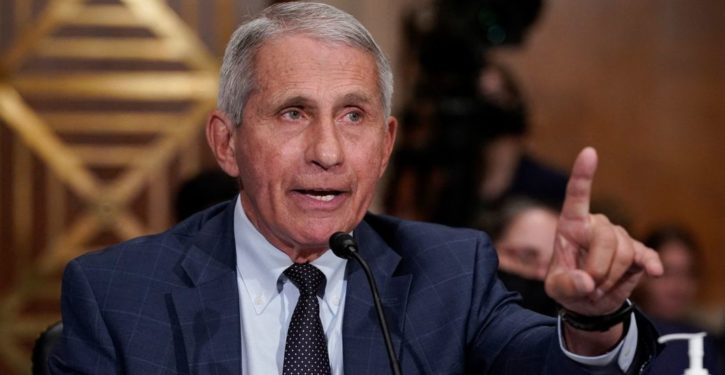
Former Director of the National Institute of Allergy and Infectious Diseases Dr. Anthony Fauci invoked the Fifth Amendment Wednesday in response to questions from Republican Kentucky Sen. Rand Paul about the origins of the COVID-19 pandemic.
“On advice of counsel I respectfully decline to answer based upon my rights under the Fifth Amendment of the Constitution,” Fauci repeatedly said in response to Paul’s questions. (RELATED: EXCLUSIVE: Congressman Who Confronted Fauci Reveals What He Expects From Blockbuster Hill Hearing)
Fauci’s stonewalling threatens the ability of Paul’s investigation to obtain answers about the truthfulness of Fauci’s testimony on gain-of-function research in Wuhan, the relationship between the NIH and the intelligence community, signs of engineering in the COVID genome and his history of championing high- risk virology research.
“It’s against the law to obstruct an investigation of Congress and there will be repercussions for your refusal to testify today,” Paul said.
That prompted repeated outbursts by Fauci’s attorney, who was subsequently removed by Capitol Police from the hearing.
Fauci’s refusal to answer questions about ties between his institute and high-risk coronavirus research at the Wuhan Institute of Virology marks a dramatic fall from grace for the man once championed by the corporate press as a pandemic hero.
Paul pressed Fauci on why he funded a maximum security lab in China despite the national security risks, whether NIH handled classified research for the CIA and other spy agencies and whether the lab in Wuhan had the capacity to splice novel spike genes into SARS-related coronaviruses.
Fauci refused to answer.
Finally, Paul asked whether Fauci still felt that the benefits of gain-of-function research were worth the risks, as he wrote in a 2012 editorial in The Washington Post.
Fauci authored the editorial in response to criticism from biosecurity-minded scientists like Rutgers University microbiologist Richard Ebright and Stanford University microbiologist David Relman about the risks of such work.
Fauci said the work should proceed even if it risked triggering a pandemic. The National Institutes of Health kept funding the work. Paul pressed Fauci on whether that worst case scenario had occurred, but did not get an answer.

