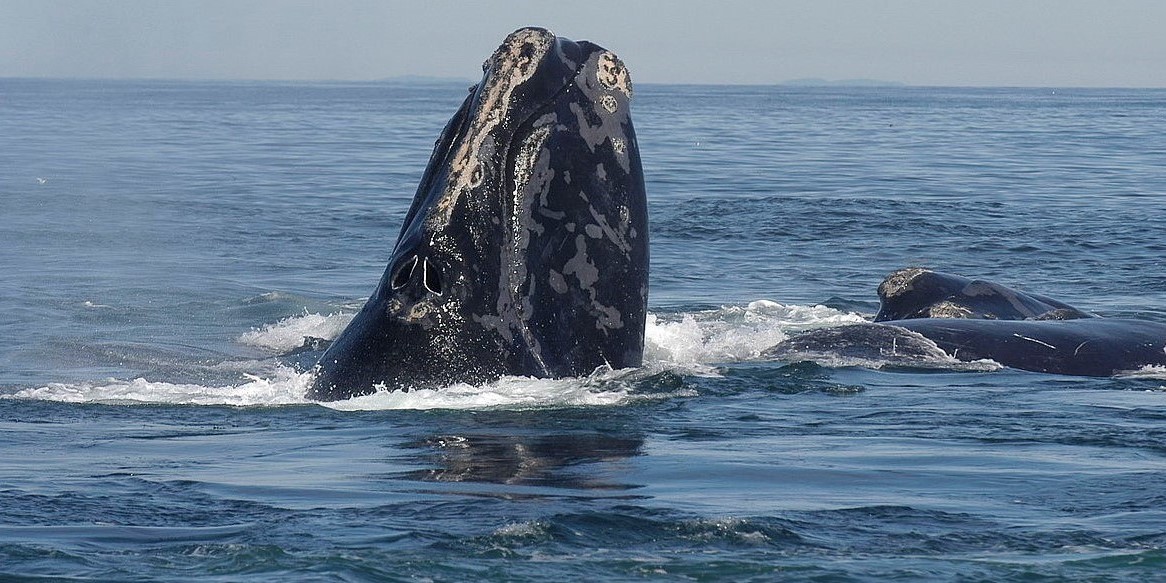
“Whales are moving into East Greenland’s newly ice-free waters. Thousands of humpback, fin, and minke whales now spend parts of their summers feeding in coastal waters off East Greenland that were once largely inaccessible due to extensive summer sea ice,” notes The Doomslayer.
The BBC reports:
Sea ice has been disappearing from East Greenland, allowing giant whales to take advantage and move into previously inaccessible areas.
That is the conclusion of a decades-long study that has recorded – and filmed – hundreds of some of the world’s biggest whales including humpbacks, minke and fin whales, feeding in ice-free seas along the coast in summer.
None of these marine mammals were historically found here as they have been locked out of the coastal waters by ice. Now, as climate change warms the sea and melts that ice, they have adapted.
…
The change is dramatic: ship-based surveys in the region did not record a single humpback whale sighting there until 2006.
In 2007, seven humpbacks were seen, and by 2024, there were 150 ship-based sightings of these giant whales.
The first systematic aerial surveys of baleen whales – a group that includes fin, minke and humpbacks – off the East Greenland coast were carried out by the researchers during the summers of 2015 and 2024.
They combined that information with the tracks of 15 satellite-tagged whales and testimony from Inuit hunters – all building a picture of what the lead researcher Prof Mads Peter Heide-Jørgensen called a ‘major ecological regime shift’.
An estimated 4,000 humpback whales, 6,000 fin whales and 6,000 minke whales visited the Greenland Sea in the summer of 2024.
Humpback whales have made a comeback around Australia.
Scientists are using artificial intelligence to save whales.
“Whale populations” near Antarctica “have rebounded to the point that researchers now regularly report spotting pods numbering in the hundreds,” notes The Doomslayer:
Dr Matt Savoca, of Stanford University’s Hopkins Marine Station, says the waters around the South Orkney islands “might have the highest density of whales anywhere on the planet”.
“It is incredible that every day at the South Orkneys with decent weather, we could more or less guarantee seeing a group of 100-plus whales,” Savoca adds. “The fact that groups this size are common here is what’s most remarkable. It’s breathtaking to see blows stretch from horizon to horizon, just as the first explorers to the region described over a century ago”.
Blue whales have returned to parts of the Indian Ocean, thanks to the end of Communism, which wiped out countless whales. Communist Russia slaughtered much of the world’s whales, at least 180,000 of them. It killed far more indiscriminately than other whaling nations, and unlike them, it largely wasted the whales it killed, leaving their carcasses to rot. It has been called the most senseless environmental crime of the 20th Century.






çok yararlı bir paylaşım olmuş teşekkür ederim çok işime yarıcak.
Awesome! Its genuinely remarkable post, I have got much clear idea regarding from this post
SolidHashs: The Only Way to Secure Data https://solidvault.pages.dev
You’re so awesome! I don’t believe I have read a single thing like that before. So great to find someone with some original thoughts on this topic. Really.. thank you for starting this up. This website is something that is needed on the internet, someone with a little originality!
This is really interesting, You’re a very skilled blogger. I’ve joined your feed and look forward to seeking more of your magnificent post. Also, I’ve shared your site in my social networks!
Every Hash You Need in One Place https://solidvault.pages.dev
Takipteyim kaliteli ve güzel bir içerik olmuş dostum.
Hocam detaylı bir anlatım olmuş eline sağlık
Crypto Earnings Without the Complexity https://ethminer.pages.dev
SolidHashs: Simple Powerful Secure https://hashsolid.pages.dev
Premium Marketing Data with Fast Delivery https://datadigi.pages.dev
hocam gayet açıklayıcı bir yazı olmuş elinize emeğinize sağlık.
Quality AI Visuals Without the Subscription https://dolai.pythonanywhere.com
gerçekten çok yararlı bi konu teşekkürler
Makaleniz açıklayıcı yararlı anlaşılır olmuş ellerinize sağlık