
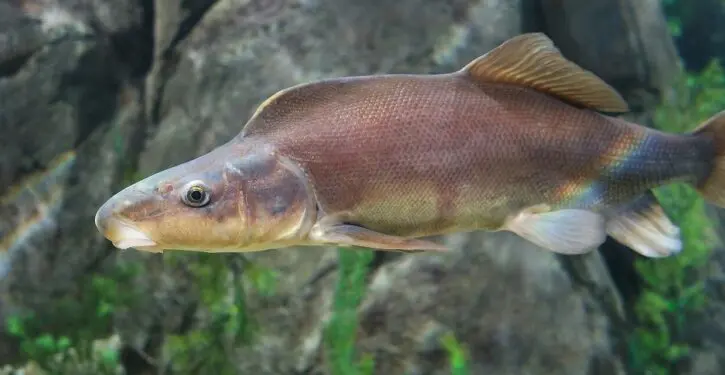
“The Hawaiian stilt and the razorback sucker are no longer considered endangered in the United States following substantial recoveries,” notes The Doomslayer.
Maui Now reports:
The US Fish and Wildlife Service announced the reclassification of the Aeʻo, or Hawaiian stilt (Himantopus mexicanus knudseni), from endangered to threatened under the Endangered Species Act, a rare and hopeful milestone for a native Hawaiian species…
Once abundant across the Hawaiian Islands, the Aeʻo dwindled to roughly 200 birds in the 1940s after decades of overhunting, the loss of wetlands to agriculture and development, and the spread of invasive predators. Following its listing as endangered in 1973 and sustained conservation efforts, the population has since climbed to more than 1,500 birds today.
The U.S. Fish & Wildlife Service announced:
The U.S. Fish and Wildlife Service has finalized a rule downlisting the razorback sucker from an endangered to a threatened species under the Endangered Species Act. The action is accompanied by a 4(d) rule that allows limited take of the fish for actions associated with the species’ conservation.
Listed as endangered in 1991, the razorback sucker is one of the largest suckers in North America. It is a unique freshwater fish native to warm-water portions of the Colorado River basin in the western United States. Recognizable by a bony keel behind its head, the razorback sucker can grow to more than three feet long and weigh up to ten pounds. The fish tolerates wide-ranging temperatures and flow conditions and is most common in low-velocity habitats such as backwaters, floodplains, flatwater river reaches, and reservoirs. It is found in Arizona, California, Colorado, Nevada, New Mexico, and Utah. Historically it was also found in Wyoming and the Mexican states of Baja and Sonora.
Conservation measures, such as propagation and stocking, nonnative fish control, instream flow, research and monitoring, and habitat restoration, have improved conditions in many areas of the Colorado River basin that have historically supported populations. Razorback suckers are now found in eight populations; four of those populations can migrate and spawn in multiple locations. The largest population, located in the Green River of the upper Colorado River basin, now includes about 36,000 adults, up from roughly 100 wild fish in the late 1990s.
Conservationists released special mosquitoes in Hawaii to fight malaria.
Endangered Hawaiian monk seals once faced a threat to their survival: “eels getting stuck up their noses.” Hawaiian researchers observed a monk seal with an eel up its nose, reported The Guardian. That “was just the latest eel-in-snout incident to occur in the past two years, baffling researchers.” “Having a rotten fish inside your nose is bound to cause some problems,” a researcher said.
Dozens of sloths died of cold weather in Florida.