
“According to data compiled by the US Energy Information Administration, China’s nuclear energy generation capacity nearly doubled between 2016 and 2026, growing from 31.4 gigawatts to 58.7. The EIA also reports that 36 reactors, totaling another 38.9 GW of capacity, are currently being built in China, making up 49 percent of all global nuclear energy construction. All that development has led to learning; nuclear power plants in China are completed in an average of six years, three years faster than the global average,” reports The Doomslayer.
The Energy Information Administration explains:
From 2016 to 2024, China’s nuclear generation capacity increased 76% (24 GW), based on our International Energy Statistics (IES) data. According to the International Atomic Energy Agency’s Power Reactor Information System (PRIS), China added an additional 1.1 GW of nuclear power capacity in 2025 and 2.2 GW in 2026 (through May). China is continuing to build out its nuclear generating capacity and has 36 reactors under construction, accounting for more than 49% of total world nuclear construction, according to PRIS.
China’s nuclear fleet is concentrated near population centers in the eastern part of the country, along the Pacific Ocean coastline from the Liaoning province in the north to the Hainan province in the south. According to IAEA’s PRIS, China’s existing nuclear fleet mostly consists of pressurized water reactors.
As of May 2026, China had 60 operational reactors with 58.7 GW of total capacity installed at 18 different sites. China has also implemented strategies to help rapidly expand its nuclear power plant fleet.
Nuclear projects in China use a standardized project management approach for design, licensing, and construction for multiple reactor technologies. Reactors are built in batches of 6 to 10 reactors to take advantage of economies of scale. China is also building up a nuclear supply chain with a focus on domestic manufacturing of the main plant components to decrease reliance on foreign nuclear vendors.
Additionally, China’s average build time for nuclear power plants is below the global average. According to the World Nuclear Industry Status Report, 2022 the average build time for a nuclear power plant in China between 2012 and 2021 was six years, compared with a global average construction time of about nine years. More recent reporting in 2024 similarly indicates that Chinese firms built reactors both inside and outside of China in five to seven years.
China started construction of six new reactors in 2025 and two new reactors, Xuwei-1 and Taipingling-4 in 2026 through May. China has also commissioned two new units so far in 2026: Sanao-1 and Taipingling-1. In total, China has 36 reactors under construction across 19 sites which will add about 38.9 GW of additional capacity.
China is building its first small modular reactor (SMR), the Linglong-1, a domestically designed 100 MWe pressurized water reactor that can be used for power generation, water desalination, and district heating. The project is intended to demonstrate commercial operation and is expected to start operation in the first half of 2026. The Linglong-1 uses the ACP100 SMR design, a modular design, allowing certain components to be built in a factory and installed onsite.
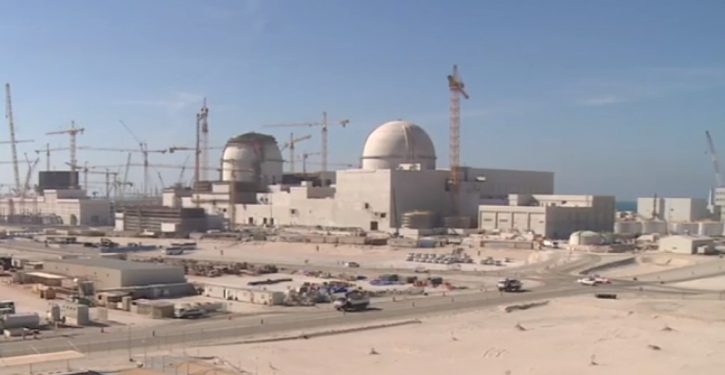
Despite having lots of oil, the United Arab Emirates (UAE) recently built four nuclear power reactors.
Right now, nuclear energy produces about 19% of the electricity generated in America. Nuclear energy produces no greenhouse gas emissions or air pollution. Nuclear plants generate most electric power in countries like France and Slovakia, but in the U.S., it has been much more difficult and costly to construct a nuclear power plant.
A sodium-cooled nuclear power plant was recently approved in Wyoming. “Sodium cooling allows reactors to operate at higher temperatures and lower pressures than conventional water-cooled plants, which can improve efficiency. The design will also include thermal storage, allowing the reactor to store energy as heat during periods of low demand,” reports The Doomslayer.
A nuclear plant in Florida is helping crocodiles thrive. Russia signed an agreement with Ethiopia to build a nuclear power plant.
Nuclear power is already “the safest form of energy we have, if you consider deaths per megawatt of energy produced,” notes Yale University’s Steven Novella. “Wind turbines, surprisingly, kill more people than nuclear plants,” notes an environmentalist. And “solar panels require 17 times more materials in the form of cement, glass, concrete, and steel than do nuclear plants, and create over 200 times more waste,” such as “dust from toxic heavy metals including lead, cadmium, and chromium.”
Nuclear plants emit no air pollution, only harmless steam. Unlike wind farms, nuclear power plants don’t kill birds. The biggest utility that generates wind power pleaded guilty to federal crimes for killing 150 eagles.