
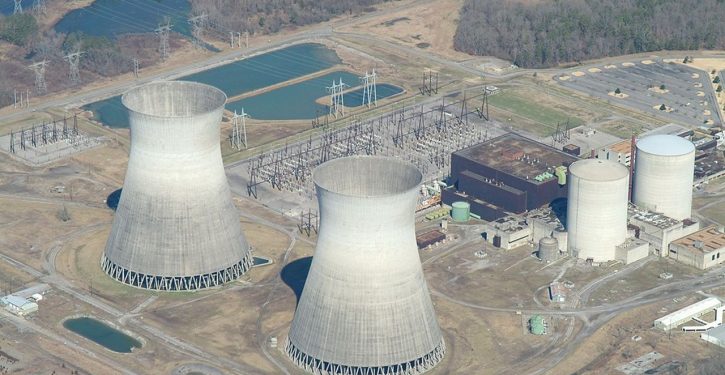
“The Nuclear Regulatory Commission has proposed a practical disposal pathway for “Greater-Than-Class-C” nuclear waste, the most radioactive category of low-level nuclear waste, which currently has no functioning disposal route and is instead being held at various power plants, hospitals, and other facilities across the country. The proposed rule would tailor disposal requirements to the radioactivity of the material, potentially allowing nearly 80 percent of GTCC waste to be buried near the surface rather than in a deep geological repository, which does not currently exist in the United States for this kind of waste,” reports The Doomslayer.
The total amount of nuclear waste is not that big to begin with — much less than the amount of toxic waste produced by other forms of energy. As an environmentalist notes, “solar panels require 17 times more materials in the form of cement, glass, concrete, and steel than do nuclear plants, and create over 200 times more waste,” such as “dust from toxic heavy metals including lead, cadmium, and chromium.” Nuclear plants emit no air pollution, only harmless steam. Unlike wind farms, nuclear power plants don’t kill birds. The biggest U.S. utility that generates wind power pleaded guilty to federal crimes for killing 150 eagles. Wind turbines don’t last forever, and they leave behind fiberglass blades that landfills often won’t accept. Moreover, “burning fiberglass emits dangerous pollutants. So CNN says “wind energy has a massive waste problem.”
There once was an excellent place to put all of America’s most radioactive waste — below Yucca mountain, in Nevada — but it was blocked from operating for unscientific, political reasons, after billions of dollars were spent on it. As an AI Overview explains,
- The Nuclear Regulatory Commission (NRC) conducted a comprehensive safety review. In 2015, they concluded that the Department of Energy’s license application met all regulatory requirements, stating the facility would safely contain nuclear waste for one million years. [1]
- Economic Cost: Because the federal government failed to open a permanent repository, it breached contracts with utility companies. By the mid-2010s, taxpayers had already paid out over $5.3 billion in damages, with tens of billions more projected in long-term liabilities.
Now, POWER Magazine reports on the new way to dispose of nuclear waste authorized by the Nuclear Regulatory Commission:
Rather than classifying waste by its origin, the proposed rule would scale disposal requirements to the actual radiological hazard of the material, using site-specific, risk-informed analyses to match waste streams to appropriate disposal depths and engineered barriers. Nieh said the agency has built the technical basis for that approach over several years and concluded that nearly 80% of the GTCC inventory by volume is potentially suitable for near-surface disposal, given site-specific analyses and appropriate safety controls.
Nuclear power, unlike wind energy, produces steady, reliable power, regardless of the weather. Many years ago, France and Sweden replaced most of their fossil-fueled electricity with nuclear power, and as a result, ended up emitting less than a tenth of the world average of carbon dioxide per kilowatt-hour. “Nuclear power is the safest form of energy we have, if you consider deaths per megawatt of energy produced,” notes Yale University’s Steven Novella. “Wind turbines, surprisingly, kill more people than nuclear plants,” notes Michael Shellenberger.
Nuclear power is best for the environment, concluded Reason Magazine’s science writer, Ronald Bailey.