
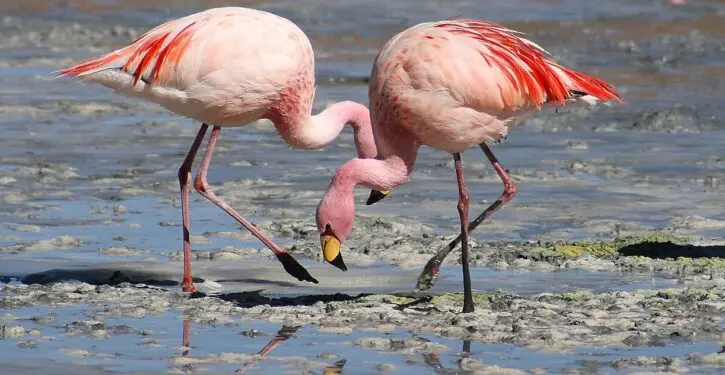
“In the early 2000s, a population of flamingos began making the Venetian Lagoon their winter home. Since then, the annual population peak has risen to nearly 24,000 birds,” reports The Doomslayer. The lagoon is now one of the most important wintering spots for flamingos, says an ornithologist quoted by The Associated Press:
Flamingos — which most famously nest in Spain and France — started showing up in the vast Venetian Lagoon in the early 2000s, mostly in fishing valleys and mudflats in the lagoon’s furthest reaches, with only rare sightings in the canaled historic center of Venice that is most frequented by global tourists.
Environmentalists say their arrival in Venice as the European flamingo’s range expands is a sign of the lagoon’s health and suitability as a feeding ground.
Last year, the number of wintering flamingos in Venice peaked at a record of nearly 24,000. That is 6,000 more than the previous year, numbers ‘that position the Venetian Lagoon as one of the most important wintering spots in its entire habitat range,’ said ornithologist Alessandro Sartori.
Crested ibises have returned to Japan.
Fish have returned to the once horrifically polluted Chicago River. Many fish in the Hudson River are now safe to eat.
For over a century, the river that flows through Paris (the Seine) was so dirty that it was illegal to swim in it. But now, it has become so clean that swimming in it was recently legalized by the City of Paris.
The population of the critically endangered Siberian crane has risen by 50%.
The Little Bustard, “a heavy-bodied grassland bird native to Eurasia,” is making a comeback in Kyrgyzstan after nearly being wiped out during the Communist Soviet Union’s rule over Kyrgyzstan.
In Germany, a sludge-filled river became a thriving ecosystem: “For more than a century, Germany’s Emscher river carried sewage and industrial sludge through the Ruhr, earning a reputation as an open sewer. Now, after a massive cleanup, the river is becoming a thriving ecosystem once again.”