A Quick Bible Study Vol. 303: The Best of St. Paul

St. Paul’s scripture is magnificent poetry that conveys timeless truths about Jesus and the meaning of His sacrifice.

Paul was a Jewish leader and Roman citizen who initially persecuted the Jewish followers of Jesus until his life-changing event on the “Road to Damascus.” Paul is credited with writing 13 of the 27 New Testament “books.” These are actually letters to his brethren in the early Christian communities who faced persecution, division, uncertainty, and moral decline. Paul addressed those issues by combining theological reflection about Jesus’s teachings and His very existence with practical self-help guidance.

After years of laboring over this “quick” study, I have come to appreciate the beauty of St. Paul’s writing. It is poetry that conveys timeless truths about the Lord Jesus, the meaning of His sacrifice for our sins, and it has grown into the world’s largest religion. As a writer, I marvel at his talent, inspired by the Holy Spirit. So today, I was inspired to share what I consider the “best of Paul.”

Back in May 2021, I wrote Vol. 61: St. Paul’s Greatest Hits. Here, some of those passages are repeated, but one never grows tired of Paul’s exquisite verses, which can penetrate your soul. You can see or hear them, and later, when reading again, derive new meaning or comfort from the same passage because it speaks to what is happening in your life. Moreover, nearly every Bible study I write includes a passage from Paul because he was such a prolific writer, and his words always apply to whatever topic I am covering.

Paul is credited with writing 13 of the 27 New Testament books, letters to his brethren in early Christian communities. These early Christians faced persecution, division, uncertainty, and moral decline, and Paul addressed those issues. His words combine theological reflection on the meaning of Jesus’s teachings and His very existence with practical self-help guidance.

Due to the beauty and truth of Paul’s most popular verses, many have been incorporated into the secular lexicon. Thus, he is quoted without people realizing they are quoting the Bible. A good example of that is “money is the root of all evil.” The complete verse reads:

“For the love of money is a root of all kinds of evil. Some people, eager for money, have wandered from the faith and pierced themselves with many griefs” (1 Timothy 6:10).

Before we review Paul’s “best” passages, here is a quick refresher about his background. Saul of Tarsus – later known as Paul – was born a Jewish-Roman citizen in Tarsus (modern-day Turkey). Aside from Jesus, he is most responsible for the explosive growth of early Christianity. And never forget that he initially persecuted Jews who believed that Jesus was the Jewish Messiah. In last week’s Vol. 302 about pain, I quoted Jesus saying about Saul/Paul:

“For I will show him how much he must suffer for the sake of my name” (Acts 9:16). Read more here, and in Vol. 60.

Now let’s turn to Paul’s “best” passages (or I should write “Myra’s favorites” because all Paul fans have their own list) beginning with:

“And we know that for those who love God all things work together for good, for those who are called according to His purpose” (Romans 8:28).

I love this verse! It speaks to situations where you are defeated and trying to understand what has happened and why. Life’s ups and downs are viewed through God’s perspective, who knows our past, present, and future. God’s long view is always reconciled when, years later (or sometimes sooner) after you have experienced a major disappointment or calamity, you begin to see God’s perfection and why painful events had to line up the way they did.

The next verse is Paul’s deeply personal realization:

“I have been crucified with Christ. It is no longer I who live, but Christ who lives in me. And the life I now live in the flesh I live by faith in the Son of God, who loved me and gave Himself for me” (Galatians 2:20).

Paul understands that his Christian identity connects to Christ’s suffering. He speaks to all believers who are always seeking a closer personal relationship with Jesus.

It’s time for Paul’s most familiar passage, from (1 Corinthians 13:4-8) “the best of the best.” Over the years, I have observed that often, even at secular weddings, these magnificent words are read:

“Love is patient, love is kind. It does not envy, it does not boast, it is not proud. It does not dishonor others, it is not self-seeking, it is not easily angered, it keeps no record of wrongs. Love does not delight in evil but rejoices with the truth. It always protects, always trusts, always hopes, always perseveres. Love never fails.”

Paul’s famous “wedding passage” describes the essence of love: God is love, and, operationally, Jesus tells us to “love one another.” This verse is a behavioral guide for maintaining a loving relationship, a healthy marriage, or any relationship.

This next verse is another of the most widely quoted:

“I can do all things through Him who strengthens me” (Philippians 4:13).

Inner strength through faith is a secret of successful people. Reliance on Christ offers people a continuous opportunity to be motivated and reach beyond themselves. Paul’s following passage encapsulates Christianity’s foundational message:

“For the wages of sin is death, but the gift of God is eternal life in Christ Jesus our Lord” (Romans 6:23).

In the late 1990s, I saw that verse on a highway billboard in North Carolina and didn’t understand its meaning then, but I do now. We are human, and we sin. However, because Jesus, who was sinless, took on our sins and the sins of the world for our sake, was resurrected, and defeated death, we will have His gift of eternal life IF you accept Him as your Lord and Savior.

Another of Paul’s verses is a universal truth. Sometimes it is used to justify countries’ policies or actions:

“If God is for us, who can be against us?” (Romans 8:31).

The next verse perfectly explains the human condition:

“For all have sinned and fall short of the glory of God” (Romans 3:23).

This study could be pages long because Paul’s writings are among the best that humankind has to offer. Due to space constraints, I am omitting his famous “Armor of God” passage in Ephesians 6:10-18. It was recently discussed in Vol. 301 on New Year’s resolutions when I proclaimed that mine was to “wear the full armor of God.” For more about the passage, see Vol. 81

This study concludes with a passage that I had engraved on our wedding reception silver cups that says “Romans 8:39”:

“For I am convinced that neither death nor life, neither angels nor demons, neither the present nor the future, nor any powers, neither height nor depth, nor anything else in all creation, will be able to separate us from the love of God that is in Christ Jesus our Lord” (Romans 8:38-39).

Such a powerful verse emphasizes that Paul knew he would be martyred for that truth. The question I will leave you with: “Would you be martyred for the truth?”

Myra Kahn Adams is a conservative political and religious writer. Her book “Bible Study For Those Who Don’t Read The Bible“ reprints the first 56 volumes of this popular study. “Part 2,” reprints Vols. 57 –113. Order it here.

Myra is also the Executive Director of the National Shroud of Turin Exhibit. You can help support our new exhibit in Orlando, Florida. Contact: Myraadams01@gmail.com

This article originally appeared at Townhall.com.

Trump imposes tariffs on Europe to pressure our ally Denmark to give up Greenland

“President Donald Trump said Saturday that he would charge a 10% import tax starting in February on goods from eight European nations because of their opposition to American control of Greenland,” reports NPR.

Trump’s demand for Greenland is a breach of America’s century-old treaty with Denmark. In that treaty, America explicitly agreed to Danish control over Greenland in exchange for Denmark selling the Virgin Islands to the United States. Pressuring Denmark to give the U.S. Greenland is an act of aggression against America’s NATO ally, Denmark, showing a lack of respect for its territorial integrity. Greenland has been part of Denmark for centuries. Denmark is America’s friend: 43 Danish soldiers died fighting on America’s side in Afghanistan.

NPR reports that

Trump said in a social media post that Denmark, Norway, Sweden, France, Germany, the United Kingdom, the Netherlands, and Finland would face the tariff and that it would climb to 25% on June 1 if a deal is not in place for “the Complete and Total purchase of Greenland” by the United States.

The threat of tariffs was a drastic and potentially dangerous escalation of a showdown between Trump and NATO allies, further straining an alliance that dates to 1949 and provides a collective degree of security to Europe and North America.

Greenland is a costly white elephant that costs Denmark far more to maintain than it gets from Greenland in tax revenue. The U.S. closed most of its bases on Greenland over the years because a U.S. presence on most of Greenland is so unnecessary. Denmark let the U.S. put bases wherever it wanted, but after the end of the Cold War, the U.S. realized it didn’t need most of its bases anymore.

Most Americans do not want the U.S. to acquire Greenland. And 85% of Greenlanders oppose becoming part of the United States.

Running Greenland costs money. Denmark recently helped finance three new airports in Greenland costing $800 million. It has spent billions and billions of dollars on Greenland, for little in return. Greenland is too cold and remote to profitably mine most of its minerals (although Greenland welcomes U.S. investment and Australians and others are involved in Greenland’s mining sector).

Greenland is mostly covered by ice and has fewer than 57,000 people. Most of Greenland is uninhabitable because it is covered by a massive ice sheet.

Europe could retaliate with tariffs of its own, in response to Trump’s tariffs. Trump’s tariffs on Europe could provoke a destructive trade war that wipes out many American jobs.

After Trump imposed his “Liberation Day” tariffs, America’s manufacturing sector shrank, as tariffs increased the cost of imported raw materials used by American manufacturers, such as aluminum and steel.

In December, the U.S. factory sector shrank for the 10th straight month. Economists say tariffs on aluminum and steel wipe out more U.S. jobs than they save, by increasing the costs of manufacturers who make things out of aluminum and steel.

Hegseth ‘Taking A Sledgehammer’ To Costly Race-Based Program You’ve Likely Never Heard Of

By Mariane Angela

Secretary of War Pete Hegseth said Friday the Pentagon is launching a sweeping crackdown on a little-known federal contracting program he said has become a breeding ground for waste, fraud, and race-based preferences.

Hegseth took to social media to announce a sweeping overhaul of the Small Business Administration’s 8(a) program, saying that the initiative has drifted from its original purpose and now siphons defense funds into what he described as corrupt diversity, equity and inclusion (DEI) schemes. He said the move follows through on promises he made after President Donald Trump appointed him to lead the Department of War, including redirecting taxpayer funds toward building a more lethal military.

“When President Trump appointed me as your Secretary of War, I made you a series of promises. I promised that every single one of your taxpayer dollars would go toward one thing, and one thing only. Building the most lethal fighting force on the planet,” Hegseth said. “And I promised we would gut the corruptive, unconstitutional, non-merit based DEI programs that have weakened our military and distracted us from our primary mission.”

Hegseth identified the 8(a) program as a prime target, describing it as the oldest DEI program in the federal government and one largely unknown outside Washington.

“We’re actually taking a sledgehammer to the oldest DEI program in the federal government. A program few people outside of Washington have ever heard of that I hadn’t heard of. It’s called the 8A program… 8A refers to the Small Business Administration’s program to assist, quote, small disadvantaged businesses owned by a socially disadvantaged individual or tribe. Providing these small businesses with opportunities is a laudable goal, but over the decades, as it happens, the 8A program has morphed into swamp code words for DEI race-based contracting.” Hegseth said. “In many, many instances, these socially disadvantaged businesses, they don’t even do work. They take a 10%, 20%, sometimes 50% fee off the top and then pass the contract off to a giant consulting firm, commonly known as Beltway Bandits.”

Hegseth said the Pentagon alone sends out enormous sole-source contracts through the program with little oversight or competition.

“In the Pentagon, $100 million sole source contracts go out our door to these 8A firms almost every day, without any competition or opportunity for anyone else to bid,” Hegseth said. “So, effective immediately, I’m ordering a line-by-line review of every small business sole source 8A contract that is over $20 million, and we’ll look at everything smaller than that, too.”

The 8A program has led to costly lawsuits against the government over its racial set-asides, lawsuits by public-interest law firms such as the Center for Individual Rights and the Wisconsin Institute for Law & Liberty. The lawsuits allege that the racial set-asides contained in the 8A program violate the Supreme Court’s decisions restricting race-based programs in Adarand Constructors v. Pena (1995) and Students for Fair Admissions v. Harvard (2023).

Hegseth said the Pentagon’s review will follow a simple test, whether a contract makes the military more lethal.

“First, if a contract doesn’t make us more lethal, it’s gone. We have no room in our budget for wasteful DEI contracts that don’t help us win wars, period. Full stop,” Hegseth said. “We’ll make sure that every small business getting a contract is the one actually doing the work, and not just some shell company funneling your money to a giant consulting firm.”

On his first day of taking office, President Donald Trump signed an executive order directing federal agencies to dismantle DEI initiatives he described as extreme and costly, along with race-based decision-making. He followed it with another order aimed at ending what the administration calls unlawful discrimination tied to those policies and reestablishing merit-driven standards nationwide. (RELATED: Here’s How Trump Has Put ‘Radical’ DEI In The ‘Dustbin’ Throughout 2025)

The Department of War has reviewed and rolled back diversity-related initiatives throughout 2025 in response to Trump’s executive actions. Hegseth said in an April 18 social media post that DEI no longer operates within the Pentagon.

The Trump administration spent 2025 dismantling diversity initiatives that expanded across government and corporate America under the previous administration. A series of executive actions from President Donald Trump has pressured agenciesschools, and companies to retreat from those policies, with analysts telling the Daily Caller News Foundation that many businesses now see DEI as a liability rather than an asset.

Unearthed Data Makes Pennsylvania’s Puberty Blocker Payouts Look Even Sketchier

By Megan Brock

Pennsylvania saw a meteoric rise in the number of adolescents receiving puberty blockers through an insurance billing code currently being investigated under the Trump administration on fraud suspicions.

More than 220 claims for puberty blocking drugs were reimbursed for minors aged 10-13 with the International Classification of Diseases (ICD) billing code, E30.1, for precocious puberty between Jan. 1, 2013 and Dec. 31, 2024, costing taxpayers more than $1.8 million, according to the data. The number of claims in the 10-13 age group went from zero in 2012 and ballooned to 47 by 2016. The Department of Justice (DOJ) has raised concerns that this billing code may have been fraudulently used by gender doctors to obtain insurance coverage for sex-rejecting interventions.

“A spike of this magnitude in the diagnosis of precocious puberty — especially among children past the usual age — is highly atypical and raises the very real possibility that the diagnosis has been used as a billing workaround,” Dr. Kurt Miceli, medical director at Do No Harm, told the Daily Caller News Foundation. (RELATED: EXCLUSIVE: Pennsylvania Gender Clinic Used Thousands Of Taxpayer Dollars To Train Mental Health Providers)

“The data indicates that the Department of Justice’s concerns merit serious investigation rather than being stalled in litigation,” Miceli stated.

Central Precocious Puberty (CPP) is caused by an early activation of the pituitary gland, which stimulates the production of sex hormones, and is widely accepted as occurring before age 10. ICD codes are published by the World Health Organization and provide diagnoses for diseases and injuries.

“I would expect to see kids on puberty blockers for precocious puberty if they are age 8 and younger,” Dr. Roy Eappen, an endocrinologist and Senior Do No Harm Fellow, told the DCNF.

“I would be surprised to see girls or boys on puberty blockers for precocious puberty after age 8,” Eappen stated.

Dr. Quentin Van Meter, a pediatric endocrinologist and past president of the American College of Pediatricians, told the DCNF it would be “very, very rare” for a child to be diagnosed with precocious puberty at age 10.

“The kids who are started on puberty blockers at age 11 and later are not generally treated for the diagnosis of precocious puberty, but are more than likely trans kids who are purposely being mis-coded to hide this travesty,”  Van Meter told the DCNF. (RELATED: EXCLUSIVE — Rachel Levine Let Notorious Gender Clinic Meet With Child In Gov’t Office)

“[The age] would be an indication that this is not precocious puberty. You’re basically trying to block true puberty, which you shouldn’t do,” Van Meter said.

Van Meter noted the data the DCNF obtained would be more meaningful if it showed the ages a child was diagnosed with precocious puberty and started on blockers. The DCNF asked for the age affiliated with each individual reimbursement claim but was not provided that information. 

The data showed a more than 2100% increase in reimbursement for puberty blocker claims using the E30.1 code between 2013 to 2017, with yearly totals for minors under 18 rising from $34,906 in 2013 to $786,728 in 2017, according to data from the Pennsylvania Department of Human Services (PA DHS). There was no reimbursement for puberty blockers using this code in any age group from 2010 to 2012, according to the data.

Eappen told the DCNF it seemed “highly unusual” to see such a sudden spike in the use of a specific diagnostic code for an endocrine disorder and this scenario would be more likely seen in an infectious disease.

An additional data set was obtained by the DCNF that provided all Pennsylvania Medical Assistance spending on the puberty blocking medications GoserelinHistrelinLeuprolide and Triptorelin, for minors 18 and under between Jan. 1, 2020, to Dec. 31, 2024. The data set showed the state spent more than $76 million giving the drugs to minors 18 and under with the average cost per claim being over $11,200. It also revealed more than 1,000 puberty blocker claims for minors aged 14 to 18 and more than 1900 claims for those aged 10 to 13.

The DCNF requested the ICD codes affiliated with each encounter but was not provided that information.

Judges Block Transparency As DOJ Investigates Possible Medical Fraud

The DOJ is actively investigating possible billing fraud involving puberty blockers in Pennsylvania and a handful of other states, stating in an October 2025 court filing that initiating puberty blockers at age 10 and up under the diagnosis of precocious puberty raises suspicions of fraud.

More than 20 providers of child sex-rejecting procedures were subpoenaed in June 2025, including The Children’s Hospital of Philadelphia (CHOP) and Boston Children’s Hospital (BCH), as part of the DOJ’s investigation(RELATED: Boston Children’s Hospital Could Be Illegally Tricking Insurers Into Covering Sex Changes, DOJ Suggests)

An analysis of insurance claims appeared to show almost 250 minors at CHOP were diagnosed with Central Precocious Puberty (CPP) at age 10 or older, including teenagers aged 14 to 18, between 2017 and 2024, an October 2025 DOJ court filing states.

This is well beyond the age at which children are typically diagnosed with precocious puberty,” the court filing states.

Puberty blockers, which are approved by the Food and Drug Administration for the treatment of precocious puberty but not for the treatment of gender dysphoria, can cost tens of thousands of dollars.

“That’s something that if insurance doesn’t cover it, almost nobody can afford,” Nadia Dowshen, co-founder and co-medical director of the CHOP Gender Clinic, stated during a 2018 National Institutes of Health lecture.

In July 2025, CHOP filed a motion to limit the DOJ’s subpoena claiming it violated the privacy rights of patients. The DOJ said the patient information requested in the subpoena was needed to determine if the gender clinic had used improper billing codes with fraudulent intent, in a court document.

“Linking each patient’s clinical record to corresponding billing and insurance claims can demonstrate whether diagnoses were miscoded, which can prove fraudulent intent,” stated the DOJ in a court filing.

Van Meter told the DCNF you’d expect a minor with precocious puberty to have clinical documentation of early pubertal development in their medical record.

“There is going to be some lab work that will be done and there will certainly be in the medical record evidence that the child is way ahead in terms of pubertal staging,” Van Meter told the DCNF.

In November 2025, an Obama-appointed federal judge struck down part of the DOJ’s subpoena, writing in his memorandum opinion that providing child sex-rejection procedures aligns with Pennsylvania’s standards of medical care.

Gov. Josh Shapiro filed an amicus brief filed in support of the CHOP gender clinic that accused the DOJ of seeking “to intimidate medical providers from offering critical, medically necessary health care.”

CHOP did not respond to the DCNF’s request for comment.

BCH was also subpoenaed by the DOJ and had a “large spike” in “facially suspect diagnoses” of CPP in children aged 10 or older, similar to CHOP’s, from 2020 to 2023 which raised suspicion that children may have been given the diagnosis “to mislead insurance companies or others into covering puberty blockers for older children with gender dysphoria,” according to a court document submitted by the DOJ.

There is “no clear explanation for why BCH would go from diagnosing almost no 11-year-olds with CPP for the years 2017-19 to diagnosing 50 11-year-old patients with CPP in 2022,” the government argued. BCH’s motion to quash the DOJ subpoena was granted by a Biden-appointed federal judge.

The DOJ declined to provide the DCNF with a comment on its investigation.

Texas Attorney General Ken Paxton alleged a Texas pediatric gender doctor used a fraudulent billing code when prescribing a minor a puberty blocker in a November 2024 lawsuit. Paxton announced new evidence of fraud involving Medicaid reimbursement for sex-rejecting interventions had emerged that included “falsifying records, altering diagnosis codes, and submitting deceptive billing information,” in a December 2025 press release.

“My office has identified schemes where providers use deceptive billing codes and misdiagnoses to obscure the true nature of these despicable and legally prohibited procedures,” Paxton told the DCNF.

“I’m committed to protecting Texas children and relentlessly enforcing state law, which is why we are actively investigating fraudulent billing practices and false diagnoses used to circumvent our laws which prohibit ‘transition’ procedures on minors,” Paxton said.

One study by a leading advocate of gender-affirming care found no improvement in mental health for those who took puberty blockers.

Dr. Johanna “Olson-Kennedy disclosed to how she speaks with parents of gender dysphoric patients: ‘We often ask parents, “Would you rather have a dead son than a live daughter?”’” But there is little evidence that medications such as puberty blockers reduce suicides. The transgender lawyer challenging Tennessee’s restrictions on transgender treatments for minors, Chase Strangio, conceded to the Supreme Court that “completed suicide is thankfully and admittedly rare” among transgender youth, even those not given gender-affirming treatment, and that “there is no evidence…that this treatment reduces completed suicide.”

Some transgender treatments have significant side effects. A recent study found 95% of young biological women on testosterone developed pelvic floor dysfunction. The London Telegraph reported, “Around 87 per cent of the participants had urinary symptoms such as incontinence, frequent toilet visits and bed-wetting, while 74 per cent had bowel issues including constipation or being unable to hold stools or wind in. Some 53 per cent suffered from sexual dysfunction.”

Trump pardons convicted fraudster a second time

“Trump pardons a convicted fraudster for the second time,” reports The New York Times. “In 2021, a convicted fraudster named Adriana Camberos was freed from prison when President Trump commuted her sentence. Rather than taking advantage of that second chance, prosecutors said, Ms. Camberos returned to crime. She and her brother were convicted in 2024 in an unrelated fraud.” Now, Trump has pardoned her yet again, after yet more criminal activity.

This was just one of a “raft of pardons. Among the lucky recipients: a man whose daughter had given millions to a Trump-backed super PAC, a former governor of Puerto Rico, a former F.B.I. agent who had pleaded guilty in a political corruption case and a California woman whom the president had granted relief once before.”

Releasing people who commit crimes from prison results in more crimes.
When Italy released inmates early, that increased its crime rate a lot, according to a 2014 study. (See Alessandro Barbarino & Giovanni Mastrobuono, the Incapacitation Effect of Incarceration from Several Italian Collective Pardons, American Economic Journal, Vol. 6, No. 1, pp. 1-37 (2014)). Other studies find similar results.

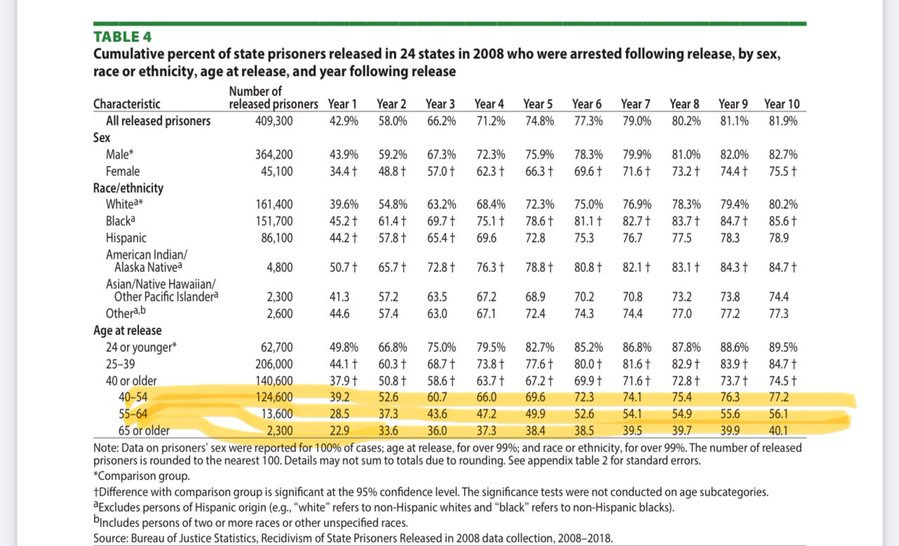
Criminals often commit more crimes after being released. Nationally, 81.9% of all state prisoners released in 2008 were subsequently arrested within a decade, including 74.5% of those 40 or older at the time of their release. (See Bureau of Justice Statistics, Recidivism of Prisoners in 24 States Released in 2008: A 10-Year Follow-Up Period (2008-2018)pg. 4, Table 4)).

In late November, Trump granted clemency to a CEO convicted of fraud, which wiped out his duty to pay $15 million in court-ordered restitution.

Recently, Trump pardoned a Texas Democratic Congressman indicted for corruption. As a result, Democrats will likely keep that seat in Congress. Political analysts say that Trump’s pardon of  Congressman Henry Cuellar “inadvertently compromised” the Republican “party’s ability to flip one competitive seat by pardoning its congressman, Democratic Rep. Henry Cuellar.” “Trump’s pardon of Cuellar” has shifted Cook Political Report’s rating of the race in Texas’ 28th Congressional district “from toss up to lean Democrat,” notes political analyst Erin Covey in the Cook Political Report.

Measles outbreak doubles in a week in South Carolina

“The South Carolina measles outbreak is growing at an astounding speed,” reports NBC News.

“Over the last seven to nine days, we’ve had upwards of over 200 new cases. That’s doubled just in the last week,” said Dr. Johnathon Elkes, an emergency medicine physician in Greenville, South Carolina. “We feel like we’re really kind of staring over the edge, knowing that this is about to get a lot worse.”

South Carolina’s health department said today that 124 more measles cases had been diagnosed since Tuesday, bringing the state’s total to 558.

A Health Department spokesman says “eight people, including adults and children, required hospitalization for complications of the disease.”

“Because measles is so contagious and people can spread the virus up to four days before symptoms appear, each sick individual has the potential” to infect many other people, notes a pediatrician.

Back in 2000, measles had been eradicated, and was declared eliminated. But that was a time when more Americans got vaccinated against measles.

Over the last 25 years, vaccination rates have plummeted (especially over the last 5 years), and people with measles sometimes migrate into the United States. By 2013, U.S. vaccination rates for measles had fallen to 91% for 1-year-olds, similar to the vaccination rate in Mexico, and lower than the vaccination rates of Canada, England, Germany, Russia, and Ukraine. Now, the vaccination rate for American 1-year-olds is closer to 80%.

So a lot more people are unvaccinated, and can catch the measles, in the United States.

By contrast, 22 nations have eliminated measles and rubella by vaccinating at rates of over 90%.

Unvaccinated children died last year of measles in Los Angeles and Texas.

Measles vaccination has saved 94 million lives globally since 1974. Of those, 92 million were children”, says Our World in Data. But measles vaccination rates have fallen in the U.S., and as a result, an unvaccinated child died this year in Texas.

After vaccination rates fell, whooping cough cases jumped 14-fold in Michigan, resulting in a few deaths. Many more people are getting the disease, which makes you feel awful, as if you are coughing your lungs out. For babies, the disease can be deadly.

Reagan-Era Judge Calls Trump ‘Authoritarian’ As He Prepares To Block Deportations

By Katelynn Richardson

A Reagan-appointed federal judge called President Donald Trump an “authoritarian” during a hearing on Thursday.

U.S. District Judge William Young, who is overseeing a case challenging the administration’s attempts to deport pro-Palestine protesters on college campuses, indicated he would issue a ruling restricting the government’s efforts, according to Reuters.

The administration’s efforts came in response to at times violent protests that erupted on college campuses after Hamas’ deadly Oct. 7, 2023 attack on Israel, which left over 1,200 people dead.

“We cast around the word ‘authoritarian,’” Young said, per Reuters. “I don’t, in this context, treat that in a pejorative sense, and I use it carefully, but it’s fairly clear that this president believes, as an authoritarian, that when he speaks, everyone, everyone in Article II is going to toe the line absolutely.”

“It’s bizarre that this judge is broadcasting his intent to engage in left-wing activism against the democratically-elected President of the United States,” White House spokeswoman Anna Kelly said in a statement to the Daily Caller News Foundation. “President Trump will always put American citizens first, which includes removing national security threats from our homeland.”

Young said Trump’s cabinet secretaries “have failed in their sworn duty to uphold the Constitution.”

“I find it breathtaking that I have been compelled on the evidence to find the conduct of such high-level officers of our government — cabinet secretaries — conspired to infringe the First Amendment rights of people with such rights here in the United States,” Young said, according to Politico. (RELATED: Reagan Appointed Judge Rules Trump Admin Deportations Over Anti-Israel Protests Unconstitutional)

Article III Project founder Mike Davis said on X that Young was a “liberal judge was picked by Senators Ted Kennedy and John Kerry in 1985” who timed his retirement to let Joe Biden, rather than Trump, pick his replacement.

Ted Kennedy and John Kerry were the Democratic senators representing Massachusetts in 1985. When a federal trial judge is appointed, it is usually a lawyer recommended by the senators in that state, who the President then nominates. But if the senators and the president are in opposing parties, they often have to compromise on who is picked. Since both the senators in Massachusetts were Democrats, they likely would not have signed off on President Reagan picking a conservative Republican. As a result, some Reagan appointees to the bench in Massachusetts were rather liberal.

This Massachusetts liberal judge was picked by Senators Ted Kennedy and John Kerry in 1985.

And Judge William Young strategically semi-retired in 2021 to let President Biden replace him.

He is clearly incapable of being objective, as evidenced by the most bizarre opinion ever: https://t.co/wX5fbv5iMh pic.twitter.com/KQ0bg9dziV

— 🇺🇸 Mike Davis 🇺🇸 (@mrddmia) October 1, 2025

Opposition to the administration’s policy relies on “a basic misunderstanding of the First Amendment, which under binding Supreme Court precedent applies differently in the immigration context than it otherwise does domestically,” the government has argued in court.

In October, Young issued an opinion finding lawfully present noncitizens in the U.S. have the same free speech rights as American citizens.

Secretary of State Marco Rubio and Homeland Security Secretary Kristi Noem acted to “misuse the sweeping powers of their respective offices to target noncitizen pro-Palestinians for deportation primarily on account of their First Amendment protected political speech,” Young wrote.

“They did so in order to strike fear into similarly situated non-citizen pro Palestinian individuals, pro actively (and effectively) curbing lawful pro-Palestinian speech and intentionally denying such individuals (including the plaintiffs here) the freedom of speech that is their right,” he wrote.

Virginia state tax rate could rise from 5.75% to 13.8%, highest in the nation

Bills pending in the Virginia state legislature could raise the state income tax a lot. The most likely to pass bill would increase the state income tax rate from 5.75% to 8% on incomes over $600,000 and 10% on incomes over $1,000,000. Another bill would impose an additional 3.8% tax (a “net investment income tax”) on most income above $500,000. If both bills pass, Virginia would have an 13.8% tax rate. That would be higher than what is currently the highest state tax rate in America, the 13.3% rate in California for households with million-dollar incomes. It would be far higher than the top tax rates in the region around Virginia, such as the 3.99% tax rate in North Carolina, the 4.82% rate in West Virginia, and the zero percent tax rate in Tennessee, which has no state income tax.

The most likely to pass bill is HB 979, introduced by Delegate Vivian Watts, the powerful chair of the Finance Committee in Virginia’s House of Delegates. HB 979 “establishes two new tax brackets beginning on and after January 1, 2027, that tax income in excess of $600,000 but not in excess of $1,000,000 at a rate of eight percent and income in excess of $1,000,000 at a rate of 10 percent.”

“Something like this has an excellent chance of passing now,” said a Virginian who spent years lobbying Virginia legislators about tax and other issues.

Virginia is now one of the higher-tax states both in terms of dollars paid, and tax burdens compared to other states.

But HB 979’s sponsor, Delegate Watts does not seem to realize this. She is a veteran legislator who has served since 1996, when Virginia was a low-tax state. On her web site, she expresses the outdated belief that Virginia has unusually low taxes, which hasn’t been true for years. For example, she says Virginia has “low taxes (44th per $1000 of personal income.” That’s in an article first posted on her website several years ago, when Virginia already had a higher state income tax rate (5.75%) than a majority of states (7 states had no state income tax at all in 2020, two other states only taxed interest and dividends, and others had much lower rates than Virginia, like North Dakota’s 2.9% maximum rate). Unlike Virginia, some states have no sales tax, such as Montana, New Hampshire, Alaska, Delaware, and Oregon.

Virginia is already a somewhat high-tax state. The Tax Foundation notes that in 2022, Virginia ranked 20th in state and local tax collections per capita, $6845. In 2025, Virginia ranked a bit below average in state tax competitiveness, due to higher-than-average levels of taxation.

Times have changed, but not Delegate Watts’ outdated impression that Virginia is a low-tax state. So she is eager to raise tax rates, which could result in Virginia having much higher tax rates than neighboring states, like Kentucky (which has a 3.5% maximum state tax rate) and North Carolina (which has a 3.99% tax rate). Setting Virginia taxes higher than neighboring states will result in some wealthy people relocating to those states to avoid Virginia taxes on their investment income. People who work in Danville or Virginia Beach can move their home to nearby North Carolina to avoid higher taxes. That would shrink Virginia’s tax base and leave Virginia worse off.

Delegate Watts may not have given much thought to that possibility, because for almost all of her time in the Virginia legislature, neighboring states had higher income tax rates. North Carolina once had an 8% top income tax rate. Even in 2015, Virginia still had lower state income tax rates than North Carolina, West Virginia, and Kentucky. Back then, the top marginal tax rate was 6.5% in West Virginia, 6% in Kentucky, and 5.8% in North Carolina, compared to 5.75% in Virginia. But since then, most of Virginia’s neighbors have cut tax rates a lot, unlike Virginia, reducing tax rates to below 4% or 5%.

Due to high taxes and high living costs in Virginia, a modest number of people are already moving from Virginia to West Virginia and states south of Virginia like North Carolina, Tennessee, and Florida. That exodus could grow into a flood if taxes in Virginia go up to 8% or 10% from 5.75%, making it much more expensive to live in Virginia.

When Maryland raised taxes on millionaires, many moved out of state, resulting in Maryland raising less revenue as a result. The Tax Foundation described how Maryland’s tax base shrank:

The Comptroller of Maryland has reported that the number of “millionaire” returns tumbled sharply between 2007 and 2008, a 30% drop in filers and 22% drop in declared income. Rather than income taxes from this group rising by $106 million, they fell by $257 million….One-in-eight millionaires who filed a Maryland tax return in 2007 filed no return in 2008….A Bank of America Merrill Lynch analysis of federal tax return data on people who migrated from one state to another found that Maryland lost $1 billion of its net tax base in 2008 by residents moving to other states.

Maryland’s tax on millionaires didn’t raise tax rates to 10%, as the proposed Virginia tax increase would. But it was still enough to drive rich people out of the state, and reduce the state’s tax base, leaving Maryland worse off.

Delegate Watts’ 10% tax rate could do even more damage to Virginia’s economy, because it would give rich people an even bigger incentive to leave, and thus shrink Virginia’s tax base even more than Maryland’s tax base shrank. It could end up shrinking both Virginia tax revenue and the size of Virginia’s economy.

Another pending bill — by Delegate Elizabeth Bennett-Parker, HB 378 — would impose a 3.8% “net investment income tax” on most income above $500,000. Add this 3.8% tax to Delegate Watts’ 10% tax rate, and you get a 13.8% top tax rate in Virginia. This 3.8% tax rate would apply to most income above $500,000, because it applies to interest, dividends, and capital gains, as well as business income, which basically all high-income taxpayers have, and accounts for much of their income. Taxpayers making $10 million or more get about 50% of their income from capital gains, about 25% from business income, and over 90% of their income is subject to tax by HB 378.

Investors are usually more mobile than wage earners, so raising taxes on investors makes even more of them leave the state, and results in even more shrinkage of the tax base.

Raising marginal tax rates in Virginia to 10% or 13.8% would harm Virginia by reducing the migration of prosperous and productive people into Virginia from Maryland. Right now, more people move from Maryland to Virginia than from Virginia to Maryland, resulting a net migration of thousands of people from Maryland to Virginia in recent years. But Marylanders would be less likely to move to Virginia if Virginia had higher taxes than Maryland.

Scientific advance may improve human fertility

“Researchers at Ovo Labs, a fertility biotech startup, say they’ve found a way to reduce chromosome errors in human eggs, a major cause of fertility issues for older women. After restoring a protein that helps chromosomes separate correctly, the team observed abnormal chromosomes in 29 percent of treated eggs compared to 53 percent in a control sample,” reports The Doomslayer.

People are having children at later and later ages, or — more frequently — not having children at all.

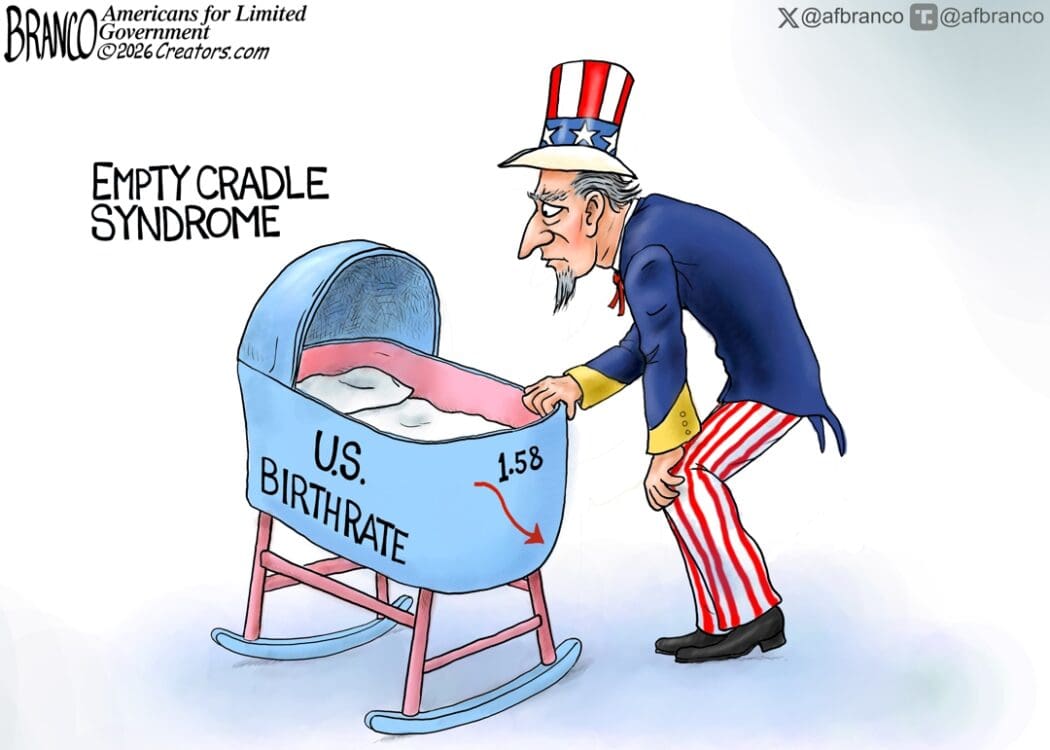
The population growth rate has experienced a collapse over the last decade. In 2015, the average number of children per woman was 2.77 in the Philippines; now, it’s only 1.55 kids. In 2015, the average number of kids per woman was 2.24 in Argentina; now, it’s only 1.14. In Costa Rica, the average number of kids has fallen from 1.76 in 2015 to 1.1 kids in 2025. In China, the number of kids has fallen from 1.75 to 1.1, while in the United States, the number of kids has fallen from 1.84 to 1.58.

“For years, it was treated as a demographic law: as countries grow wealthier, they have fewer children. Prosperity, it was believed, inevitably drove birth rates down. This assumption shaped countless forecasts about the future of the global population,” notes The Doomslayer.

But this turned out to be an oversimplification. Women are having more kids in wealthy America (1.58 kids) and well-to-do Denmark and Norway (about 1.5 kids), than in countries that are not wealthy, such as Colombia and Thailand, where women are having only about one kid, on average. On the other hand, people are still having lots of kids in Africa, which is even poorer still. In most African nations, women still have at least 3 kids on average, although the African birth rate is lower than back in 2020, when women in at least 7 African nations had 6 kids or more on average.

“For many years, wealthier European countries tended to have lower birth rates than poorer ones. That pattern weakened around 2017, and by 2021 it had flipped. This change fits a broader historical pattern. Before the Industrial Revolution, wealthier families generally had more children. The idea that prosperity leads to smaller families is a modern development. Now, in many advanced economies, that trend is weakening or reversing. The way that prosperity influences fertility is changing yet again. Wealth and family size are no longer pulling in opposite directions,” notes The Doomslayer.

Greenlander Opposes America Taking Over His Island Because He Hunts ‘Cute’ Whales, Seals

By Anthony Iafrate

A Greenlander interviewed by The New York Times said he opposes the U.S. gaining control of the world’s largest island because he is “afraid” it would upend his ability to hunt whales and seals.

President Donald Trump wrote in a Wednesday post to Truth Social that the U.S. “needs Greenland for the purpose of National Security” and that if the country does not acquire the island, which is currently an autonomous territory of Denmark, “RUSSIA OR CHINA WILL, AND THAT IS NOT GOING TO HAPPEN!” The same day, the NYT published a story detailing interviews with several Greenlanders opposed to the U.S. taking over their homeland, with one man telling the outlet that he opposes Danish control because Americans think marine mammals are “cute.” (RELATED: NATO Makes Teensy Deployments To Greenland As Trump Presses For Control)

“I hunt whales and seals. In the United States they think whales and seals are cute and shouldn’t be hunted. That’s what I’m afraid of,” Kunuk Abelsen, a resident of Kulusuk — a remote Greenlandic settlement with a population of just 241 — told the NYT.

A website devoted to Greenland tourism describes Kulusuk as “a traditional Greenlandic settlement with hunting and fishing in its heart and tourism in its embrace.”

The Marine Mammal Protection Act (MMPA), which former President Richard Nixon signed into law in 1972, prohibits the unpermitted hunting, harassment, capture, or killing of whales, seals and other marine mammals in U.S. waters and by U.S. citizens on the high seas.

While commercial whaling is banned in both the U.S. and Denmark, both countries still allow “aboriginal subsistence hunts” of marine mammals by native populations in Greenland and Alaska — as well as a part of Washington state — respectively. The only three countries that presently allow commercial whaling are Japan, Norway and Iceland.

Another Greenlander interviewed by the NYT said she has “never heard anyone talk like that about another country before,” referring to Trump’s expressed desire to take control of the Danish territory.

Despite being three times the size of Texas, Greenland only has a population of about 56,000 people — giving it a population density of around 0.07 people per square mile. By comparison, if the island of Manhattan had the same population density as the Arctic territory, it would not even be home to two people. About 80% of Greenland’s area is covered by the massive Greenland Ice Sheet.

“President Trump has made it well known that acquiring Greenland is a national security priority of the United States, and it’s vital to deter our adversaries in the Arctic region,” White House Press Secretary Karoline Leavitt said in a statement to The Hill earlier in January.

A statement from Trump’s White House at the time said “the president and his team are discussing a range of options to” pursue their goal to obtain the Arctic Island “and of course, utilizing the U.S. military is always an option at the commander-in-chief’s disposal.”

Democratic Sen. John Fetterman expressed openness to the U.S. acquisition of Greenland through peaceful means stating that while he opposes a military invasion of the island, “Ideally we could purchase it. And that’s not scandalous either.”

“That’s been an idea in our history for a while. Ideally, we could purchase it,” Fetterman said.

Former Sen. Kyrsten Sinema Had MDMA-Laced Affair With Her Married Security Guard, Lawsuit Alleges

By Alexis Lapp

Former Democratic turned Independent Arizona Sen. Kyrsten Sinema was hit with a lawsuit from the ex-wife of her former bodyguard, Matthew Ammel, according to documents filed in a North Carolina Federal Court.

Heather Ammel alleged Sinema was involved in an affair with her then-husband, Matthew Ammel, according to the lawsuit. She claimed Sinema’s allegedly inappropriate behavior with her husband, which included lavish trips, directly contributed to their separation in 2024. The couple was married for 14 years, according to the documents.

The lawsuit was filed late in 2025 and moved to a federal court in January, WRAL reported.

Along with allegedly taking the former member of her staff on frequent solo rendezvous, Heather Ammel accused the former Senator of paying for her ex-husband to obtain “psychedelic treatment.”

The lawsuit cited alleged messages between Sinema and Matthew Ammel. He said he was intimidated by Sinema, and she allegedly responded that she seeks only to be “intimidating to her opponents,” according to the documents.

She is accused of advising him to bring MDMA drugs, also known as ecstasy or molly, on a work trip so she could “guide him through a psychedelic experience.” (RELATED: Gonna Be A Sinema-tic: Thorn In Democrats’ Side Back To haunt Her Party Colleagues)

In May 2024, Sinema allegedly paid for Matthew Ammel to receive psychedelic treatment in Nashville, Tennessee, before flying him out to Napa Valley, California, to provide security for a concert. The lawsuit further claimed that she and Matthew Ammel resided together in a private Airbnb.

Sinema has spoken out in the past about her support for Ibogaine, a psychedelic which is developed from the African shrub plant, Politico previously reported.

The lawsuit claims that early in 2024, the two messaged each other while Matthew Ammel was at a baseball game. Matthew Ammell allegedly wrote that he wanted to start a “f*ck the troops” chant, and Sinema allegedly responded that she would “f*ck the hot ones.”

In June 2024, Sinema allegedly offered Matthew Ammel a position in her U.S. Senate staff as a Defense and National Security fellow, the documents read. (RELATED: ‘The Hypocrisy Is The Point’: Kyrsten Sinema Is Having The Last Laugh On The Filibuster)

Before resigning, Sinema’s former head of security expressed concerns in 2023 that Sinema was allegedly having “sexual relations with other security members,” the lawsuit stated.

Heather Ammel also claims her husband suffered from post-traumatic stress disorder and traumatic brain injuries as a result of his prior job in the U.S. Army.

Sinema left the Democratic party and registered as an Independent in 2022 during her time in the Senate. In 2024, she announced she would not be running for reelection. She is a senior advisor at a Washington, D.C.-based law firm as of publication.

Sinema did not respond to a request for comment on the lawsuit, according to Politico.

U.S. public overwhelmingly opposes U.S. acquiring Greenland

“President Donald Trump’s push to seize Greenland might be the least popular idea in American political history,” reports Reason Magazine.

“A Reuters/Ipsos poll released Wednesday found a staggering 4 percent of Americans favor the idea of seizing Greenland with military force.” That’s as low as the percentage of Americans who say the world is controlled by lizards wearing skin suits!

“Just 17 percent of Americans…support the effort” to acquire Greenland peacefully.

As noted earlier, acquiring Greenland would cost way more than it is worth:

Because it is poorer than the United States, absorbing Greenland would be costly. The poorest U.S. states receive more money from the federal government than their citizens pay in taxes. Greenland has high rates of alcohol abuse and domestic violence. It’s a cold, barren wasteland.

Yet the New York Times notes that President Trump “seems increasingly fixated on the idea that the United States should take over” Greenland…But why do we need to take it from our Danish allies?…As the New York Times notes,

“Under a little-known Cold War agreement, the United States already enjoys sweeping military access in Greenland. Right now, the United States has one base in a very remote corner of the island. But the agreement allows it to “construct, install, maintain, and operate” military bases across Greenland, “house personnel” and “control landings, takeoffs, anchorages, moorings, movements, and operation of ships, aircraft, and waterborne craft.”

“The U.S. has such a free hand in Greenland that it can pretty much do what it wants,” said Mikkel Runge Olesen, a researcher at the Danish Institute for International Studies…“I have a very hard time seeing that the U.S. couldn’t get pretty much everything it wanted,” he said, adding, “if it just asked nicely.”

Similarly, Dan Gardner says, “what does the US need or want that Denmark denies? The US had DOZENS of bases on Greenland; it chose to reduce them to one. If the US asked for more bases, or whatever, Denmark would say yes, as it always has.”

Conservative Danish parliamentarian Rasmus Jarlov says, “The USA already has a defence agreement with Denmark that gives them exclusive and full military access to Greenland. But they are not using it. They have downgraded their presence by 99%.”

Greenland does have minerals, but only a small fraction of them are economically viable to mine. Greenland is too cold and icy a place to mine most of those minerals when mining is easier in more temperate climates. Moreover, “analysts say, the United States doesn’t need to take over the island to get” its minerals. “Greenlanders have said they are open to doing business — with just about anyone.” Australians, Canadians, and other foreigners are already involved in mining in Greenland.

As a hedge fund investor notes, Greeland’s minerals are mostly inaccessible:

“People are hallucinating on Greenland’s mineral wealth. Exploring and mining in the Arctic is a literal hellscape. The constraints are insane and the costs to overcome ’em are way past imagination.

“Geologically, permafrost is a nightmare. Ground’s frozen solid—normal drilling hits a wall. Building stable foundations for gear is a massive money pit. Operations are cooked too.

“Constant darkness for months in winter. Working 24/7 under floodlights craters efficiency and spikes accident risk. At -40°C to -50°C, metal gets brittle and just snaps.

“You need custom alloy gear, and keeping fuel/lube from freezing is a constant battle. The diesel/power burn just to keep lights on and engines warm is eye-watering. Immediate Opex blow-up. Logistics? Absolute disaster. It’s not about digging it out; it’s about moving it.

“Zero roads or rails. Everything moves by heli, light plane, or ship. Moving ore to a port costs multiples of what normal mines pay. Plus, zero local smelters.

“You gotta ship it across oceans, burning time and cash. Shipping windows are tiny. Some coasts are only accessible a few months a year. You either pay for icebreakers or pray the 1-year supply/export window doesn’t get wrecked by bad weather. If the ship misses the slot, the whole year is a wash. Look at the Citronen Fjord Zn project at 83°N. It’s one of the world’s biggest undeveloped Zn-Pb deposits, but it’s 2,100km north of Nuuk. Total isolation. They get a 3-month window to move a year’s worth of cargo.

“One bad storm and the project is bricked for the season. Ironbark Zinc tried for ages, but it just got flipped to Dubai-based Almeera Ventures. That’s a clear signal on how brutal the Capex and funding hurdles are.

“The core issue: does the margin even justify the risk? Building a mine w/ zero infra is a Capex black hole. Think global warming helps? Think again. Thawing permafrost is actually trashing existing infra and roads. Extreme weather just jacks up Opex even more. We’re talking 10-15 years from discovery to first ore. If commodity prices crater in between, you’re left holding a stranded asset….Arctic development is 10x harder than you think.”

Running Greenland costs money. Denmark recently helped finance three new airports in Greenland costing $800 million. It has spent billions and billions of dollars on Greenland, for little in return.

Greenland is mostly covered by ice and has fewer than 57,000 people. Most of Greenland is uninhabitable because it is covered by a massive ice sheet. Obviously, Denmark is not going to build thousands of miles of roads to serve a tiny number of people, when it is faster to travel by airplane across the vast ice sheet. Instead, Denmark has spent generously on ports and airports Greenlanders can use.

The uncle of a Liberty Unyielding blogger, who took an interest in Greenland, made the mistake of going there on a trip, and discovered how little Greenland had to offer, and what drunken welfare recipients many of them are:

“Jackie and I went to Greenland on the eastern part of the island. Most of the people live on the western part of the island. The part that we visited was really harsh and inhospitable.  Everybody in the two towns we visited depended upon the welfare checks they got each month from the government … They would then get drunk and the kids would not go to school. My guess is that a good amount of their income also came from tourism. There had been a US Air Force radar site on the hills inland from the village where we stayed. We were only there for three days. Not much to do there, except hike in the local areas and look at the sled dogs. The dogs were not friendly. The dogs spent all their time outside in the cold.”

Trump’s fixation with Greenland could cost the U.S. billions of dollars in export sales, because Denmark’s government may buy fewer high-tech weapons from the U.S. due to Denmark’s deteriorating relations with America as a result of Trump’s designs on Greenland.

“We must avoid American weapons if at all possible,” said the chairman of Denmark’s parliamentary defense committee last year. He said he regrets choosing America’s F-35 fighter aircraft for his country, citing the possibility that the U.S. may cut off support for the fighter in order to seize Greenland. “As one of the decision-makers behind Denmark’s purchase of F-35s, I regret it,” said Rasmus Jarlov, a member of parliament for Denmark’s Conservative People’s Party.

Jarlov was responding to rumors that the Lockheed Martin F-35 Lightning II may have a “kill-switch” that allows the U.S. government to remotely disable F-35s bought by U.S. allies. On March 18, the Pentagon denied that the stealth fighter has such a kill-switch.

But the Danish official was not convinced. “We obviously cannot take your word for it,” Jarlov said.

85% of Greenlanders oppose becoming part of the United States.

African economy finally growing faster than Asian economy

Before African countries became independent in the 1960s, they were richer than much of Asia. Now, China is richer than every African country, and almost every Asian country is wealthier than most of Africa. Asian economies grew much faster than African economies (except for the African nation of Botswana, which adopted free-market policies. It went from being among the poorest African countries to almost the richest country in Africa due to its capitalist economy). Many African nations, such as Ethiopia, Angola, Mozambique, and Mali, explicitly adopted socialist policies, which retarded their growth. Other African nations like Zaire (Congo) nationalized businesses even without adopting socialism as an ideology, and those nationalizations sent their economies into a tailspin.

In 1980, China was poorer than all but two African countries, Uganda and Guinea-Bissau (Uganda’s economy had been destroyed by its dictator, Idi Amin, who killed 300,000 Ugandans and also expelled Uganda’s Indian population, who ran most of its businesses. Guinea-Bissau had been devastated by a bloody war for independence against Portugal, which killed many of its people. Most other African countries were peacefully given their independence by France or England, without a fight.). But then China adopted some free-market reforms, and its economy took off. While African countries like Mozambique and Ethiopia were still following socialism.

This year, Africa finally expects to see economic growth as fast as Asia’s. “The International Monetary Fund predicts that in 2026, for the first time in history, Sub-Saharan Africa’s economies will grow faster than Asia’s—about 4.4 percent compared with Asia’s 4.1 percent,” notes The Doomslayer.

African economies need to grow faster, because Africa’s population is growing, unlike Asia, whose population is hardly growing at all, and will begin falling within a couple of decades. Some African nations like Angola, Niger, and Mali have population growth rates of over 3% per year. If a country’s economy doesn’t grow, it can’t create jobs for its growing population.

Ethiopia is a poor African country with 135 million people and a persistent trade deficit. It is now creating jobs and shrinking its trade deficit by exporting offal to the Middle East.

The southern African nation of Zambia used artificial intelligence to find more mineral wealth.

In other good news, the African nation of Guinea recently eradicated sleeping sickness, a parasitic disease carried by the tsetse fly that causes irreversible brain damage, aggressiveness, psychosis, and then death, if left untreated.

Niger recently became the first nation in Africa to eliminate river blindness, a disease spread by flies that breed near rivers. Those flies carry long thin parasitic worms that burrow in a victim’s skin.

Quebec Premier Bails As Province Flirts With Leaving Canada Entirely

By Mark Tanos

Quebec Premier François Legault resigned Wednesday as a separatist party surges in the polls and threatens to tear Canada’s second-largest province from the federation.

Legault announced his exit at the Quebec City legislature ahead of the Oct. 5 provincial vote, according to CBC News. His Coalition Avenir Quebec (CAQ) party has cratered to just 10 percent support. The separatist Parti Québécois (PQ) had 31 percent support and appears poised to win a majority government, according to a Pallas Data poll.

The PQ’s leader Paul St-Pierre Plamondon has vowed to hold an independence referendum if elected, according to the Globe and Mail. (RELATED: Liberal Party Chooses Mark Carney As New Canadian PM As Trudeau Era Closes)

Quebec voters narrowly rejected sovereignty in 1995 when 50.58 percent chose to remain in Canada. A third vote could fracture the country at a moment of economic uncertainty.

Daniel Béland, a political science professor at McGill University, told the Associated Press that Legault is “the least popular premier in the country right now.”

Béland warned that the timing for any secession push is reckless.

“The presence of Donald Trump in the White House should give pause to those who think a provincial independence referendum is a good idea in the current context,” he said.

The CAQ has been in freefall. Two cabinet ministers quit in fall 2025 over policy disagreements, according to CBC.

Legault acknowledged voters wanted him gone. “I’m seeing now that many Quebecers are hoping and wanting a change and a change in premier,” he said at a news conference, CBC reported.

The outgoing premier defended his seven-year tenure.

“Of course, there were a few failures — we have talked about them a lot — but there was a lot of success above all,” he told reporters.

Legault founded the CAQ and won majority governments in 2018 and 2022. He will stay on until the party picks a replacement.

A billion fewer people risk a nasty eye infection

“According to the World Health Organization, the number of people at risk of contracting trachoma, a bacterial eye infection, fell to 97 million in late 2025, down from 1.5 billion in 2002.”

Recently, Egypt and Fiji “eliminated trachoma as a public health problem,” the latest of 27 countries.

“The 27 countries validated by WHO as having eliminated trachoma as a public health problem to date are Benin, Burundi, Cambodia, China, Egypt, Fiji, Gambia, Ghana, India, the Islamic Republic of Iran, Iraq, the Lao People’s Democratic Republic, Malawi, Mali, Mauritania, Mexico, Morocco, Myanmar, Nepal, Oman, Pakistan, Papua New Guinea, Saudi Arabia, Senegal, Togo, Vanuatu, and Viet Nam.”

Scientists have come up with a cure for whipworm infections, which afflict 300 million people.

Last year, a treatment was discovered for sleeping sickness, a disease that kills 50,000 to 500,000 people in Africa each year. Sleeping sickness is an awful disease that begins with fever and aches. Then things get worse. The parasite that causes the disease will disrupt sleeping patterns and cause aggressiveness and psychosis. The death rate from sleeping sickness is close to 100%, if it is untreated.

Last year, a blood test was developed that detects many brain cancers that doctors previously couldn’t detect until it is too late to save most victims. Despite advances in fighting other kinds of cancer, “brain tumors have remained notoriously difficult to diagnose. They affect hundreds of thousands of people worldwide each year, and kill more children and adults under the age of 40 … than any other cancer.”

A new cancer vaccine for dogs nearly doubles their survival rates for certain kinds of cancer. This is significant, because similar vaccines might be developed for humans in the future.

A new blood test can detect which bowel cancer patients can receive a lifesaving immunotherapy rather than chemotherapy, enabling them to be cancer free after surgery. Around 10-15% of patients with stage two or three bowel cancer have a particular genetic make-up that enables them to benefit from the life-saving immunotherapy known as pembrolizumab.

Malaria vaccines are saving thousands of lives in Africa.

Virginia parole bill would usurp governor’s appointment powers and release dangerous inmates

A Virginia legislator apparently thinks the parole board isn’t releasing enough inmates. So he has introduced a bill, HB318, that would let legislators, rather than the governor, pick many of the parole board’s members. His bill would also make it much easier to parole inmates serving life sentences — which could result in the release of many killers. The bill would also make it hard not to parole inmates who committed crimes as juveniles, if their continuing dangerousness is due to “the nature of the offense” they committed or other factors beyond their “demonstrated ability to control.”

Right now, the Virginia Parole Board has five members, all picked by the governor and confirmed by the General Assembly. Delegate Patrick Hope’s HB318 would expand the parole board to 10 members, and let individual legislators pick 5 of them. “Three of” those five would “be appointed by the Speaker of the House of Delegates,” and “two of” them would “be appointed by the Chair of the Senate Committee on Rules.” (The Speaker of the House is Don Scott, who in 2020 proposed a failed bill that would have required the release of many inmates based on their age, leaving the parole board with no discretion to block their release even if they were still dangerous).

Letting individual legislators pick members of the parole board is a radical departure from existing Virginia law. As the Virginia Mercury notes, right now, the governor appoints the members of “Virginia’s governing boards and commissions. Virginia law gives governors the power to appoint people to these groups, and remove them.” HB 318 would eliminate the governor’s ability to remove members of the parole board, crossing out existing statutory language stating that the “members of the Board shall serve at the pleasure of the Governor.” That would reduce their political accountability, which could be a constitutional separation of powers violation. Under the Supreme Court’s ruling in Myers v. United States (1926), the president has the right to fire most high-ranking executive branch officials without cause, although not (for the time being) the ability to fire members of independent commissions without cause (the Supreme Court is currently considering whether to overturn its 1935 ruling that members of independent agencies can’t be fired without cause).

Under the federal constitution, giving individual legislators the ability to pick members of a powerful board  — like a parole board — would be unconstitutional. Giving them that power would violate both the constitutional separation of powers — by mixing legislative and executive functions and aggrandizing the legislative branch at the expense of the executive — and also violate the federal constitution’s Appointments Clause, which lets the President appoint important federal officials, like the members of the Federal Election Commission or the Securities and Exchange Commission.

In Buckley v. Valeo (1976), the Supreme Court struck down the system by which members of Congress directly appointed Federal Election Commission commissioners. The Supreme Court ruled that only the President could pick members of a board or commission who have “substantial powers” as opposed to merely “investigative and informative” functions. “Legislative power, as distinguished from executive power, is the authority to make laws, but not to enforce them or appoint the agents charged with the duty of such enforcement. The latter are executive functions,” the Supreme Court said.

Later, a federal appeals court ruled that “Congress exceeded its legislative authority” and violated the separation of powers “when it placed its agents, the Secretary of the Senate and the Clerk of the House of Representatives, on [an] independent Commission as non-voting ex officio members.” (See Federal Election Commission vNational Rifle Association Political Victory Fund6 F.3d 821 (D.C. Cir. 1993)).

Having the legislature pick the members of the parole board — which has “substantial powers,” not just an advisory or “informative” role like some Virginia boards and commissions — seems similarly at odds with separation of powers principles. Like the federal constitution, the Virginia state constitution has a separation of powers provision, Article III, Section 1.

On the other hand, HB 318 might not violate the Virginia constitution’s Appointments Clause (Article V, Section 10), even though it generally gives the governor, not the legislature, the power to appoint state officials. The Virginia constitution’s Appointments Clause is phrased differently than the federal constitution’s Appointments Clause (in Article II, Section 2, Clause 2). The Supreme Court’s Buckley v. Valeo decision relied partly on the federal Appointments Clause, which doesn’t apply to the Virginia legislature or parole board.

It is not clear whether the Virginia state Appointments Clause even applies to a multi-member body like a parole board, since the state constitution refers to “the head” of a division or department. The Virginia state constitution’s Appointments Clause says that “‘Except as may be otherwise provided in this Constitution, the Governor shall appoint each officer serving as the head of an administrative department or division of the executive branch of the government.” By contrast, the federal appointments clause treats the members of multi-member agencies as collectively the “Heads of Department” of their agency, according to the Supreme Court. (see Free Enterprise Fund v. PCAOB (2010)). The federal Appointments Clause gives the President, or “Heads of Departments”, respectively, the ability to appoint “Officers of the United States.”

HB 318 would make it much easier to parole murderers and others serving life sentences. Under current law, four members of the parole board have to vote to release an inmate serving a life sentence. (See Va. Code § 53.1-134.1). That means a lot when there are only five parole board members — almost everyone on the parole board has to agree that an inmate is no longer dangerous. But requiring four votes to parole an inmate means nothing when there are ten parole board members. Under HB 318, many parole board members could view an inmate as dangerous, yet the inmate could still be released with the support of a few parole board members.

That problem is made a lot worse by another provision of HB 318. It also bars the parole board from denying parole based on “the nature of the offense” committed by a juvenile offender, even if the inmate is a serial killer and rapist whose offense demonstrates a deep-seated compulsion to kill and rape, and a psychological inability to change his dangerousness to the community. For example, the bill states, “The Board shall not deny parole for a juvenile offender based on factors outside of his demonstrated ability to change, such as the nature of the offense or any effects resulting from the commission of such offense.” How do you “demonstrate” that a serial killer has the “ability to change” his compulsive desire to kill people? Why does his lack of “demonstrated ability to change” his dangerousness justify his release?

An inmate’s dangerousness is sometimes revealed by “the nature of the offense,” like when the inmate is a serial killer, who killed again and again after previously being released from prison. A classic example is Kenneth McDuff. At the age of 19, after being paroled, McDuff and an accomplice kidnapped three teenagers. He shot and killed two boys, then killed a girl after raping and torturing her. Later, after being paroled yet again, he murdered as many as 15 additional women.

To keep such killings from happening, a parole board needs to take into account “the nature of the offense” as one of many factors, in order to avoid releasing dangerous inmates. But HB318 would keep parole boards from taking that into account.

Juvenile offenders spend years in prison before being eligible for parole, so people may assume they have aged out of crime. But many inmates haven’t.

Most inmates commit more crimes after being released, even when they have already served over ten years in prison. 57.5% of federal inmates imprisoned for violence for ten years or more were arrested yet again after being released, according to a 2022 report from the U.S. Sentencing Commission. (See Recidivism of Federal Violent Offenders Released in 2010, pg. 33 (Feb. 2022)). Nationally, 81.9% of all state prisoners released in 2008 were subsequently arrested within a decade, including 74.5% of those 40 or older at the time of their release and 56.1% of those age 55 or over at the time of their release. (See Bureau of Justice Statistics, Recidivism of Prisoners in 24 States Released in 2008: A 10-Year Follow-Up Period (2008-2018)pg. 4, Table 4)).

These arrest figures understate the crime rate among released inmates, because most crimes never even lead to an arrest: the FBI says only 45.5% of violent crimes were cleared in 2019, and only 17.2% of property crimes.

NOTE: The Virginia legislature and parole board are subject to the state constitution’s separation of powers provision and appointments clause, but not the federal constitution’s separation of powers requirements or its appointments clause.

Michigan professor arrested by ICE for sex offenses is fired

A professor in Michigan has been fired in the wake of his arrest by federal immigration officials, who called him a “criminal illegal alien sex offender.”

Immigration and Customs Enforcement (ICE) arrested Ferris State University marketing professor Sumith Gunasekera on Nov. 12, listing a series of convictions and crimes in a Nov. 25 press release.

Mr. Gunasekera came from Sri Lanka, an island nation south of India.

According to ICE, police in the Canadian province of Ontario arrested Mr. Gunasekera twice in 1998, for making death threats and sexual misconduct.

As Campus Reform explains,

Gunasekera told police that the sexual offense charge involved a minor.

He was later convicted by an Ontario court of “utter threat to cause death or bodily harm and sexual interference.”

In 2004, after Gunasekera moved to the United States on a student visa, a Las Vegas court convicted him of “disorderly conduct,” after he was arrested for “open and gross lewdness.”…

“Professor Gunasekera is no longer with Ferris State University,” university spokesman Dave Murray told Campus Reform on Monday. “It would be inappropriate to discuss a personnel issue.”

College hosts sexually explicit event in a church for new student orientation

A very expensive college recently hosted “a sexually explicit event in a church,” reports Campus Reform:

Amherst College, a Massachusetts-based institution with tuition north of $70,000 per year, held its “Voices of the Class” orientation event, which is meant to instruct students on the school’s code of conduct….

Students performing in the event were seen acting out “mock sex acts including oral sex, masturbation, and group sex,” while others simulated drug use, according to unearthed videos posted by The Washington Free Beacon.

The event was hosted in Johnson Chapel, which is “used for worship services, convocations, senior assemblies, and other significant gatherings.”…

“The administration instructed us to send the first-years to the event,” one orientation leader told the Free Beacon. “Had I known what it was, I certainly wouldn’t have.”

The administration denied that the performance was vulgar, claiming it is “graphic.” It also explained that the script is approved by school officials and funded by the Orientation budget.

The school has also hosted a number of other sex events, including “Beyond Monogamy,” a panel discussion and Q&A featuring “three licensed therapists who specialize in polyamory and ethical non-monogamy.”

The school also started hosting an annual drag show last year. The inaugural event included drag queens “Stanley Coochie,” “Frankie Cyanide,” and several others performing songs such as “Vagina” and “Big Ole’ Freak.

Portland State University promoted polyamory and BDSM (as well as vibrators, dildos, and ‘Chicanx sexuality”)

A “queer polyamorous neurodivergent woman” teaches a college workshop on “ethical non-monogamy.”

Sex weeks are common at colleges. In 2022, during Harvard’s Sex Week, that university held a demonstration on painting “Pussy Portraits.” At an earlier Harvard Sex Week, students attended a BDSM demonstration which employed “whips, rope bondage and some floggers with different flogging techniques.”

Colleges have also held events such as “Queering Menstruation” and “Anal 101.”

Cornell University has had a class called “Queer Marxism.”  Occidental College offers the course “Black Queer Thought,” which critiques “the demands” of “patriarchy and capitalism.”

Colleges have also offered courses on “Queering God” and “How To Be A Bitch.”

“To love capitalism is to end up loving racism. To love racism is to end up loving capitalism…Capitalism is essentially racist; racism is essentially capitalist,” says Ibram Kendi’s book How to Be An Antiracist, which has been assigned reading for many students.

81-Year-Old Ugandan Dictator Cuts Internet, Arrests Priests Ahead Of 7th ‘Election’

By Derek Vanbuskirk

Ugandan religious leaders and opposition party members face arrests, heightened security and an internet blackout heading into Thursday’s presidential elections.

Screenshots and photos circulating in Uganda show a statement from the Uganda Communications Commission (UCC) allegedly announcing that all mobile money and internet services would be suspended during the electoral process. OkayAfrica reported the internet would be suspended Tuesday to curb misinformation, electoral fraud and incitement, adding that armed forces had been deployed across Kampala. (RELATED: EXCLUSIVE: Somali Official Shows How Entrenched The ‘Fraud Pipeline’ Really Is)

The UCC wrongly denied these claims, publishing a statement on Jan. 3 calling the notice “fake and not issued by the Commission.”

“Big national moments like this election season test more than our patience; they test our judgment, too,” a UCC statement said. “In the rush of headlines and forwarded messages, it’s easy to confuse noise for news. Uganda deserves conversations anchored in the objectivity of facts, not excitement and hunger for likes. We all need to slow down, cross-check to verify, and keep our public space honest.”

However, NetBlocks, which maps internet freedom in real time, confirmed that “live network data show a nation-scale disruption to internet connectivity” in Uganda.

The UCC released a statement Wednesday reminding news agencies and social media accounts that announcing the election results from any source other than the Electoral Commission is legally prohibited.

On Jan. 6, the UCC warned against “fake news” heading into the election while announcing that Starlink, the satellite internet service from SpaceX, had been cut off in the country for failing to meet UCC regulations.

“The government has not announced, directed, or implemented any decision to shut down the internet during the election period,” Aminah Zawedde, permanent secretary of the Ministry of ICT and National Guidance, said in the statement. “Such misinformation unnecessarily creates fear, undermines public confidence, and risks heightening tension at a critical national moment.”

Uganda faced a similar blackout during its last election. NetBlocks reported the country’s internet went dark from Jan. 13-18, 2021, after the UCC restricted access. Reuters reported at the time that it had seen a letter from the UCC ordering internet service providers to block all social media platforms and messaging apps until further notice.

Other actions have been taken against Christians and political rivals of 81-year-old President Yoweri Museveni, who seeks his seventh term Thursday.

The Inter-Religious Council of Uganda shared concerns in late November over arrests of opposition supporters, campaign disruptions, violence and a lack of response from the Electoral Commission, according to NTV Uganda. The council said many candidates describe difficulty moving freely to meet with supporters, making it harder for voters to engage with differing political views.

“Over time, these patterns discourage participation, fuel apathy, and deepen the sense that elections are predetermined rather than competitive,” the council said.

In December, Uganda’s military confirmed holding Catholic priest Father Deusdedit Ssekabira for “violent subversive activities” two weeks after he disappeared, according to AfricaNews.

Local church leaders called for Ssekabira’s immediate release, with one bishop calling it a “grievous wound” for the church and his family, AfricaNews reported.

Open Doors reported that Ugandan persecution of Christians and harassment of political opposition during elections goes back at least a decade.

“I will vote because it is my right,” Lunyolo, a 33-year-old mother of three, told Religion News Service, as local church leaders advocate for nonviolence and political involvement. “But many people are afraid. We hear about arrests and blocked rallies. You wonder if the results are already decided.”

Museveni’s chief opponent is 43-year-old former pop star Robert Kyagulanyi Ssentamu, who goes by Bobi Wine and draws tens of thousands of especially young voters where they are permitted to gather, Religion News Service reported

‘Beyond Parody’: Teacher’s Union In Failing Schools Sends Out Flyer With Glaring Typo

By Anthony Iafrate

The Chicago Teachers Union’s (CTU) social media accounts disseminated a flyer across multiple platforms that misspelled the word “governor.”

CTU’s official accounts on XFacebook and TikTok posted the flyer, which began with the line “TELL GOVERNER [sic] PRITZKER.” After school choice advocate Corey DeAngelis posted the misspelled flyer to X, the CTU deleted its posts featuring the spelling error on all three of the platforms.

The CTU, which represents teachers in the public school system of the third-largest city in the United States, did not immediately respond to the Daily Caller News Foundation’s request for comment. (RELATED: Controversial Left-Wing Chicago Teachers Union President Elected To Higher Position)

“The Chicago Teachers Union doesn’t know how to spell ‘Governor,’” DeAngelis, the executive director of the Educational Freedom Institute, wrote in his X post, enclosing an image of the flyer, branded with the CTU logo.

“If the union can’t handle simple spelling on a flyer, imagine the oversight in their classrooms,” DeAngelis told the DCNF in a statement, calling the spelling mistake “Beyond parody.” “No wonder so many kids in Chicago can’t read.”

A November 2024 report from the Illinois Policy Institute, a free market think thank, found that fewer than one-third of elementary students at Chicago Public Schools could read at their grade level — and less than 20% met their grade level’s math standards that year.

CTU President Stacy Davis Gates called standardized tests “junk science rooted in white supremacy” when asked about the poor reading and math results across her city’s public schools, in an interview that year.

A June 2025 report from ChalkBeat and ProPublica said that approximately 150 schools in the Windy City’s public school district were “half-empty,” while 47 were “at less than one-third capacity, leading to high costs and limited course offerings.”

“Chicago Teachers Union leadership must have graduated from the ‘Quality Learing Center’ – how else do you explain such a glaring error while insisting on more money for ‘education’?” DeAngelis asked, referring to a since-closed Minneapolis daycare center’s misspelled sign. The center was prominently featured in YouTuber Nick Shirley’s recent viral video investigating a fraud scandal.

“The teachers union is begging for more funding when Chicago already spends over $30,000 per student per year, yet they can’t even spell ‘governor’ correctly on their own materials,” DeAngelis said in this statement.

The flyer in question urged Democratic Illinois Gov. JB Pritzker, to “Make the ultra-wealthy pay their fair share & fully fund our schools.” Pritzker is a multi-billionaire heir to the Hyatt hotel fortune.

A quick-response code on the flyer still links to a petition sponsored by the May Day Coalition that includes the hashtags #NoKings and #NoBillionaires. The petition, unlike the flyer, spells the word “governor” correctly and states, “Help our Governors to stand up against the Trump occupations of our cities … while taking on the billionaires who are bleeding us dry.”

Cartoon of the Day: Empty Cradles

U.S. Birthrate is going down

Facebook Twitter Pinterest Flipboard

A.F. Branco Cartoon – The declining birthrate in America is reaching dangerous levels at only 1.58, well below replacement level.

BRANCO TOON STORE

Trump Exploring Ways to Resolve America’s Demogaphic Crisis — Including $5,000 ‘Baby Bonus’ For Mothers

By Ben Kew – April 22, 2025

The Trump administration is exploring ways to address America’s demographic crisis.
According to a report from The New York Times, Trump aides are considering a range of proposals designed to encourage families to have more children.
One idea involves reserving 30 percent of Fulbright scholarships — a prestigious, government-funded international fellowship — for applicants who are married or have children.
Another proposal would give American mothers a $5,000 payment following childbirth.
A third proposal would fund programs to educate women on reproductive health and fertility awareness, including how to better understand ovulation and conception timing… READ MORE

DONATE to A.F. Branco Cartoons – Tips appreciated – $5.00, $10.00, $20.00 – It all helps to fund this website and keep the cartoons coming. Also, Venmo @AFBranco – THANK YOU!

A.F. Branco has taken his two greatest passions (art and politics) and translated them into cartoons that have been popular all over the country in various news outlets, including NewsMax, Fox News, MSNBC, CBS, ABC, and “The Washington Post.”

Supreme Court Majority Seems Inclined To Back State Efforts To Protect Women’s Sports

By Katelynn Richardson

A majority of the Supreme Court seemed inclined on Tuesday to back state efforts to protect women’s sports.

The justices considered challenges to Idaho and West Virginia laws that prohibit boys from playing in girls’ sports during oral arguments that lasted over three hours.

Both cases question whether the laws violate the equal protection clause of the 14th Amendment, while West Virginia’s case also weighs whether the state’s law violates Title IX.

Justice Samuel Alito asked whether having separate sports divisions requires an understanding of what it means to be a man or woman.

“How can a court determine whether there is discrimination on the basis of sex without knowing what sex means for equal protection purposes?” he asked.

Justice Brett Kavanaugh, who is known for coaching his daughters’ basketball teams, asked Kathleen Marnett, attorney representing one of the transgender athletes, to look at the “big picture.”

“One of the great successes in America over the past 50 years has been the growth of women and girls’ sports. It’s inspiring,” Kavanaugh said. “Some states and the federal government, the NCAA and the Olympic committee, think that allowing trans women and girls to participate will undermine or reverse that amazing success and will create unfairness.”

“For the individual girl who does not make the team, or doesn’t get on the stand for the metal, or doesn’t make all-league, there’s a harm there,” he said. (RELATED: Trump Admin Bars Visas From Men Competing In Women’s Sports)

“How we approach the situation of looking at it not as boys versus girls, but whether or not there should be an exception with respect to the definition of girls…. That would, if we adopted that, that would have to apply across the board, and not simply to the area of athletics,” Chief Justice John Roberts said.

Roberts suggested that the landmark 2020 Bostock v. Clayton County ruling expanding sex discrimination to include gender identity and sexual orientation in the context of employment may not apply to the women’s sports cases.

Justice Neil Gorsuch, author of the Bostock ruling, raised some of the most critical questions of the conservative justices.

He questioned at one point whether transgender status should be viewed as its own class, given the “history” of discrimination against these individuals.

Some justices also questioned how any “scientific uncertainty” about athletic advantages of transgender athletes factors into the case.

“Is treating someone who is transgender, but who does not have, because of the medical interventions and the things that have been done…the same threat to physical competition and safety and all the reasons the state puts forward – that’s actually a different class, says this individual,” Justice Ketanji Brown Jackson asked Idaho Solicitor General Alan Hurst. “So you’re not treating the class the same. And how do you respond to that?”

Belligerent Sex Offender Gets Arrested At Portland Anti-ICE Protest, Released In No Time

By Hudson Crozier

A protester accused of violence outside Portland, Oregon’s Immigration and Customs Enforcement (ICE) facility is a sex offender with a record of illegally failing to report as one, documents show.

Thirty-nine year-old Andrew Simmons was charged with harassment and disorderly conduct on Friday and released on bond within 24 hours after allegedly pushing a bike officer during a demonstration, according to a Portland Police Bureau (PPB) statement and jail records. Simmons was also convicted in 2014 and 2020 of failing to report as a sex offender in Oregon, and the state dropped two more counts of the same charge against him in 2023, court documents first reported by journalist Andy Ngo show. (RELATED: ‘Where Are We Looting?’: Meet The Portland Leftists Who Keep Getting Arrested And Released)

Records do not yet list an attorney for Simmons’ current case. It is unclear where and when his original sex offense occurred.

Simmons’ arrest marks another of several Portland protest defendants over the past year who had prior criminal histories and were swiftly released by liberal Multnomah County. Transgender rioter Julie Winters was given a “time served” sentence in December after swinging and throwing a butcher knife around federal officers during a Portland anti-ICE protest, the latest of several cases on Winters’ record, the Daily Caller News Foundation previously reported.

Police have made at least 79 arrests related to anti-ICE protests in Portland that began after President Donald Trump returned to office, the PPB said Friday. Simmons’ was the only arrest the bureau reported for Friday.

Video footage from Friday night showed dozens gathered in a crowd, some wearing black clothing or gas masks. Police in yellow uniforms were seen surrounding and restraining an unidentified person on the ground after an off-camera altercation as other protesters surrounded them, blowing whistles.

“Do you guys really want to do this? Do you guys really want to do this?” someone shouted in the video.

Police arrested another protester the following day on a harassment charge, though she was released that night, and another who is still in custody on unlawful use of a weapon and coercion counts, jail records show. Both arrests were based on warrants from before the protest, the PPB said.

Virginia parole bill would usurp governor’s appointment powers, release dangerous inmates

A progressive Virginia legislator apparently thinks the parole board isn’t releasing enough inmates. So he has introduced a bill, HB318, that would let progressive legislators, rather than the governor, pick many of the parole board’s members. His bill would also make it much easier to parole inmates serving life sentences — which could result in the release of many killers — and hard not to parole inmates who committed crimes as juveniles, if their continuing dangerousness is due to “the nature of the offense” they committed or other factors beyond their “demonstrated ability to control.”

Right now, the Virginia Parole Board has five members, all picked by the governor and confirmed by the General Assembly. Delegate Patrick Hope’s HB318 would expand the parole board to 10 members, and let individual legislators pick 5 of them. “Three of” those five would “be appointed by the Speaker of the House of Delegates,” and “two of” them would “be appointed by the Chair of the Senate Committee on Rules.” (The Speaker of the House is Don Scott, who in 2020 proposed a failed bill that would have required the release of many inmates based on their age, leaving the parole board with no discretion to block their release even if they were still dangerous).

Letting individual legislators pick members of the parole board is a radical departure from existing Virginia law. As the Virginia Mercury notes, right now, the governor appoints the members of “Virginia’s governing boards and commissions. Virginia law gives governors the power to appoint people to these groups, and remove them.” HB 318 would eliminate the governor’s ability to remove members of the parole board, crossing out existing statutory language stating that the “members of the Board shall serve at the pleasure of the Governor.” That would reduce their political accountability, which could be a constitutional separation of powers violation. Under the Supreme Court’s ruling in Myers v. United States (1926), the president has the right to fire most high-ranking executive branch officials without cause, although not (for the time being) the ability to fire members of independent boards and commissions without cause (the Supreme Court is currently considering whether to overturn its 1935 ruling that members of independent agencies can’t be fired without cause).

Under the federal constitution, giving individual legislators the ability to pick members of a powerful board would be unconstitutional. Giving them that power would violate both the constitutional separation of powers — by mixing legislative and executive functions and aggrandizing the legislative branch at the expense of the executive — and also violate the federal constitution’s Appointments Clause, which lets the President appoint important federal officials, like the members of the Federal Election Commission or the Securities and Exchange Commission.

In Buckley v. Valeo (1976), the Supreme Court struck down the system by which members of Congress directly appointed Federal Election Commission commissioners. The Supreme Court ruled that only the President could pick members of a board or commission who have “substantial powers” as opposed to merely “investigative and informative” functions. “Legislative power, as distinguished from executive power, is the authority to make laws, but not to enforce them or appoint the agents charged with the duty of such enforcement. The latter are executive functions,” the Supreme Court said.

Later, a federal appeals court ruled that “Congress exceeded its legislative authority” and violated the separation of powers “when it placed its agents, the Secretary of the Senate and the Clerk of the House of Representatives, on [an] independent Commission as non-voting ex officio members.” (See Federal Election Commission v. National Rifle Association Political Victory Fund, 6 F.3d 821 (D.C. Cir. 1993)).

Having the legislature pick the members of the parole board — which has “substantial powers,” not just an advisory or “informative” role like some Virginia boards and commissions — seems similarly at odds with separation of powers principles. Like the federal constitution, the Virginia state constitution has a separation of powers provision, Article III, Section 1.

On the other hand, HB 318 might not violate the Virginia constitution’s Appointments Clause (Article V, Section 10), even though it generally gives the governor, not the legislature, the power to appoint state officials. The Virginia Appointments Clause is phrased differently than the federal constitution’s Appointments Clause (in Article II, Section 2, Clause 2). I don’t know whether the state Appointments Clause even applies to a multi-member body like a parole board, since the state constitution refers to “the head” of a division or department. The Virginia state constitution’s Appointments Clause says that “‘Except as may be otherwise provided in this Constitution, the Governor shall appoint each officer serving as the head of an administrative department or division of the executive branch of the government.” By contrast, the federal appointments clause treats the members of multi-member agencies as collectively the “Heads of Department” of their agency, according to the Supreme Court. (see Free Enterprise Fund v. PCAOB (2010)). The federal Appointments Clause gives the President, or “Heads of Departments”, respectively the ability to appoint “Officers of the United States.”

HB 318 would make it much easier to parole murderers and others serving life sentences. Under current law, four members of the parole board have to vote to release an inmate serving a life sentence. (See Va. Code § 53.1-134.1). That means a lot when there are only five parole board members — almost everyone on the parole board has to agree that an inmate is no longer dangerous. But requiring four votes to parole an inmate means nothing when there are ten parole board members. Under HB 318, many parole board members could view an inmate as dangerous, yet the inmate could still be released with the support of a few parole board members.

That problem is radically worsened by another provision of HB 318. It also bars the parole board from denying parole based on “the nature of the offense” committed by a juvenile offender, even if the inmate is a serial killer and rapist whose offense demonstrates a deep-seated compulsion to kill and rape, and a psychological inability to change his dangerousness to the community. For example, the bill states, “The Board shall not deny parole for a juvenile offender based on factors outside of his demonstrated ability to change, such as the nature of the offense or any effects resulting from the commission of such offense.” How do you “demonstrate” that a serial killer has the “ability to change” his compulsive desire to kill people? Why does his lack of “demonstrated ability to change” his dangerousness justify his release?

An inmate’s dangerousness is sometimes revealed by “the nature of the offense,” like when the inmate is a serial killer, who killed again and again after previously being released from prison. A classic example is Kenneth McDuff. At the age of 19, after being paroled, McDuff and an accomplice kidnapped three teenagers. He shot and killed two boys, then killed a girl after raping and torturing her. Later, after being paroled yet again, he murdered as many as 15 additional women.

To keep such killings from happening, a parole board needs to take into account “the nature of the offense” as one of many factors, in order to avoid releasing dangerous inmates. But HB318 would keep parole boards from taking that into account.

Juvenile offenders spend years in prison before being eligible for parole, so people may assume they have aged out of crime. But many inmates haven’t.

Most inmates commit more crimes after being released, even when they have already served over ten years in prison. 57.5% of federal inmates imprisoned for violence for ten years or more were arrested yet again after being released, according to a 2022 report from the U.S. Sentencing Commission. (See Recidivism of Federal Violent Offenders Released in 2010, pg. 33 (Feb. 2022)). Nationally, 81.9% of all state prisoners released in 2008 were subsequently arrested within a decade, including 74.5% of those 40 or older at the time of their release and 56.1% of those age 55 or over at the time of their release. (See Bureau of Justice Statistics, Recidivism of Prisoners in 24 States Released in 2008: A 10-Year Follow-Up Period (2008-2018)pg. 4, Table 4)).

These arrest figures understate the crime rate among released inmates, because most crimes never even lead to an arrest: the FBI says only 45.5% of violent crimes were cleared in 2019, and only 17.2% of property crimes.

NOTE: The Virginia legislature is subject to the state constitution’s separation of powers provision, but not the federal constitution’s separation of powers provision.

Wife can’t be denied right to carry a gun because of her husband, appeals court rules

The Massachusetts Appeals Court has ruled that a wife’s right to carry a gun was wrongly denied because of her spouse’s behavior. Below is an except from Guinane v. Chief of Police of Manchester-by-the-Sea, a unanimous decision by the Appeals Court on January 9:

In October 2022, Barbara Guinane applied to the chief of police of Manchester-by-the-Sea (chief) for a license to carry firearms (LTC) …. The chief found Guinane unsuitable and denied the application. The chief did so based on recent incidents in which Guinane’s husband had acted aggressively and violently during disputes with neighbors, resulting in multiple police responses to the Guinanes’ home, criminal charges, two G. L. c. 258E harassment prevention orders against the husband, and the suspension of his LTC….

[At a court hearing,] the chief testified that he found Guinane unsuitable based on the conduct of her husband. In May 2022, a neighbor had called 911 to report that, in connection with a property line dispute, the husband “came to [that neighbor’s] property yelling about trash cans and was carrying a baseball bat and then smashed a light pole in a fit of rage.” When police responded, they found the Guinanes sitting on their front porch, where the husband told them, “I know I smashed a light.” He explained that he believed someone had broken into his shed and that he had lost his temper. The husband was criminally charged with vandalizing property, a charge that remained pending at the time of the hearing, and the neighbors obtained a G. L. c. 258E harassment prevention order against him, effective until June 2023. The chief suspended the husband’s LTC, finding him both unsuitable, based on his “volatile behavior,” and to be a prohibited person, based on the G. L. c. 258E order.

Subsequently, the husband and a second neighbor had a “verbal altercation,” leading to the husband’s being charged with threatening to commit a crime (“to wit kill”) and with “assault [with intent] to intimidate based on the victim’s race, religion, color and/or disability.” Those charges, too, remained pending at the time of the hearing, and the second neighbor also obtained a G. L. c. 258E order against the husband.

When Guinane applied for her own LTC, the chief found her unsuitable. The chief acknowledged that, unlike the typical unsuitability determination focusing on “behaviors or incidents involving the applicant him or herself,” here he denied Guinane’s application because of his concern that her husband, who was an unsuitable and prohibited person, lived with her and thus “would have access to the weapons.” The chief acknowledged on cross-examination that Guinane herself had no criminal record and had not been charged in any of the incidents involving the husband. The chief agreed that, if Guinane were not married to her husband, “she would be a suitable person.” The chief nevertheless determined that “it may be a threat to public safety” to issue an LTC to Guinane….

[Guinane] testified that she was a licensed manicurist who operated a nail salon out of their house; customers sometimes paid her in cash. Also, she provided care to and was “directly responsible” for her elderly mother and a niece who lived in the home with her and her husband….

The appeals court ruled that the criminal charges against her husband were insufficient reason to deny Ms. Guinane’s application to carry a gun:

The chief pointed to no behavior by Guinane suggesting that her licensure might create a safety risk. There is no evidence that she engaged in violent or aggressive behavior, or that she assisted or contributed to her husband’s past violent and aggressive behavior, or that she engaged in behavior suggesting that she might be negligent in securing her firearms as required by law.

Nor was there reliable evidence that she intended to or might be forced to make firearms available to her husband or any other prohibited or unsuitable person. Although the District Court judge suggested that the timing of Guinane’s application, shortly after her husband’s LTC was suspended, “lends credence to the Chief’s belief that her application was a pretense to allow her husband to maintain access to firearms,” the chief himself never stated that he held such a belief. Nor did counsel for the chief, at the evidentiary hearing, elicit any evidence from Guinane, or ask her, about the possibility that she would give her husband unlawful access to firearms….

The chief’s natural concern that the husband might somehow obtain access was certainly deserving of consideration. But ultimately it lacked the evidentiary basis statutorily required to support a determination of unsuitability….

An application for an LTC shortly after a family member’s LTC was suspended (or application was denied) might be considered some evidence that the applicant had “exhibited or engaged in behavior that suggests that, if issued a license, the applicant or licensee may create” a safety risk by making firearms available to the unlicensed family member. But here it did not amount to the requisite “reliable, articulable and credible information” suggesting any appreciable risk that Guinane might do so and was therefore unsuitable.

Iranians Burn Down Mosques

By Hudson Crozier

Iranian demonstrators set mosques ablaze during heated protests against the country’s Islamic government, according to local video and reports this weekend.

Protesters in Iran have set numerous fires since the riots broke out Dec. 28, with Tehran’s fire department claiming as many as 34 mosques were burned, according to multiple outlets. One video verified by NBC News showed a crowd cheering Friday night while a Tehran mosque became engulfed in flames. (RELATED: ‘Death To America’ Radical Complains She Got Detained By Customs After Iran Trip)

The mass uprising reportedly began in response to economic woes but follows months of instances of women shedding their mandatory headwear in a statement against the country’s forced Islamic norms. Another video posted by Reuters showed a mob vandalizing the Abuzar Mosque in Tehran on Thursday, scattering furniture and laying incendiary devices.

The Iranian regime has massacred hundreds while clamping down on the disorder, the U.S.-based Human Rights Activists in Iran reports, according to The New York Post.

President Donald Trump on Jan. 2 hinted at possible military action if Iran kills protesters, leading to a social media duel with Iranian Supreme Leader Ali Khamenei over the following days that involved the ayatollah posting an image of Trump in a coffin. Trump previously bombed multiple Iranian nuclear facilities amid conflict with Israel, marking the most overt U.S. military operation against the regime in years.

Harvard removes dean who bashed ‘whiteness’ and the police

Harvard has removed a dean who bashed “whiteness”, defended looting and rioting, and called all cops “evil” and “racist.” The university may have feared that the dean’s anti-white rhetoric would be used as circumstantial evidence against Harvard, in any federal Title VI investigation of Harvard for racial discrimination in hiring or admissions.

The College Fix reports that a “Harvard University residence hall dean who” denounced “whiteness” and “called police racist was removed from his role” on January 5. “Gregory Davis, the former resident dean of Dunster House, ‘is no longer serving’ in the role.'”

“We are writing to confirm that Gregory Davis is no longer serving as the Allston Burr Resident Dean of Dunster House, effective today,” Faculty Deans Shirley and Taeku Lee wrote in a January 5 email. “We thank Gregory for serving in this role and wish him and his family the best in their future endeavors.”

The College Fix adds,

In October, Davis faced calls for his termination after Yard Report, a relatively new right-leaning blog about Harvard, exposed a series of social media posts where he….called for hating the police, and denounced “whiteness“…

In another post in 2019, he wrote: “Whiteness is a self-destructive ideology that annihilates everyone around it.” In 2020, he defended looting and rioting as a part of democracy akin to “voting and marching.” He also posted that cops are “racist and evil,” according to screenshots from the Yard Report….

“These comments, and many others, made by Davis disqualify him from serving in his role at Harvard,” the Yard Report argued. “They reveal an ideology unbefitting of American society, let alone its most elite institution of higher education. The university must fire him immediately.”

Last year, Harvard appointed the drag queen LaWhore Vagistan to its faculty.

Last October, Harvard was forced to postpone a transgender health class because it contained an illegal, sex-discriminatory fee waiver that violated Title IX and the Massachusetts Civil Rights Act.

In 2024, Harvard’s president was forced to resign after her pervasive plagiarism came to light.

Jerome Powell Says Trump’s DOJ Probe Is Retaliation For Interest Rates

By Harold Hutchison

Federal Reserve Chairman Jerome Powell on Sunday accused President Donald Trump of trying to “manipulate” the Federal Reserve through a criminal perjury investigation.

Republican Florida Rep. Anna Paulina Luna referred Powell to the Justice Department in July, alleging he lied to the Senate Banking Committee about renovations to the Federal Reserve’s Washington headquarters in June. Powell confirmed the probe in a blistering video statement released Sunday night. (RELATED: DOJ Opens Probe Into Fed Chair)

“I have deep respect for the rule of law and for accountability in our democracy. No one—certainly not the chair of the Federal Reserve—is above the law. But this unprecedented action should be seen in the broader context of the administration’s threats and ongoing pressure,” Powell claimed. “This new threat is not about my testimony last June or about the renovation of the Federal Reserve buildings. It is not about Congress’s oversight role; the Fed, through testimony and other public disclosures, made every effort to keep Congress informed about the renovation project. Those are pretexts.”

“The threat of criminal charges is a consequence of the Federal Reserve setting interest rates based on our best assessment of what will serve the public, rather than following the preferences of the president,” Powell continued. “This is about whether the Fed will be able to continue to set interest rates based on evidence and economic conditions—or whether instead monetary policy will be directed by political pressure or intimidation.”

Trump and Powell have clashed over the Fed’s resistance to lowering interest rates at a pace desired by the president. Powell also came under fire for his handling of inflation during the Biden administration, initially predicting inflation would be transitory during an August 2021 speech at Jackson Hole, Wyoming, before later admitting inflation ended up being more persistent than he “expected.”

Trump questioned Powell over the renovations during a July 24 tour of the Federal Reserve headquarters project site with Republican South Carolina Sen. Tim Scott, presenting Powell with documents supposedly showing the cost for the project had ballooned to $3.1 billion, a cost overrun of roughly 25%. (RELATED: Hard-Hat Clad Jerome Powell Visibly Shakes His Head At Trump During Fed Building Tour)

“So, we are taking a look, it looks it gets about 3.1 billion, it went up a little bit, or a lot. The 2.7 is now 3.1. It just came out,” Trump said as he pulled out a sheet of paper appearing to list the cost overruns.

“I’m not aware of that, I have not heard that from anybody,” an apparently stunned Powell, after putting on glasses to read the document, responded. He went on to note the $3.1 billion included “the Martin renovation,” completed in 2021, which he described as “a third building” making up the Federal Reserve’s headquarters.

Powell’s term as Fed chair concludes May 2026; he may remain a Fed governor through January 2028.

Supreme Court Case Will Set Major Precedent For American Energy

By Audrey Streb

The Supreme Court will hear oral arguments Monday in a case determining whether companies acting under federal orders can shift state lawsuits to federal court — with many concerned parties arguing that American energy is at stake.

The case addresses whether Chevron and other energy companies can move a Louisiana state lawsuit to federal court under the federal-officer removal statute, based on actions taken on behalf of the federal government during World War II. Roughly 40 lawsuits have been filed since 2013 over oil and gas companies’ alleged role in Louisiana’s coastal erosion, and the Supreme Court’s upcoming review of Chevron U.S.A. v. Plaquemines Parish  decides whether those cases can be moved from state to federal court.

“At the end of the day, this is about federal supremacy… that means that those doing the work of the federal government can’t be hauled into some state or local court to face judgment for the work they’re doing for the federal government,” Mike Fragoso a partner at Torridon Law PLLC, said in a statement. (RELATED: Trump DOJ Joins Fight As Major Players Sound Alarm Over ‘Climate Lawfare’ That Could ‘Cripple’ American Energy)

Several parties filed amicus briefs in September — including the Department of Justice (DOJ), Republican Sen. Ted Cruz of Texas and Republican Alaska Attorney General Stephen Cox — arguing the lawsuits should be heard in federal court because some of the alleged conduct occurred during World War II when companies operated under federal contracts.

Chevron and other energy companies are urging the Supreme Court to overturn a Fifth Circuit ruling that found the oil companies failed to establish federal jurisdiction. Former U.S. Attorneys General Bill Barr and Michael Mukasey, along with numerous state attorneys general, support Chevron’s position. They argue the parishes are seeking to impose retroactive liability for conduct that the federal government previously authorized.

“The FDR administration ordered the oil companies to drill as much oil as they can in Louisiana and then refine it into aviation gasoline. … In an emergency situation like wartime, you can’t just go around suing people 80 years later for what the government told them to do,” John Shu, a constitutional law expert and legal commentator who served in the George H.W. Bush and George W. Bush administrations, told the Daily Caller News Foundation. “If you can sue somebody 80 years later for what the government told you to do to win a war, then no one’s going to do it.”

Others like Alliance For Consumers Executive Director O.H. Skinner argue the lawsuits could harm consumers as he links them to “woke lawfare,” or in other words, lawsuits pushed by climate activists that seek to wield the courts to enact their agenda.

Skinner told the DCNF previously that “woke lawfare is one of the key fronts being pressed by left-wing activists, where they hope to obtain the policy victories in court that have been rejected at the ballot box and in the halls of Congress. … This Louisiana lawsuit is a chief example of the climate lawfare that is being pushed by these activists and trial lawyers. It would mark a major turning point for the Supreme Court to rule against the plaintiffs and provide its first decision disrupting that campaign.”

Many major climate lawsuits brought by Democrat cities and states against energy companies have been dismissed recently, though some analysts argue that if even one surviving case succeeds, it could set a precedent with far-reaching impacts for the energy sector and consumers.

The Louisiana oil and gas industry is massive, generating over $54 billion for the state in 2021, according to an analysis from the Louisiana Mid-Continent Oil and Gas Association (LMOGA) and the American Petroleum Institute (API). The Gulf Coast accounts for 55% of American refining capacity, with Louisiana’s Gulf Coast alone accounting for a significant portion, according to data from the Energy Information Administration (EIA).

Legal experts, including Carrie Severino, president of the Judicial Crisis Network, have pointed out alleged close ties and aligned interests between Louisiana’s governor and a trial lawyer leading many of these cases.

Fragoso also argued that “Louisiana is probably the worst place in the country for getting hometowned. Their judges are elected… with the support of plaintiffs’ lawyers… Plaquemines Parish [has] like 23,000 people in it. So do the math of $745 million divided by 23,000 people, and you’re seeing the financial incentive for any individual resident who’s on the jury is tremendous.”

Republican Louisiana Gov. Jeff Landry moved to intervene in the local government lawsuits against the oil and gas companies and said they had “differing and competing interests” that affected Louisiana’s coastal restoration and economy in 2016, according to NOLA.com, a local New Orleans publication. Landry has since voiced support for the lawsuits.

The Baton Rouge law firm Talbot, Carmouche and Marcello, represented the local government’s lawsuit against Chevron for wetlands damages. It also donated $300,000 to the Protect Louisiana’s Children PAC, which supported Landry’s gubernatorial run in 2023, according to the Louisiana Illuminator.

Vaccine developed for deadly bat-borne disease

“A vaccine for Nipah virus, a highly deadly bat-borne disease with no existing treatments, has entered phase 2 clinical trials for the first time,” notes The Doomslayer.

The Telegraph reports:

An Oxford-designed vaccine for Nipah virus has launched phase two trials, in a ‘major milestone’ for efforts to curb the deadly pathogen…

The disease – which inspired the Hollywood blockbuster Contagion – is rare but extremely deadly, with a fatality rate as high as 75 per cent. The World Health Organization considers it a priority pathogen for research, as no vaccines or treatments currently exist to tackle it.

This month a jab [vaccine] developed by the University of Oxford…became the first Nipah vaccine candidate to enter phase two clinical trials to assess safety and the immune response.

It is also the first vaccine to be trialled in a region directly affected by the virus. Bangladesh has sporadic outbreaks every year, with Nipah mostly spreading from fruit bats to people via contaminated raw date palm sap – although some human-to-human transmission through bodily fluids is also possible.

The disease was first detected in Malaysia in 1998, when it triggered a major outbreak among pig farmers. Since then, 754 known cases have been diagnosed, including 435 deaths – including 241 in Bangladesh, the worst hit country, where the fatality rate is 71 per cent.

Scientists have also developed a rabies vaccine for vampire bats that spreads through grooming: “The vaccine is delivered via a gel applied to one bat’s fur. When others groom it, they ingest the gel and gain immunity. Laboratory studies show this method could effectively protect entire colonies.”

22 nations have eliminated measles and rubella by vaccinating their populations at rates of over 90%. “Measles vaccination has saved 94 million lives globally since 1974. Of those, 92 million were children”, says Our World in Data.

A vaccine to save koalas from chlamydia was recently approved. That disease has killed tens of thousands of koalas.

Denmark is close to wiping out leading cancer-causing HPV strains through vaccination.

Europe and South America reach massive freer-trade deal

“After 25 years of negotiations, EU member states have approved a trade agreement with the South American Mercosur bloc (Argentina, Brazil, Paraguay, and Uruguay) that will lower tariffs on over 90 percent of goods traded between the two markets,” notes The Doomslayer.

It will result in freer trade between the two trading blocs, but not totally free trade.

Politico reports:

A qualified majority of EU member countries on Friday approved the bloc’s long-awaited trade deal with the South American Mercosur bloc.

France, Poland, Austria, Ireland and Hungary expressed their opposition while Belgium abstained. Italy voted in favor, after forcing a delay last month….

“Our message to the world is this: Partnership creates prosperity and openness drives progress,” European Commission President Ursula von der Leyen said. She hinted at signing the treaty in Paraguay “soon” but did not reveal whether that would be as early as Monday….

Additional farm market safeguards that would kick in if there is a surge in imports from Brazil, Argentina, Paraguay and Uruguay also won the approval of EU countries. “We have heard the concerns of our farmers and our agricultural sector and we have acted on them. This agreement contains robust safeguards to protect their livelihoods,” von der Leyen said….

The EU-Mercosur deal is set to create the world’s largest free trade area, covering some 700 million people. From Brussels’ perspective, the agreement is a major geopolitical win in light of China’s rising share in trade and influence in Latin America.

Reuters adds:

Mercosur will remove duties on 91% of EU exports, including for cars from a current 35% over a period of 15 years. The EU will progressively remove duties on 92% of Mercosur exports over a period of up to 10 years.

Mercosur will also remove duties on EU agriculture-based products, such as the 17% on wines and 20-35% on spirits.

For more sensitive farm products, the EU will offer increased quotas, including 99,000 metric tons more beef, while Mercosur will give the EU a duty-free 30,000-ton quota for cheeses.

There are also EU quotas for poultry, pork, sugar, ethanol, rice, honey, maize and sweet corn and for Mercosur on milk powders and infant formula.

Further, the deal recognizes 350 geographic indications to prevent imitation of certain traditional EU foodstuffs such as Parmigiano Reggiano cheese.

Countries like Germany and Spain argue that the deal provides a route away from dependence on China, especially on critical minerals. They also say it helps blunt the economic impact of tariffs imposed by the Trump administration.

This agreement is the largest reduction in tariffs charged on products from the European Union, eliminating about $5 billion per year in duties charged on European Union exports.

“The EU says that given Mercosur’s modest collection of trade agreements, the EU would have an early-mover advantage and notes that EU companies will be able to bid for public contracts in Mercosur on the same terms as local suppliers – something Mercosur has not previously offered in trade agreements.”

The EU views Mercosur as less likely to use control over critical minerals as a weapon than China, which currently processes most of the critical mineral needed for batteries — lithium. The agreement forbids export taxes on most such minerals.

Some left-wing environmental groups oppose the freer-trade deal. Friends of the Earth denounced it as “climate-wrecking.” Friends of the Earth fears the trade deal will lead to increased deforestation as South American nations sell more farm produce and raw materials, sometimes from the Amazon, the world’s largest tropical rainforest.

“Deforestation in the Amazon is slowing down. Around 5,800 square kilometers of the forest were cleared this year, down from 6,500 in 2024 and over 20,000 in 1988,” reported The Doomslayer.

This is happening even as the South American economy is much bigger than it was in 1988. Brazil and Peru had shrinking economies in 1988. In 2025, their economies grew.

U.S. Strikes ISIS Targets In Syria

By Anthony Iafrate

The Defense Department carried out airstrikes against ISIS targets in Syria, U.S. Central Command (CENTCOM) announced Saturday afternoon.

CENTCOM wrote in a statement posted to X it conducted “large-scale strikes against multiple ISIS targets across Syria” at about 12:30 p.m. EST “alongside partner forces.”

“The strikes today targeted ISIS throughout Syria as part of our ongoing commitment to root out Islamic terrorism against our warfighters, prevent future attacks, and protect American and partner forces in the region. U.S. and coalition forces remain resolute in pursuing terrorists who seek to harm the United States,” CENTCOM wrote. (RELATED: ‘Peace In The Middle East’: Trump Defends Having Troops In Syria After Deadly Attack)

“Our message remains strong: if you harm our warfighters, we will find you and kill you anywhere in the world, no matter how hard you try to evade justice,” CENTCOM added.

Defense Secretary Pete Hegseth replied to CENTCOM’s statement on X, simply writing, “We will never forget, and never relent.”

The Saturday operation marked the second time in weeks the U.S. launched strikes against the radical Islamic terror group in Syria.

At President Donald Trump’s direction, CENTCOM launched strikes Dec. 19 against over 70 ISIS targets across central Syria, marking the beginning of Operation Hawkeye Strike. The operation was a direct response to a Dec. 13 ISIS attack in Syria which killed two U.S. service members and one U.S. civilian.

The terror group killed two Iowa National Guardsmen — Sgt. Edgar Brian Torres Tovar, 25, and Sgt. William Nathaniel Howard, 29 — and a civilian interpreter in the Middle Eastern country.

“This was an ISIS attack against the U.S., and Syria, in a very dangerous part of Syria, that is not fully controlled by them,” Trump wrote on Truth Social, adding that Syrian President Ahmed al-Sharaa was “extremely angry and disturbed by this attack.”

“There will be very serious retaliation,” the president added.

Portland Police Chief Begins To Cry As He Reluctantly Confirms Two People Shot By CBP Were Connected To Tren De Aragua

By Timothy Sekerak

Portland Police Chief Bob Day started crying during a press conference Friday after admitting two people shot by federal agents were linked to Tren de Aragua.

“They do have some nexus to involvement with TdA, we can confirm that … and what I can say is that there is an association with the two folks from yesterday and TdA,” Day said during the press conference.

“I hesitated to even share this information initially because I’m very aware of the historic injustice of victim blaming often times portrayed by law enforcement, including this very agency that I’ve represented so proudly for so many years, and historically we have not been quick to disclose the potential criminal history of others,” he continued.

He then went on to say, “I want to speak for just a moment specifically to my Latino community,” while appearing to become emotional and pausing for a moment. “It saddens me that we even have to qualify these remarks because I understand, or at least have attempted to understand, through your voices, your concern, your fear, your anger.”

He then proceeded to wipe the tears from his eyes while saying, “This information in no way is meant to disparage or to condone or support or agree with any of the actions that occurred yesterday.”

The Department of Homeland Security (DHS) said that “two criminal illegal aliens who attacked Border Patrol in Portland are a gang member and his prostitute, NOT an innocent ‘married couple,” in a post to X on Friday. This was in response to ABC 17 News after they shared a CNN article to X with a caption saying federal agents “left a married couple wounded in Portland.” (RELATED: Feds Say Two Shot By Border Patrol In Portland Were Gang Member And His Prostitute)

Border Protection agents  shot Luis David Nico Moncada Thursday, a Venezuelan national and suspected member of Tren de Aragua, which the State Department has designated a Foreign Terrorist Organization, according to the DHS. Moncada entered the U.S. in 2022 and was released into the country during the Biden administration, according to the agency. He has since been arrested for a DUI and unauthorized use of a vehicle and has a final order of removal.

Yorlenys Betzabeth Zambrano-Contreras was also shot and is allegedly associated with Tren de Aragua as well. She entered the U.S. in 2023 and was also released during the Biden administration. She “played an active role in the Tren de Aragua prostitution ring,” DHS said. She has also been involved in a previous shooting in Portland.

The two individuals are in stable condition in the hospital as of Friday evening, according to an ABC News report.

A Quick Bible Study Vol. 302: What the Bible Says About Pain

Every week, I rely on the Lord to reveal our study topic. As usual, out of nowhere, “pain” popped into my head. That means there is a reason for this topic, and I have come to know that someone reading this will be comforted by these passages. Moreover, I am always thrilled to receive emails saying this study was “what they needed” or similar. So I say, “If through His Word, God uses me to help others, I am blessed.”

From the beginning of humankind, pain has been part of the human experience, making it a central theme in the Bible. The first mention of pain appears in Genesis 3, a consequence of the Fall of Man. (See Vol. 110.) After Adam and Eve disobeyed God, pain has plagued us all. God’s punishment was severe:

“To the woman He said, ‘I will surely multiply your pain in childbearing; in pain you shall bring forth children’” (Genesis 3:16).

God told Adam that working to produce food from the ground would be painful:

“And to Adam He said, ‘Because you have listened to the voice of your wife and have eaten of the tree of which I commanded you, ‘You shall not eat of it,’ cursed is the ground because of you; in pain you shall eat of it all the days of your life” (Gen.3:17-19).

Pain was not part of God’s original design. However, because Adam and Eve engaged in prideful behavior, pain disrupted the harmony God had intended for His creation. Therefore, pain is not only physical but also present in all broken relationships between humans and God and among humans against one another throughout the world.

In the following passage, God speaks of human conflict and the conflict between God and evil, represented by the snake (the “he”) who tempted Eve:

“I will put enmity between you and the woman, and between your offspring and her offspring; He shall bruise your head, and you shall bruise His heel” (Genesis 3:15).

The pain that Adam and Eve were going to suffer stemmed from their behavior. But in the future, pain can afflict those who love and obey God and play by the rules. A prime example of suffering by someone blameless was Job:

“He feared God and shunned evil,” and “He was the greatest man among all the people of the east” (Job 1:1-3).

The boundaries of Job’s suffering and pain were arranged and defined after this eye-opening conversation between the Lord and Satan. Afterward, Job lost everything one can lose in life, in addition to his physical trauma:

“The night racks my bones, and the pain that gnaws me takes no rest” (Job 30:17).

Like all understanding, our understanding of pain is limited compared with God’s all-knowing wisdom. In Job’s case, he remained faithful and, in the end, was made whole. But when people suffer physical or mental anguish, especially those who “don’t deserve it,” all we can do is pray and be there to comfort them. St. Paul wrote:

“Blessed be the God and Father of our Lord Jesus Christ, the Father of mercies and God of all comfort, who comforts us in all our affliction, so that we may be able to comfort those who are in any affliction, with the comfort with which we ourselves are comforted by God” (2 Corinthians 1:3-4).

James offers a “how to help” action plan for those who are sick:

“Is anyone among you sick? Let him call for the elders of the church, and let them pray over him, anointing him with oil in the name of the Lord. And the prayer of faith will save the one who is sick, and the Lord will raise him up. And if he has committed sins, he will be forgiven. Therefore, confess your sins to one another and pray for one another, that you may be healed. The prayer of a righteous person has great power as it is working” (James 5:14-16).

Paul wrote much about pain because of his extensive suffering, which Jesus revealed that Saul/Paul would experience after his Road to Damascus conversion.

“For I will show him how much he must suffer for the sake of my name” (Acts 9:16). Read more here.

Paul’s passages on pain are viewed through the lens of Christ, because at the center of Christianity is a suffering Savior who died for our sins:

“We rejoice in our sufferings, knowing that suffering produces endurance, and endurance produces character, and character produces hope, and hope does not put us to shame, because God’s love has been poured into our hearts through the Holy Spirit who has been given to us “ (Romans 5:3-5).

Let’s be honest, for the average person of faith, reconciling pain by comparing it to Christ’s suffering is a stretch. Paul takes the most optimistic view in these two verses:

“For I consider that the sufferings of this present time are not worth comparing with the glory that is to be revealed to us” (Romans 8:18).

“For this light momentary affliction is preparing for us an eternal weight of glory beyond all comparison” (2 Corinthians 4:17).

Next, Paul writes about his chronic painful ailment and unique way of dealing with it:

“Therefore, in order to keep me from becoming conceited, I was given a thorn in my flesh, a messenger of Satan, to torment me. Three times I pleaded with the Lord to take it away from me. But He [Jesus] said to me, ‘My grace is sufficient for you, for my power is made perfect in weakness.’ Therefore, I will boast all the more gladly about my weaknesses, so that Christ’s power may rest on me. That is why, for Christ’s sake, I delight in weaknesses, in insults, in hardships, in persecutions, in difficulties. For when I am weak, then I am strong” (2 Corinthians 12:7-10). (See Vol. 71 for more discussion.)

Peter mirrors Paul’s theme about sharing your pain and suffering with Christ:

“Rejoice insofar as you share Christ’s sufferings, that you may also rejoice and be glad when His glory is revealed” (1 Peter 4:12-19).

Giving or sharing your pain with Jesus and focusing on the glory that is to come sounds like a plan, but it is for those with the strongest faith. My faith is strong, but is it strong enough for the verses we have read? I can tell you that when I faced severe medical issues, I prayed often, and I know those who love me lifted me up as well. Is your faith strong enough to rejoice in your suffering?

Finally, we all look forward to the following verse, the promise that earthly pain is temporary and that God’s ultimate plan is perfection.

“He will wipe away every tear from their eyes, and death shall be no more, neither shall there be mourning, nor crying, nor pain anymore, for the former things have passed away” (Revelation 21:4). Amen!

Myra Kahn Adams is a conservative political and religious writer. Her book “Bible Study For Those Who Don’t Read The Bible“ reprints the first 56 volumes of this popular study. “Part 2,” reprints Vols. 57 –113. Order it here.

Myra is also the Executive Director of the National Shroud of Turin Exhibit. You can help support our new exhibit in Orlando, Florida. Contact: Myraadams01@gmail.com

This article was originally posted at Townhall.com.

Ethiopia begins work on Africa’s biggest airport, despite having less tourism than many other African nations

Ethiopian Airlines on Saturday officially began the construction of a $12.5 billion airport, which will be Africa’s biggest when it is completed in 2030. The state-owned airline will build the four-runway airport in the town of Bishoftu, 28 miles from Ethiopia’s capital, Addis Ababa.

Ethiopia has strikingly beautiful landscapes. But it does not have that much tourism yet, because of ongoing civil wars in various parts of the country, and bad roads that make it hard to travel from one place to another. South Africa, Kenya, and Tanzania all have bigger tourism industries than Ethiopia.

But many people are expected to stop in Ethiopia before taking connecting flights to other countries in Africa, the Middle East, or Europe. People who fly from China to Rome sometimes stop in Ethiopia’s capital before traveling on to Rome.

Despite being state-owned, Ethiopian Airlines has been competently run for decades. That was true even under the former communist government of Ethiopia, which slaughtered hundreds of thousands of its own citizens in the 1970s and 1980s.

“Bishoftu International Airport will be the largest aviation infrastructure project in Africa’s history,” said Ethiopian Prime Minister Abiy Ahmed. The airport will have space to park 270 planes and the ability to carry 110 million passengers a year.

That is more than four times the capacity of Ethiopia’s current main airport, which will reach its limits on existing traffic in the next three years.

The airline’s Director of Infrastructure Development, Abraham Tesfaye, said the airline would fund 30% of the cost of building the airport, while lenders would finance the rest. Ethiopian Airways has already earmarked $610 million for earthworks, which are due to be completed in one year. The main contractors are slated to begin construction next August. The African Development Bank said it would loan $500 million and solicit $8.7 billion from other lenders.

“Lenders from Middle East, Europe, China and USA have shown strong interest” in the project, Ethiopian Airlines said.

“Ethiopian Airlines is Africa’s biggest carrier. It added six extra routes in 2024/25, while revenues are also expanding,” notes Reuters.

The U.S. State Department warns people not to travel to Ethiopia outside its capital area, even though Ethiopia has strikingly beautiful mountains:

Reconsider travel to Ethiopia due to sporadic violent conflict, civil unrest, crime, communications disruptions, terrorism and kidnapping in border areas.

Do Not Travel To:

  • Tigray Region and border with Eritrea due to sporadic violent conflict, civil unrest, and crime.
  • Afar-Tigray border areas due to sporadic violent conflict, civil unrest, and crime.
  • Amhara Region due to sporadic violent conflict and civil unrest.
  • Gambella and Benishangul Gumuz Regions due to crime, kidnapping, ethnically motivated violence, and sporadic violent conflict
  • Oromia Region – Specific areas due to sporadic violent conflict, civil unrest, and ethnically motivated violence.
  • Southern Nations and National People (SNNP) Region due to sporadic violent conflict, civil unrest, and ethnically motivated violence.
  • Border area with Somalia due to terrorism, kidnapping, and landmines.
  • Border areas with Sudan, and South Sudan due to crime, kidnapping, civil unrest, and sporadic violent conflict.
  • Border areas with Kenya due to the potential for terrorism and ethnically motivated violence.

The security situation in Addis Ababa is stable. However, there is sporadic violent conflict and civil unrest in other areas of Ethiopia, and the security situation may deteriorate without warning. The U.S. Embassy is unlikely to be able to assist with departure from the country if the security situation deteriorates. Due to sporadic violent conflict and civil unrest throughout parts of Ethiopia, travel by U.S. government personnel is routinely assessed for additional restrictions.

A cure for whipworm infections, which afflict 300 million people

A new cure for whipworm infections, moxidectin-albendazole. In a phase 3 trial of around 270 children in Tanzania, a single combination of moxidectin and albendazole cured 69% of whipworm infections, meaning they no longer had detectable worm eggs in their stool, compared to 16% with albendazole alone,” reports The Doomslayer.

The Lancet explains:

Infection with the soil-transmitted helminth Trichuris trichiura affects up to 300 million people globally, with children in rural areas in less economically developed countries being most at risk. If untreated, infection compromises physical and cognitive development and leads to long-lasting morbidity. We assessed whether moxidectin co-administered with albendazole is superior to the recommended albendazole monotherapy in treating trichuriasis in school-aged children….
This…phase 3 trial took place between May 14 and Aug 5, 2024, in the Piki administrative district primary school in the Wete district, Pemba Island, Tanzania. Children aged between 6 and 11 years were screened for the presence of T trichiura eggs in their stool via quadruplicate Kato–Katz thick smears….For the 213 participants…we observed a cure rate of 69%…in the moxidectin–albendazole group, which was significantly higher than the cure rate of 16%…in the albendazole group…The cure rate in the placebo group was 12%…The most common treatment-emergent adverse events were abdominal pain [4% with moxidectin–albendazole, 3% with albendazole, and 3% with placebo]…all mild and transient.

Parasites can take years for countries to eradicate. It took nearly 40 years for the world to largely eradicate Guinea worms, nasty parasites that caused tens of millions of people to scream with unbearable pain. But by 2023, Guinea worms had been eradicated in at least 17 countries, and “no guinea worm was reported” in 2024.

Guinea worms used to inflict burning pain on millions of people in Africa and South Asia every year. They would grow up to 3 feet long while living inside a person’s body, then burst out of their foot or other sensitive areas of their anatomy, such as their eyeball or their penis.

With a guinea worm infection, you get a gross open wound from which the worm emerges over a period of weeks to months with extreme painfulness. There were millions of cases in the 80s, and now there are none. Incredible human progress.”

“It’s possible that the worm is evolutionarily adapted to cause prolonged pain and suffering. Since this will increase the chance that the host will put their foot in the water to soothe the pain, and that can help the worm get to the next stage in its life cycle,” notes a scientist.

“When The Carter Center began leading the international campaign to eradicate Guinea worm disease in 1986, there were an estimated 3.5 million cases in at least 21 countries in Africa and Asia. Today, that number has been reduced by more than 99.99%.”