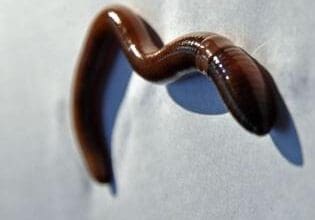
An invasive worm from Asia “is destroying forest floors and gardens across the country. Once jumping worms get into the soil, they’re nearly impossible to get rid of — so experts say curbing their spread is the best tool against them,” reports NPR.
Rebecca Smith discovered “slithering, thrashing worms inching their way up the walls of her home in Carthage, Texas,” this year. And after a recent downpour, she noticed two large worms in her living room.
“They are bizarre. It looks like a worm until you touch it. And then it starts freaking out like a snake would,” she said.
Smith first assumed the worm was just a “crazy” earthworm but then realized it was a jumping worm — an invasive species from Asia now found in nearly 40 states, including most of the central U.S., with Colorado being the latest state to be invaded by the worm.
“When we Googled it, it said to get a bucket and kill them because they are just horrible for the soil,” Smith added.
NPR notes that
Jumping worms look nearly identical to a common earthworm, except for a thick, light-colored band near the top of their heads. But these worms damage soil in gardens and forests. And they are nearly impossible to get rid of because their tiny cocoons blend with the soil and can lay dormant for years. The invasive species has been in the U.S. for as long as two centuries.
But most people have only recently begun to recognize them, says Brent Crain at Michigan State University.
“No one knew that they were a threat,” Crain lamented. “No one understood that they were invasive and just that lack of education probably resulted in a lot of underreporting.”
“Gardeners across the country have come up with home remedies to try and dispel the worms, but researchers say that preventing the spread is the most efficient way to minimize their damage,” NPR says.
The worms only burrow through top soil, notes Brad Herrick at the University of Wisconsin. He adds that they also leave behind coffee-ground-textured waste that makes the soil porous and sometimes hydrophobic, which results in it not absorbing water well.
“The first indication of jumping worms is this change in what the soil looks like,” Herrick added. “If you see that, where you can just sort of wipe away the soil with your hand, that’s a red flag.”
Ulric Chung, a master gardener at Michigan State University, noticed that coffee-ground-like soil right before he observed the worms in a local garden.
“It’s very crumbly, but it’s not like regular garden soil, which kind of sticks together a little bit,” Chung added.
There were also signs in the plants themselves, which were yellower than a healthy plant should and were far too easy to pull out of the ground.
Herrick notes that the worms eat up organic matter in topsoil, which makes it harder for some plants to thrive.




I do not even understand how I ended up here, but I assumed this publish used to be great
https://shorturl.fm/rHEk0
This was beautiful Admin. Thank you for your reflections.
You are my inhalation, I possess few web logs and very sporadically run out from to post .