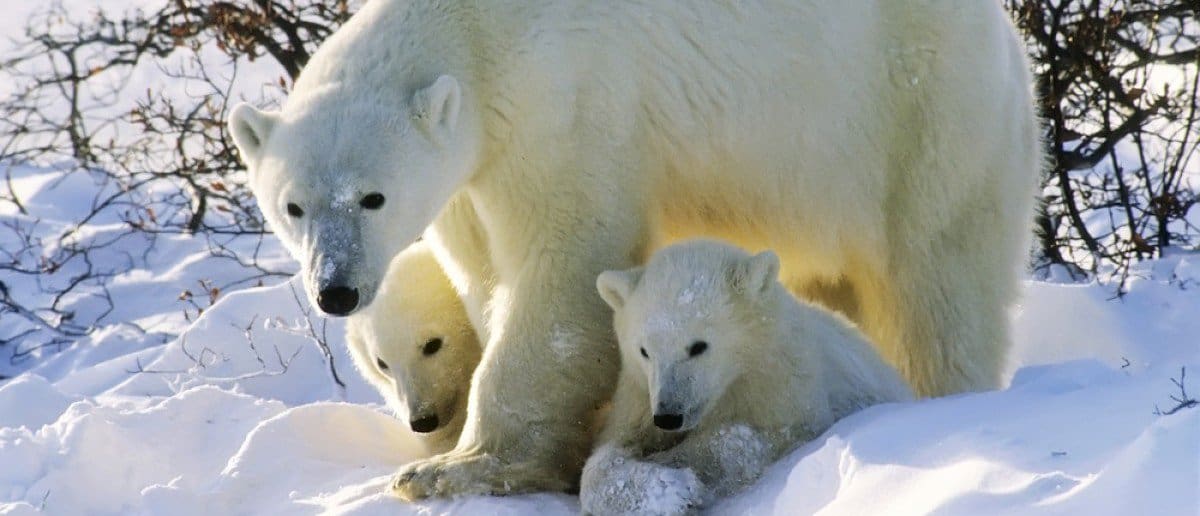
“According to recently published field research, polar bears living in the Svalbard archipelago have been getting fatter over the past few decades. This is especially interesting because sea ice around Svalbard is shrinking much faster than in other polar bear habitats, something widely expected to harm polar bear populations by shortening their seal-hunting season,” reports The Doomslayer.
The New York Times reports:
The population of polar bears in Norway’s Svalbard archipelago has improved over the past 27 years despite predictions that melting sea ice would make it harder for them to find food. Researchers on Svalbard, between mainland Norway and the North Pole, compared the body condition index, a measurement of weight and fat content of the polar bears, with the rate of sea ice melting in the surrounding Barents Sea. Over a 27-year period, they found to their surprise that the polar bears were actually gaining weight as the ice receded.
“When I started, if you asked me what do you think will happen, I would assume they would be struggling and they would get leaner, skinnier and maybe you would see effects on reproduction and survival,” said Jon Aars, senior scientist at the Norwegian Polar Institute and author of the study, which was published on Thursday in the journal Scientific Reports. “That was wrong.”
The Svalbard polar bear population has remained stable at around 2,650 animals, while the number of ice-free days has increased by 100….Dr. Aars said some of the polar bears are now eating reindeer and walrus…Others are taking advantage of denser congregations of ringed seals, which gather on remaining patches of sea ice, or eating new foods like bird eggs. “They’ve always been able to do the best of the situation and find new ways to do things,” Dr. Aars said of the polar bears..
A study in Nature describes what is happening in and around the Svalbard archipelago:
Loss of sea ice rate has been considerably higher here than in other areas with polar bears. We investigated variation in body condition index (BCI) among 770 adult bears, 1188 captures, in March-May 1995–2019, in Svalbard, Norway (western part of the Barents Sea). We assessed how intrinsic (female reproductive state, age) and both males and females, BCI declined until 2000, but increased afterwards, during a period with rapid loss of sea ice. In models including sea ice metrics and climate (Arctic Oscillation), there was no support for the predicted negative effect of warmer weather and habitat loss. This indicates a complex relationship between habitat, ecosystem structure, energy intake, and energy expenditure. Increases in some prey species, including harbour seals, reindeer, and walrus, may partly offset reduced access to seals….
In this study from the western Barents Sea, where (a) observations suggest that the number of bears has increased in recent decades, (b) the local bears stay on land longer and are shifting to a more terrestrial diet which is less energy dense, and, (c) the availability of sea ice has rapidly declined….
Polar bears are “adapting to a warmer Arctic faster than expected. New research from the University of East Anglia found that polar bears in southeastern Greenland show shifts in gene activity linked to heat stress, metabolism, and ageing as temperatures rise, hinting at early genetic responses to climate change,” reported The Doomslayer.
In 2019, a Liberty Unyielding blogger noted that
Polar bear populations are booming. That’s interesting, because it is at odds with what many people think. In my neighborhood, children posted fliers in a park about how global warming was supposedly killing off the polar bears. They were apparently told this by their teachers. Some government officials used to cite a dwindling number of polar bears as being the result of climate change.
But there are more polar bears now than there were a generation ago. As John Hinderaker points out, “polar bears are thriving.” As retired meteorologist Anthony Watts notes, “Polar bear numbers could easily exceed 40,000, up from a low point of 10,000 or fewer in the 1960s. In The Polar Bear Catastrophe that Never Happened, a book published today by the Global Warming Policy Foundation, Dr. Susan Crockford uses the latest data … and concludes that polar bears are actually thriving.”





Share our products and watch your earnings grow—join our affiliate program!
Start earning instantly—become our affiliate and earn on every sale!