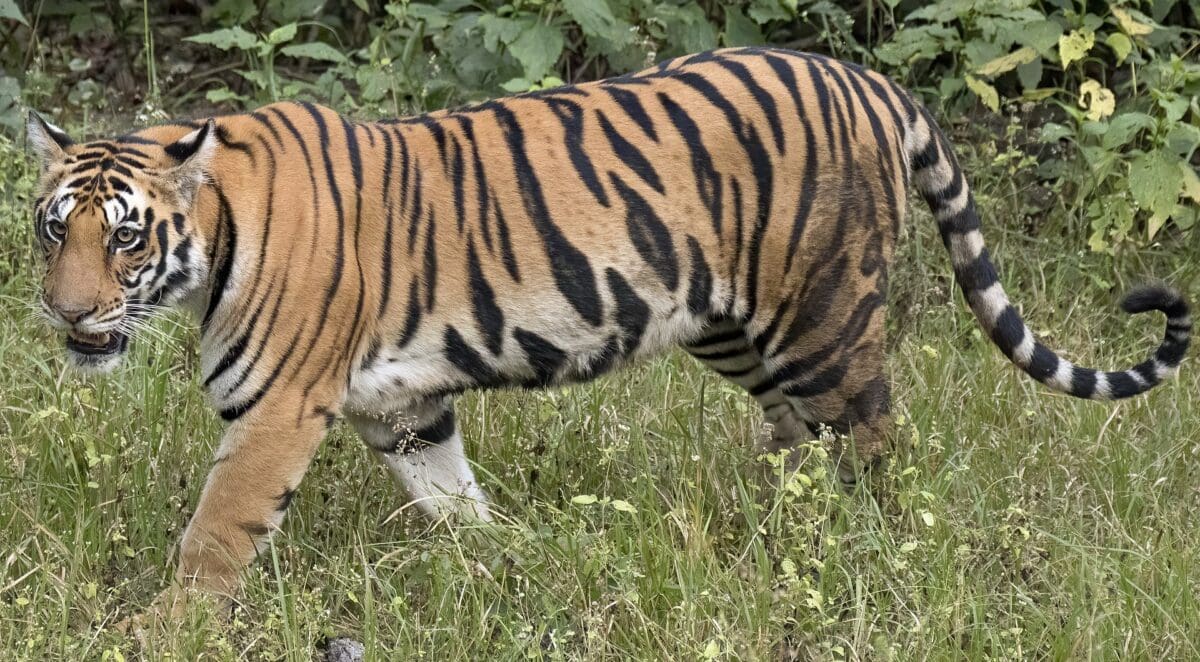
“Thailand’s tiger population is enjoying a robust recovery, thanks in part to a newly protected forest corridor that is allowing the cats to expand into new habitats,” reports The Doomslayer.
In Thailand, the tiger’s comeback is largely playing out in a region known as the Western Forest Complex, or WEFCOM. The largest remaining tract of forest in mainland Southeast Asia, WEFCOM encompasses 17 contiguous protected areas that span an area roughly the size of Kuwait. It begins just a three-hour drive northwest of Bangkok and sweeps hundreds of kilometers toward the border with Myanmar.
The tiger’s recovery in this green oasis — a mix of dry evergreen forest, dipterocarp forest, deciduous forest, and grassland — has largely unfolded in the region’s upper reaches, far away from the villages, roads and tourist fare that intrude on southern WEFCOM. Millions of conservation dollars have flowed into the core conservation area — largely Thung Yai Naresuan-Huai Kha Khaeng Wildlife Sanctuary — through nonprofits like WCS and WWF..
The region’s tiger population has more than tripled in response, increasing from a low of just 40 tigers in 2007 to more than 140 of the big cats prowling WEFCOM today. But as tiger numbers grow, space is getting tight in the jewel of WEFCOM’s crown…
In 2014, scientists first discovered tiger tracks in Salakpra Wildlife Sanctuary — a sign that at least one intrepid animal had ventured 100 km (60 mi) south of Huai Kha Khaeng. Vital to the tiger’s expansion…is the Si Sawat Corridor…
Since the protection of Si Sawat, individual tiger detections in southern WEFCOM have soared, jumping from 20 in 2021 to 54 this year…
One male tiger is even using Si Sawat as part of his home range…‘”we found that now the tigers are reproducing in south WEFCOM.”
In late 2023, a camera trap picked up three new tiger cubs in south WEFCOM. Scientists suggest the lower ranges could permanently support about 47 tigers, with an estimated 26 tigers currently living in the area.
India has doubled its tiger population, even as its population and economy have grown rapidly.
The snow leopard population has doubled in Kazakhstan.
Amur leopards are making a comeback in Russia’s Far East, growing five-fold in number.





Will World War III break out? I’m really worried!
It’s really a nice blog.