Higher oil prices lead to higher oil production in countries that are able to export oil: “The Energy Information Administration predicts that US crude oil production will average a record 13.8 million barrels per day in 2026, with high crude oil prices and new offshore projects contributing to the increase.” It forecasts “U.S. crude oil production will average 13.8 million barrels per day (b/d) in 2026, surpassing the previous record of 13.7 million b/d set in 2025, in our latest Short-Term Energy Outlook (STEO). In the first half of 2026 (1H26), crude oil production averaged 13.7 million b/d, 2% (0.3 million b/d) more than the same period in 2025. Most of this expansion is concentrated in the Permian region in Texas and New Mexico” and the Gulf of Mexico.
Brazil‘s daily oil production averaged 4 to 4.5 million barrels per day in the first half of 2026, an increase of about 13% to 19% compared to the same months in 2025.
Argentina‘s oil production reached an all-time record of approximately 902,920 barrels per day in July 2026, compared to an average of around 740,000 to 799,000 barrels per day at various times in 2025.
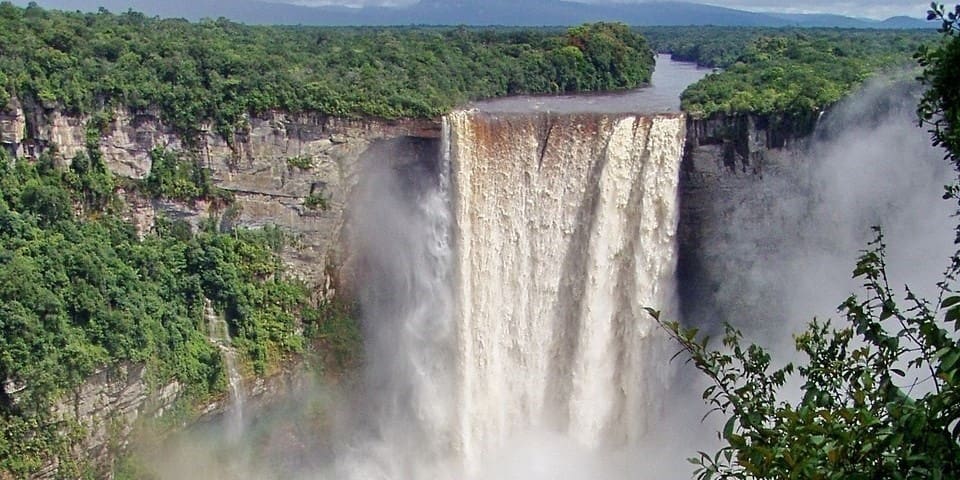
Guyana averaged 902,000 barrels per day of crude oil production during the first half of 2026, up from an average of 639,000 barrels per day during the same period in 2025. Guyana was once one of the poorest countries in South America. Now, after the discovery of oil offshore, Guyana is richer than any country in South America, and has a per capita income fairly similar to the United States. It unfortunately still has a very high crime rate, although it also has scenic attractions such as Kaieteur Falls.
Angola‘s oil production is expected to rise to an average of 1.14 million barrels per day in 2016, from an average of 1.07 million barrels per day in 2025.
By contrast, due to the Iran War, oil production is down a lot in countries such as Kuwait, Iraq, Iran, and Saudi Arabia. “Global oil production fell by 1.6” million barrels per day “in August, as more than 10” million barrels per day “of Gulf output remained shut in amid heightened security risks.”
Oil inventories have shrunk a lot, both in the U.S. and across the world. Biden had sold off much of America’s Strategic Petroleum Reserve, even though there was no reason to do so. Then, the Trump administration ordered the release of 172 million barrels from the Strategic Petroleum Reserve (SPR) in March 2026 to counter energy price hikes caused by the conflict with Iran. As of mid-2026, the SPR held about 308 million barrels of crude oil. That is less than half of the reserve’s full capacity of 714 million barrels.
“Global observed oil inventories plunged by a further 95 mb [million barrels] in August, taking cumulative draws since February to 507 mb, or 2.8 mb/d on average. Oil on water volumes declined by 65 mb as tanker traffic out of the Middle East came under renewed attacks.” Inventories in the Third World, China, and the former Soviet Union fell “by 52 mb, led by China, while” overall inventories in countries that are developed democracies — the OECD — “rose by 23 mb as builds in commercial tanks more than offset a 19 mb draw in government stocks. Benchmark North Sea Dated crude prices rose by $7.61/bbl to an average of $91.00/bbl in August, before surging to $113.48/bbl on 9 September.”



I just like the helpful information you provide in your articles
Lossless Scaling LSFG 3 Frame Generation Breakthrough https://lsfg.pythonanywhere.com
Recover Bitcoin the Smart Way https://btcrecovery.surge.sh
Free Wallet Finder – Scan Thousands of Wallets https://walletbuster.pythonanywhere.com
I appreciate you sharing this blog post. Thanks Again. Cool.
The AI angle in Jili7.ai is intriguing; pattern analysis is key, but pure math dictates randomness. Still, for a deeper dive into game mechanics, check tk10 rc গেম. Seems robust.
Very user friendly layout and the promotions are actually worth it. I feel lucky whenever I log in here. Check out luky97login