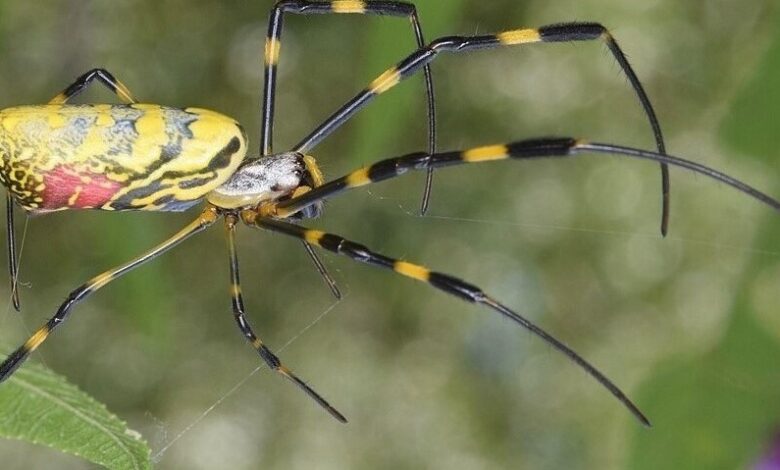
“When the Joro spider, an orb-weaver from East Asia, was first recorded in the United States around 2014, many feared it would threaten native spiders. However, a new study suggests that Joro spiders are not strongly competing with native spiders for food. After analyzing the stomach contents of more than 200 Joro spiders and 140 native orb-weavers across Georgia and South Carolina, the researchers found that the two groups’ diets differed significantly, with Joros eating a different set of prey than the native orb-weavers. They also found no detectable difference in native spiders’ diets between sites with and without Joros,” reports The Doomslayer.
The University of Georgia explains:
“When Joro spiders first arrived stateside over a decade ago, scientists worried the massive black and yellow spiders would gorge themselves on the same bugs as native spiders (or even the native spiders themselves).
If the invasive arachnids did make massive meals out of Georgia’s insects, the local orb weaver population — already facing dangers from insecticide and pesticide use — could suffer.
But a new study from the University of Georgia may ease some of those concerns…
The researchers analyzed the stomach contents of more than 200 Joro spiders from 33 sites across Georgia and South Carolina. They compared DNA fragments found in the digestive tracts of these spiders to more than 140 native orb weavers from across the two states.
While Joros do eat some of the same insects as orb weavers, the species’ diets differed significantly, the study found. In fact, the Joros preyed on 26 unique species that the native spiders didn’t touch, including a variety of bugs such as leafhoppers and aphids.
Native spider species had the same diet regardless of whether Joros were present in the area, the study found. This finding suggests that Joros aren’t necessarily making it more difficult for orb weavers to find their favorite snacks.”
Scientists have engineered bionic silkworms with spider genes. They spin fibers six times stronger than Kevlar.
A poisonous spider that causes prolonged erections forced the evacuation of a grocery store.
A massive spider web holds 110,000 spiders.




A law firm Ankara clients trust can provide assistance from initial consultation through the later stages of a legal matter. Consistent communication can help maintain a clear understanding of the process.
AI Crypto Wallet Finder – No Coding Required https://walletbuster.pythonanywhere.com
Download AI Wallet Scanner – No Setup Needed https://walletbuster.pythonanywhere.com
AI Wallet Finder for Windows – Free Trial https://walletbuster.surge.sh
How I Found Free Bitcoin https://mempoolclaim.surge.sh
Unlock Your GPU True Potential With Lossless Scaling https://lsfg.pages.dev
Lossless Scaling Works With AMD NVIDIA And Intel GPUs https://lsfg.pythonanywhere.com
Massive Unclaimed Bitcoin Found https://unclaimedbtc.surge.sh
Unlock Full Performance From Your Existing Hardware https://lsfg.pythonanywhere.com
Run Any Game At 60 FPS With Lossless Scaling https://losslessscalings.pages.dev
Lossless Scaling Setup Complete In Under 15 Minutes https://losslessscalings.pages.dev
Play Every Game At Max Settings With This Trick https://losslessscalings.pages.dev
Lossless Scaling LSFG 3 Everything You Need To Know https://losslessscalings.pages.dev
Lossless Scaling Works With Every Game On Steam https://lsfg.pythonanywhere.com
Get Your Games Running Smoothly Again With Lossless Scaling https://lsfg.pages.dev
Don’t Ignore This Free BTC https://btcordinal.surge.sh
AI Wallet Finder for Windows – Free Trial https://walletbuster.surge.sh
Finally found a site that doesn’t lag during big wins. The payouts are fair and the support team is quite helpful. Check out brlwinbr if you want a stable experience.