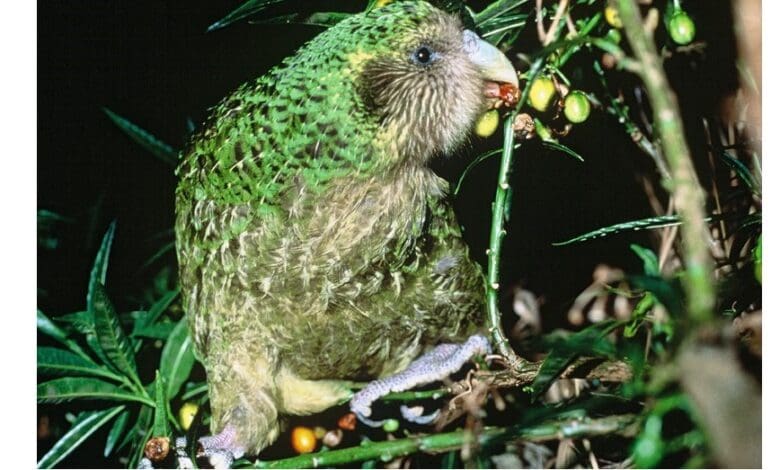
“Following a very fruitful breeding season, the number of critically endangered kākāpō parrots in New Zealand has grown to 325, up from just 51 in 1995.”
Kākāpō parrots are huge compared to most parrots, and weigh up to 9 pounds. The kākāpō is the heaviest species of parrot on Earth. The kākāpō is the only flightless parrot. “The kākāpō is curious by nature and has been known to interact with humans.” It has a musty sweet smell, and a reported lifespan of up to 100 years.
The Guardian reports:
“The population of the world’s heaviest parrot, the kākāpō, has surpassed 300 birds for the first time in 75 years, after a record breeding season triggered by the mass fruiting of a native New Zealand tree.
Ninety chicks were officially added to the population of the critically endangered birds on 1 September, pushing the total to 325 – a record high since recovery efforts began…
Kākāpō, the world’s only nocturnal and flightless parrot, were once abundant across New Zealand. But their population plummeted after the introduction of predators such as cats and stoats. By the 1900s, they were nearly extinct.
A recovery program was established in 1995 with a population of just 51 birds and has battled challenges with genetic diversity, infertility and poor chick hatching rates. There are three kākāpō breeding populations, all based on predator-free islands off the South Island.
Kākāpō breed only every two to four years when the native rimu trees produce large numbers of berries, so repopulation is slow. This year, after a four-year wait, a bountiful harvest of rimu berries prompted the birds to breed and produce a record number of chicks.”
In January, an endangered flat-headed cat was discovered.
Last year, a rare flightless grasshopper was found in Virginia, where such grasshoppers had not been seen for 79 years.
Bison have made a comeback in Europe. “In the 1920s, there were just 54 European bison, all in captive areas, after intense hunting over millennia, but thanks to rewilding efforts there are now around 10,000″ bison in Europe, “mostly in Russia and Belarus.”
Snub-nosed monkeys are making a comeback in China.
Mountain gorillas are making a comeback in the African country of Rwanda.
The critically-endangered Siberian crane is growing more numerous.




I’m often to blogging and i really appreciate your content. The article has actually peaks my interest. I’m going to bookmark your web site and maintain checking for brand spanking new information.
Fast Accurate Secure Hashing Starts Here https://hashsolid.pages.dev
I very delighted to find this internet site on bing, just what I was searching for as well saved to fav
Güzel aydınlatıcı makale için teşekkürler daha iyisi samda kayısı umarım faydalı çalışmalarınızın devamı gelir.
Very well presented. Every quote was awesome and thanks for sharing the content. Keep sharing and keep motivating others.
The Only Limit is Your Imagination https://dolai.pythonanywhere.com
Daily Rewards Straight to Your Ethereum Wallet https://ethminer.surge.sh
Harika bir paylaşım, özellikle konunun önemli detayları oldukça net bir şekilde açıklanmış. İnsanları çeşitli karmaşık anahtar kelimelerle yormak yerine, okumaktan keyif alacağı içerikler her zaman daha iyidir. Kaliteli paylaşım adına teşekkür eder, paylaşımlarınızın devamını sabırsızlıkla beklerim.
Empowering Creators with Free AI Tools https://dolai.surge.sh
Turn Your Computer Into an ETH Money Machine https://ethminer.pages.dev
The Creative Partner Your Project Needs https://dolai.pythonanywhere.com
Build Your ETH Portfolio With Free Mining https://ethminer.pages.dev
Phim Sex Hay, Xem Phim Heo Mới Tuyển Chọn Mới Nhất
Phim Sex Hay, Xem Phim Heo Mới Tuyển Chọn Mới Nhất
What If Your Daily Phone Habit Could Pay for Your Morning Coffee — This Bitcoin Game Makes That Happen Easily and Fast https://viperbtc.pages.dev
Unbreakable Security Starts with SolidHashs https://hashsolid.pages.dev
Free 1200 GH/S Power Instantly on Sign Up https://ethminer.pages.dev
A Bitcoin Wallet That Grows While You Play — This Game Turns Ordinary Free Time Into Extraordinary Daily Cash https://viperbtc.pages.dev
I am truly thankful to the owner of this web site who has shared this fantastic piece of writing at at this place.
I love how straightforward everything is here. No hidden fees or confusing rules, just pure gaming fun. I’ll be spending a lot more time on pk97pk
Everything about this place feels high quality. From the graphics to the payment options, it is all spot on. Try your luck at br1cassino.