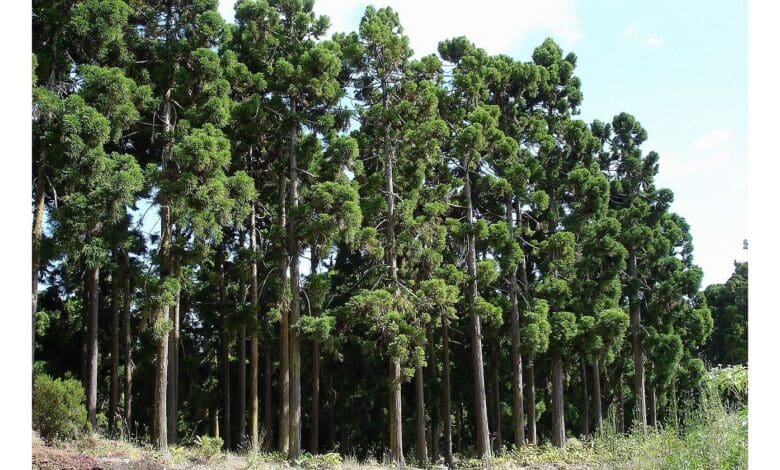
“Japan has begun replacing nearly two million acres of forests to help reduce seasonal allergies. After World War II, Japan’s government encouraged widespread planting of fast-growing sugi cedar and hinoki cypress trees to supply the country with timber. Unfortunately, the pollen from those trees has since contributed to a national epidemic of hay fever afflicting over 40 percent of the population. The Japanese government is now accelerating the removal of those forests and replacing them with a variety of local trees, including sugi varieties selectively bred to produce less pollen. The long-term goal is to halve cedar pollen emissions within three decades,” reports The Doomslayer.
Mongabay notes that most of Japan’s 50 million hay fever sufferers “are allergic to the pollen of two trees — sugi and hinoki.” In 2023, Japan’s government announced a solution: It will cut down 1.9 million acres of sugi and hinoki trees. “After decades of work, researchers have developed more than 30 strains of low-pollen and no-pollen sugi trees, which will replace some of the trees cut down.”
Suffering from hayfever costs Japan around $1.5 billion in economic losses per day during hay fever season, according to a recent survey.
Japan is the most forested of the world’s major countries, and will remain so even after some forests of sugi and hinoki trees are cut down. 68% of Japan — almost 62 million acres — is covered by forests. “Japan is a mountainous country and the slopes of its mountains and hills are covered in lush green forests that rise above many small towns and cities. The trees hold back the hillside, absorb water during the rainy season and, even, help combat the brutal heat during the summer months.”
Mangrove forests are recovering in many countries.
In the 16th and 17th Century, forests expanded in the Americas, as European diseases wiped out much of the Native American population, resulting in their land reverting to forest. 215,000 square miles of new woodlands grew.
But in this century, the expansion of forest is due to happier causes, such as more efficient agriculture, and the replacement of horses with automobiles. The automobile restored New England’s forests, which had mostly disappeared by 1910, but now cover much of the region. Today, Vermont is 78% forested, but in 1910, it was mostly un-forested.
Most of the world’s forests are expanding. Reforestation is offsetting the effects of global warming in parts of the U.S.
England has slightly more forest now than it did during the Black Death around 1350, even though England today has a dozen times as many people as it did back then. Scotland has many times more forest than it did in 1350. The United Kingdom as a whole has three times as much forest as it did at the start of the 20th century.
China’s forests have grown by about 234,000 square miles over the last 30 years, an area the size of Ukraine. The European Union has added an area the size of Cambodia to its woodlands. Many tropical forests are still shrinking, but temperate forests are expanding slightly faster than tropical forests are shrinking, meaning that trees are still removing at least as much carbon dioxide from the atmosphere as they used to.
The amount of vegetation on the Earth has increased for each of the last 30 years.
American forests are absorbing more carbon dioxide than they did in the 20th Century.




I very delighted to find this internet site on bing, just what I was searching for as well saved to fav
For the reason that the admin of this site is working, no uncertainty very quickly it will be renowned, due to its quality contents.
Bilgiler için teşekkür ederim işime son derece yaradı
I’ve been looking for a reliable platform for a while and this one really delivers. The interface is smooth and the payouts are fast. Definitely check out asia128login for a great experience.