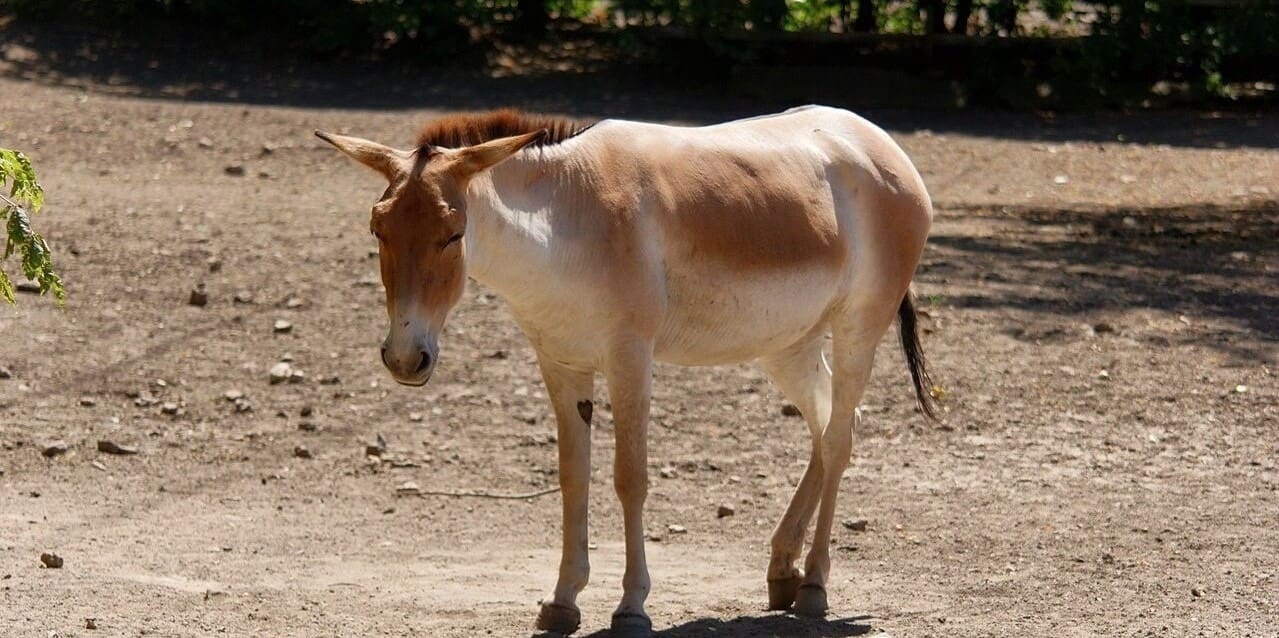
“The Asiatic wild ass, which vanished from Mongolia’s Eastern Steppe in the mid-20th century after the Trans-Mongolian Railway fenced off its migration routes, is beginning to return thanks to targeted fence removals along the railway,” reports The Doomslayer.
Cambridge University Press explains:
The Asiatic wild ass, or khulan, Equus hemionus, is native to the arid landscapes of Central and East Asia. Although the Mongolian Gobi supports the largest population, the species remains threatened by habitat fragmentation, competition with livestock, illegal hunting and climate change. Historically, the khulan ranged widely across Mongolia, including the Eastern Steppe. However, the construction of the fenced Trans-Mongolian Railway in the mid 20th century created a near-continuous barrier to movement, leading to the species’ local extinction east of the railway.
In 2019, a pilot conservation initiative removed sections of the fence and documented the first confirmed crossing of the Trans-Mongolian Railway by a khulan in over 6 decades. To assess the current status of khulan east of the railway, we combined GPS data from 29 collared individuals in the South Gobi with distance sampling and opportunistic field surveys. We recorded two confirmed crossings near the Zamiin–Uud border during the winters of 2023 and 2024. Additionally, during field surveys in 2024 we observed 384 khulan in four groups east of the railway. These findings provide the first confirmed evidence of khulan recolonization within their historical range and establish a baseline for future conservation efforts.
The Victorian grassland earless dragon has come back from the edge of extinction.
Heat-resistant corrals were recently discovered.
The world’s coral reefs are more plentiful than previously thought. “High-resolution satellite maps show that coral reefs cover an area of ocean larger than New Mexico,” reported Bloomberg News. That’s about twice the size of some prior estimates.
A very healthy coral reef is nestled among offshore oil platforms.
A study found that corals recover faster on artificial structures than on natural reefs.
A multivitamin could save some coral reefs.






https://shorturl.fm/0MlK7
https://shorturl.fm/dxotv
https://shorturl.fm/H30pM