Scientists create tumor-eating bacteria

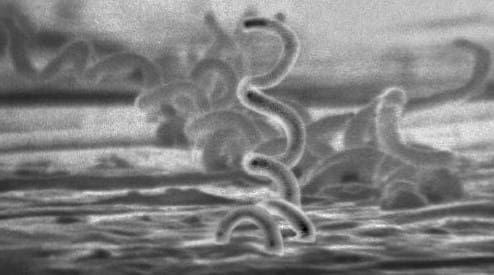
Canadian researchers are developing a cancer treatment that uses a new strain of bacteria to consume tumors from the inside. The bacteria target the unique, oxygen-free environments inside tumors.
“Bacteria spores enter the tumor, finding an environment where there are lots of nutrients and no oxygen, which this organism prefers, and so it starts eating those nutrients and growing in size,” said Dr. Marc Aucoin, a chemical engineering professor at the University of Waterloo. “So, we are now colonizing that central space, and the bacterium is essentially ridding the body of the tumor.”
The bacteria was developed from Clostridium sporogenes, which is a bacteria found in soil that flourishes only in totally oxygen-free conditions.
“The center of a solid cancerous tumor is made up of dead cells and lacks oxygen, creating an ideal environment for this bacterium to thrive and multiply.” But “there is a key limitation. As the bacteria spread toward the outer layers of tumors, they encounter small amounts of oxygen. This exposure causes them to die before they can fully eliminate the tumor. To overcome this challenge, researchers introduced a gene from a related bacterium that is better able to tolerate oxygen. This change allows the engineered bacteria to survive longer near the tumor’s outer regions.”
The bacteria was engineered by Doctors Brian Ingalls, Sara Sadr, and Marc Aucoin, faculty at the University of Waterloo.
The three doctors “also developed a way to activate the oxygen-tolerance gene only when needed, which helps prevent the bacteria from growing in oxygen-rich areas such as the bloodstream. They achieved this using a natural process called quorum sensing. Quorum sensing involves chemical signals released by bacteria. When enough bacteria accumulate inside a tumor, the signal becomes strong enough to switch on the oxygen-tolerance gene, ensuring it is not activated too early.”
In one study, the bacteria’s developers and two other researchers showed that the bacteria can be modified to tolerate oxygen. In a follow-up study, they tested the quorum-sensing system by engineering the bacteria to generate a green fluorescent protein.
“Using synthetic biology, we built something like an electrical circuit, but instead of wires we used pieces of DNA,” said Doctor Ingalls, who teaches applied mathematics. “Each piece has its job. When assembled correctly, they form a system that works in a predictable way.”
“Researchers now plan to combine the oxygen-tolerance gene with the quorum-sensing control system in a single bacterium and test it on tumors in preclinical trials. The promising project grew out of work by PhD student Bahram Zargar, who was supervised by Ingalls and Dr. Pu Chen, a retired professor of chemical engineering at Waterloo.”
A cancer vaccine for dogs doubles their survival rates.
DNA nanorobots fight cancerous tumors by cutting off their blood supply.
A nasty tumor that kills sea turtles is diminishing.
Doctors overseas are using artificial intelligence to detect cases of breast cancer more effectively. A new ultrasound therapy could help treat cancer and Alzheimer’s disease and skull implants could fight depression.
In 2024, a child was cured of a type of brain cancer that previously always killed kids who had it.
A recently-developed blood test can screen for 50 different cancers.




https://shorturl.fm/h9Wbl
https://shorturl.fm/PJLMw
Totally agree on the UX angle! For seamless mobile play, check out jilliph app casino. It nails that blend of slots and sports betting mentioned; makes managing deposits so smooth. 🌴🍹