Deep-fried tarantulas are tasty, to many Cambodians. Wikipedia explains that
Fried spider is a regional snack in Cambodia. In the Cambodian town of Skuon, Cheung Prey, Kampong Cham, the vending of fried spiders as a specialty snack is a popular attraction for tourists. Spiders are also available elsewhere in Cambodia – in Phnom Penh for instance – but Skuon, a market town on the highway 75 kilometres (47 mi) from the capital, is the centre of their popularity. The spiders are bred in holes in the ground in villages north of Skuon, or foraged for in nearby forestland, and fried in oil. It is not clear how this practice started, but some have suggested that the population might have started eating spiders out of desperation during the years of Khmer Rouge rule, when food was in short supply.
The spiders are a species of tarantula called “a-ping” in Khmer, and are about the size of a human palm. The snacks cost about 300 riel each in 2002, or about US$ 0.08….The popularity of the dish is a recent phenomenon, starting perhaps as late as the 1990s…the spiders are tossed in a mixture of MSG, sugar, and salt; crushed garlic is fried in oil until fragrant, then the spiders are added and fried alongside the garlic until “the legs are almost completely stiff, by which time the contents of the abdomen are not so runny.”
The taste has been described as bland, “rather like a cross between chicken and cod“, with a contrast in texture from a crispy exterior to a soft centre. The legs contain little flesh, while the head and thorax have “a delicate white meat inside”. The abdomen is often not consumed, however, as it contains a brown paste consisting of organs, possibly eggs, and excrement. Some people call it a delicacy while others recommend not eating it.
In Mexico, tarantulas have been offered in tacos, with a serving of guacamole.
A Liberty Unyielding blogger enjoyed
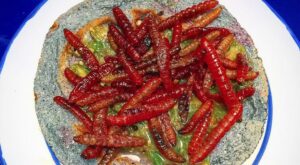
Worm tacos, from Oaxaca, Mexico. Made with maguey worms.
Maguey worms are surprisingly tasty. They are actually caterpillars.
Red maguey worms, also called chinicuiles, are larvae of the moth Hypopta agavis. They infest the core and roots of the agave plant in a glutenous mass.
Another LU blogger once ate penguin eggs:
When you finish cooking penguin eggs, you can see the yolks in the middle through the egg “white.” When penguin eggs are boiled, the albumen does not whiten but remains translucent. That is because penguin eggs have more of a glycoprotein called penalalbumin, which would normally help the baby penguin survive the cold. The taste of penguin eggs is somewhat fishy as krill form a major part of the diet.
Throughout history, explorers of the Antarctic have eaten penguin eggs. They are generally about the size of a duck egg.
The eggs of the emperor penguin are the most sought-after by humans of all bird eggs. They are said to be delicious and are a prized item in many parts of the world.
In the United States, it is illegal to import, export, or sell penguin eggs, so unless you have access to an egg produced by a domestic penguin (such as one in a zoo), you probably won’t be able to eat one.
Penguin eggs are generally available in markets in the countries where penguins are found. They can also be found online from specialty food stores.
No one at Liberty Unyielding has ever eaten the stomach-churning appetizer marara, but Americans have done so in the past, to their misfortune. Marara is a disgusting appetizer of raw internal organs of sheep, mixed with slices of onion. It is served in Sudan, a huge, arid African country.
Wikipedia says it is made of “sheep’s offal (including the lungs, liver, and stomach), onions, peanut butter, and salt. They are eaten raw.”
Other times, it is seasoned with lots of chili powder, rather than peanut butter. A man who traveled to Sudan explains, “Marara is a traditional hors d’oeuvre in parts of Sudan and is made up of raw sheep organs covered with chili powder.”
An American geographer who visited Sudan described how gross it is to eat it: “Waiting for dinner” in rural Sudan, “we tried to be the best of guests. A plate of ‘marara’ was served while the main food dishes were still being prepared.”
He was offered the marara by his host and felt compelled to try it, lest he
offend them by not being a gracious guest. I rationalized that “Maybe the chili powder will kill any living parasites or bacteria.”
I quickly scanned the array of blood fresh body temperature entrails including liver, heart, kidney, testicles, gallbladder and an unknown that I carefully chose because it seemed to be the smallest and least disgusting. (I learned later that is was the epiglottis.) Not wanting to delay the process by thinking about it too much and becoming sick with the thought of it, I popped the inch long organ into my mouth and began to chew. I wanted to get this over with and if I could break it down to a size that I could swallow, I would be done with this little ordeal.
To my dismay I found this tiny organ was like chewing on an inch of garden hose and what’s more when it came in contact with my saliva it began to swell. Finally, I bit down harder than usual creating enough pressure to squeeze out some kind of bile which squirted into my throat.
Desperately, fighting the urge to retch, as my mouth became fuller and fuller, I frantically tried to think of a way out. Finding none which I thought would keep me in the good graces of my hosts, I took one desperate gulp and the mass of glop slowly slid down my throat…
Back in Khartoum I related the experience to some of my Sudanese friends. They proceeded to gag and laugh and explained that they never eat marara and informed me that in fact, it would not have been considered offensive had I refused to eat it in the first place!






https://shorturl.fm/RmMMZ