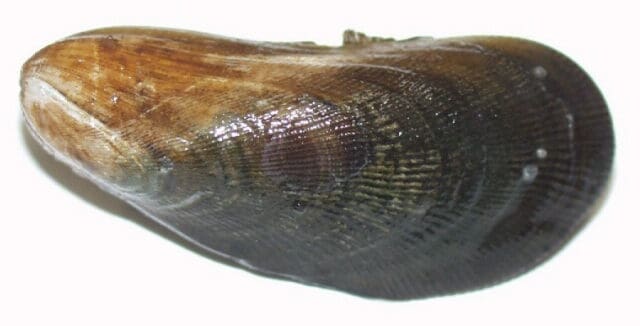
“Ribbed mussels are proliferating along Virginia Beach. These aren’t the kind of mussels you’d order at a restaurant, but ecologists say the growing population could help reduce erosion and clean up excess nitrogen, phosphorus, and bacteria in local waterways,” notes The Doomslayer.
WHRO reports:
Just a few years ago, people would be hard-pressed to find mussels around the Lynnhaven River. But officials have recently seen an ‘explosion’ of the muddy mollusks.
And they’re growing seemingly without help from humans…
The mussels popping up in the river are not the same kind that diners encounter at a restaurant, which are typically smooth, blue mussels that live on rocks or pilings.
The Chesapeake Bay’s aptly named ribbed mussel, on the other hand, has a ribbed shell and prefers to attach to the roots of marsh grass and burrow in the mud.
That makes them great at stabilizing marshes to prevent erosion, which is particularly important in the face of rising sea levels…
Like oysters, ribbed mussels filter nutrients that run off land and cause pollution, such as nitrogen and phosphorus. But they also consume bacteria, which is a step further than oysters, which pass through and excrete bacteria.
Together, the bivalves are powerhouses for cleaning the river. Their recent growth likely reflects improvements in water quality, which then becomes a happily reinforcing cycle.
These mussels are not the only life form that eats pollution. Water hyacinth is often viewed as an invasive growth. But it can remove pollution such as heavy metals and microplastics, protecting human health:
Researchers in China have found that the water hyacinth—a prolific South American species that has colonize waterways around the world—is highly effective at absorbing microplastics. Within 48 hours, the hyacinths had removed more than half of the plastic particles in highly contaminated water. Remarkably, the plants were still healthy two weeks after the exposure…
Native to South America, water hyacinth has become invasive in waterways across the globe. It’s known for quickly forming dense mats that clog waterways and harm native species, and municipalities have launched campaigns to eradicate the plant also known as “water cancer” in parts of the Middle East.
But water hyacinth has been shown to clean polluted water, effectively removing agricultural runoff and heavy metals.
Previous studies have shown that water hyacinth can also absorb microplastic, but less well-understood is how they do it and why the plants aren’t harmed in the process. The new study from China sheds light on both questions.
Researchers placed seven water hyacinths in water with 50 milligrams per liter of microplastic particles, an amount similar to heavily polluted waterways. Within 2 days, the plants removed 55-69% of the polystyrene microplastic particles. Within five days, they removed 78% of the pollution.
In Germany, a sludge-filled river became a thriving ecosystem: “For more than a century, Germany’s Emscher river carried sewage and industrial sludge through the Ruhr, earning a reputation as an open sewer. Now, after a massive cleanup, the river is becoming a thriving ecosystem once again.”





https://shorturl.fm/v4Gaj