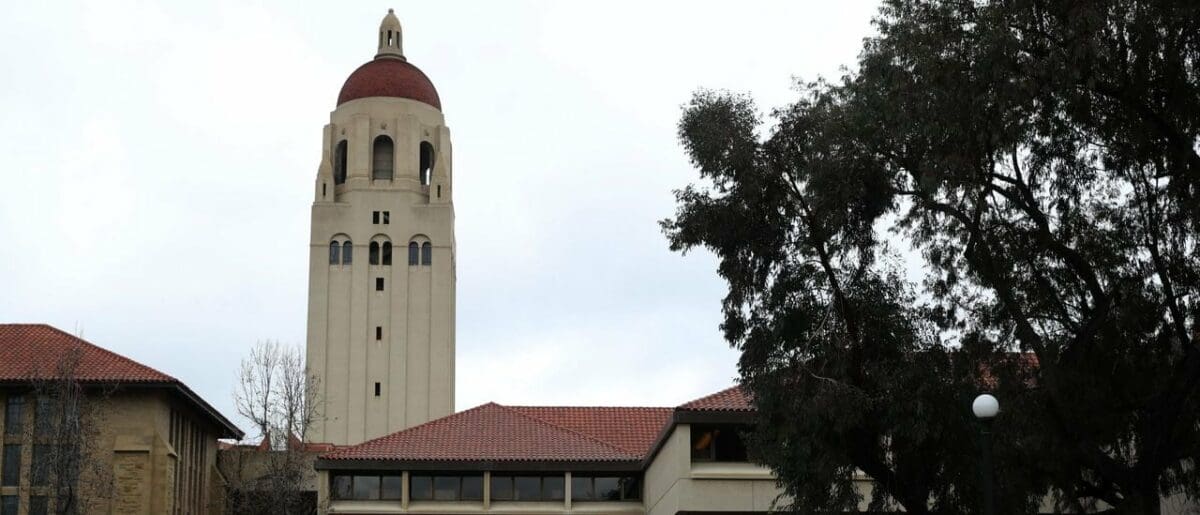
“Several student government entities at Stanford University” have called for a return of “land acknowledgement” statements before “campus-wide ceremonies,” reports The College Fix:
The Undergraduate Senate and the Graduate Student Council both signed onto a petition circulated by the campus American Indian Organization demanding a return of the statement.
The university has reportedly dropped the statement, deciding not to use it at convocation in September.
“This decision was disseminated through an unsigned letter sent out to a limited number of administrative personnel, presumably from university leadership,” a Change.org petition states.
“Prior to the removal of the land acknowledgement, the Muwekma Ohlone Tribe—the original peoples of the land—the Stanford Native community, and the undergraduate population were not made aware of this decision or the unsigned letter,” the activist group stated. “This letter declared the land acknowledgment ‘symbolic’ and ‘performative.’”
Land acknowledgments can leave the misleading impression that virtually all land in America was stolen from the Native Americans.
Much of the land transferred by Native Americans to whites in the United States was sold by Native Americans, not forcibly taken, although some progressive officials find that reality offensive. The Native American population was so depleted by disease in the 17th Century that Indian tribes could afford to sell some of their land to whites, because they weren’t using most of it. Selling land they didn’t need made sense — they could use the money they got for the land to buy firearms or metal-tipped arrows to defend themselves against hostile tribes, and to buy other useful things, like pots and pans, cotton and wool cloth, and metal tools needed to improve their agricultural output.
Millions of acres were voluntarily sold to settlers by Native Americans. Legal historian Stuart Banner’s book “How the Indians Lost Their Land” documented this reality. Some land changed hands through “consensual transactions,” while other lands changed hands through “violent conquest.” You can learn more about this subject by viewing the educational video, “Are We Living on Stolen Land?”
Land acknowledgments will recite that a college is on the land of this or that Native American people, often claiming that a tribe lived on that land “since time immemorial.”
In reality, the Indian tribe they describe as having lived on that land may only have lived on that land for a century or two before whites arrived, and may have exterminated the Indian tribe that previously occupied that land, or driven the original inhabitants away. Native Americans came to North America at different times, and routinely displaced or exterminated other tribes in the process.
Rather than implying that a college is on stolen land (when a college has no intention of “returning” that land to the tribe), colleges should focus on helping tribes by expanding tribal self-determination and ability to use their own lands. Many federal regulations make Native Americans poorer and stifle economic development on Indian reservations, as The Atlantic has noted, and as tribal court judge Adam Crepelle explained in his book.



https://shorturl.fm/VefS2
https://shorturl.fm/Retc2
Your point of view caught my eye and was very interesting. Thanks. I have a question for you.
Can you be more specific about the content of your article? After reading it, I still have some doubts. Hope you can help me. https://accounts.binance.bh/zh-CN/register?ref=DCKLL1YD