
16 people have died of starvation in Uganda’s impoverished northeast due to a drought:
Farmers say they’ve lost crops because the area received little or no rain since April – the beginning of the planting season….the region’s recurring shortages are caused by climate change, poor rainfall, deforestation, overgrazing and crop pests. Together, they leave communities increasingly vulnerable to hunger.
Prime Minister Robinah Nabbanja says thousands of families have been left without food as the dry spell has destroyed crops, and her office is to seek cabinet approval on Monday to buy more supplies for affected areas.
The government says it has started distributing emergency food aid.
Large areas of maize, sorghum and soybeans have withered, shattering hopes of a bumper harvest.
Experts are calling for better forecasting, investment in irrigation and drought‑resistant crops.
Uganda’s semi-arid north-east has been struck by catastrophic food shortages before.
But other parts of Uganda are coping better with rainfall problems, and avoiding starvation.
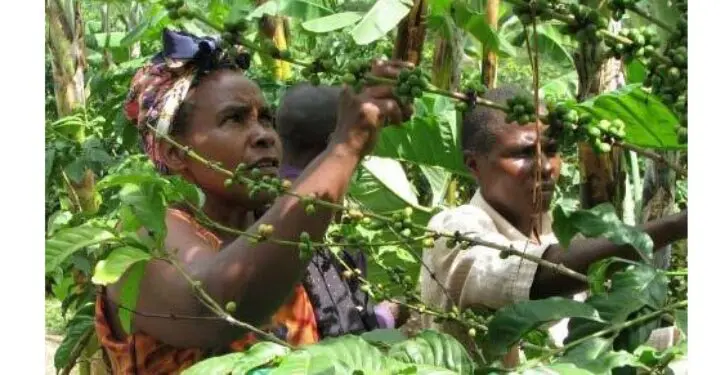
Uganda’s central coffee-growing region is defying drought thanks to improving agricultural techniques. “Uganda ranks among Africa’s biggest exporters” — at least $2.4 billion annually — “and it grows mostly robusta,” a staple variety used by Folgers and Maxwell House. In “the hilly Masaka region, robusta coffee is showing some encouraging signs in exactly the place” where the climate has gotten worse:
(Coffee protects against some major diseases, reports the Washington Post).
GreenMe magazine reports that in the coffee-growing region of Uganda, “Off-season rains, longer dry spells, depleted soils — all of this has turned into a very concrete problem for the people who live off coffee, one of the country’s most important crops and a major piece of its agricultural exports.” But “a regenerative agriculture project” is helping “change how coffee gets grown, starting with fairly hands-on work: covering the soil, protecting it from erosion, planting drought-resistant varieties, using shade trees, letting the ground hold onto water and organic matter again.” “Mulching covers the ground with organic material, which cuts down evaporation and shields roots from heat. Cover crops limit erosion and help fertility along. Shade trees lower heat stress on the coffee plants and add organic matter back through their fallen leaves,” resulting in “more microbial activity, more capacity to hold moisture, less nutrient loss when the rains get heavy.”
Climate change has made life better in some African countries over the last 30 years. The arid nation of Niger has much more forest today than it did at independence in 1960. In 2004, “Niger’s Zinder Valley had 50 times more trees than it did in 1975.” Mainly, that’s because Niger changed the law so that farmers — not the government — own the trees on their land. That gave farmers an incentive to plant and take care of trees, which proliferated as a result. But increasing rainfall since the 1990s also helped.
Kenyan farmers are using artificial intelligence tools to produce much more food.
The impoverished African nation of Zambia has used artificial intelligence to find new mineral wealth.
Niger recently became the first nation in Africa to eliminate river blindness, a disease spread by flies that breed near rivers. Those flies carry long thin parasitic worms that burrow in a victim’s skin.
In other good news, the African nation of Guinea recently eradicated sleeping sickness, a parasitic disease carried by the tsetse fly that causes irreversible brain damage, aggressiveness, psychosis, and then death, if left untreated.