
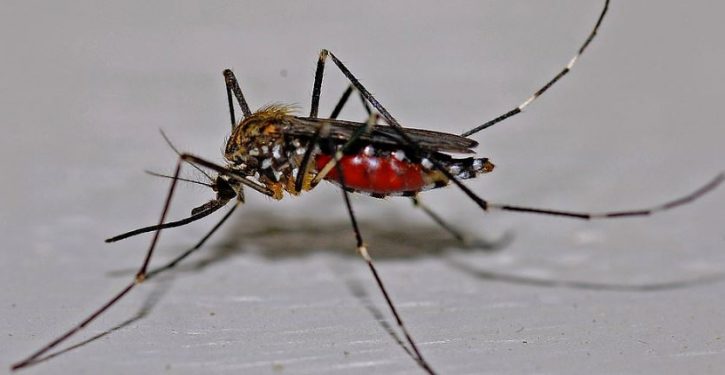
“A new mosquito-breeding facility in France is producing 1.5 million sterile mosquitoes per week to help control the population of invasive tiger mosquitoes, which can carry diseases like dengue, Zika, and chikungunya. The owner, a startup called Terratis, plans to scale up production to 40 million mosquitoes per week within two years. For comparison, Brazil’s large Wolbachia-infected mosquito factory can produce 100 million mosquito eggs per week,” notes The Doomslayer.
Phys.org reports:
Inside a factory in southern France, millions of tiger mosquitoes are being bred, not to spread, but to stop them from reproducing—though scaling up such efforts poses a mighty challenge.
At the Terratis facility in Montpellier, male insects grow inside large glass enclosures. In batches of 400,000, they are exposed to X-rays, making them infertile…
The aim is to flood an area with sterile male mosquitoes until the invasive population gradually collapses…
The tiger mosquito (Aedes albopictus), which can transmit diseases such as dengue, the Zika virus and chikungunya, is now present across most of France.
But enhancing efforts to ramp down their numbers remains difficult. Of around 50 industrial projects being developed worldwide, Terratis—founded in 2024—is seen as one of the most promising.
The startup produces 1.5 million sterile mosquitoes per week and aims to reach 40 million within two years.
Brazil’s mosquito factory has been operating longer and can produce more mosquitoes, according to a news report last September:
The world’s largest biofactory for breeding mosquitoes infected with Wolbachia bacteria, a method researchers use to combat dengue, hopes to protect some 140 million people from the disease in Brazil over the coming years….The Wolbito do Brasil plant, backed and used exclusively by Brazil’s health ministry, opened in the city of Curitiba on July 19. A joint venture between the World Mosquito Program, the Oswaldo Cruz Foundation, and the Institute of Molecular Biology of Parana, it can produce 100 million mosquito eggs per week.
Dengue, colloquially known as break-bone fever for the debilitating pain it can cause, is spread by Aedes aegypti mosquitoes that infect hundreds of millions of people each year, according to the World Health Organization (WHO).
Severe cases of dengue can be fatal and 6,297 people died of the disease in Brazil last year.
Brazil has released millions of bacteria-infested mosquitos to fight another tropic disease, dengue fever. Such bacteria-infested mosquitoes cut dengue fever by 69%, and have achieved large reductions in chikungunya and Zika, two other mosquito-borne diseases.
Scientists are also using genetically-modified fungus to catch mosquitoes that can spread diseases.
The military dictator of an African country ordered the Gates Foundation to stop releasing genetically-modified mosquitoes to fight malaria.
Releasing mosquitoes is something scientists have successfully done in other countries to fight malaria. “Conservationists are releasing Wolbachia-infected mosquitoes in Hawaii to control the spread of avian malaria, which has devastated local bird populations,” reported The Doomslayer. “A group of environmental organizations have been dropping biodegradable containers of mosquitoes into honeycreeper habitats on Maui and Kauai from helicopters….The containers fall to the ground without a top, and when they land the insects escape into the forest. Critically, these are not your typical mosquitoes. They’re all males, which don’t bite, that have been reared in a lab. More importantly, they contain a strain of bacteria called wolbachia that interferes with reproduction: When those males mate with females in the area, their eggs fail to hatch.”
Mosquitoes infested with Wolbachia bacteria have also been bred to fight dengue fever in Honduras, in hopes of replacing mosquitoes that spread dengue fever, with a strain of mosquitoes that doesn’t spread the disease.