
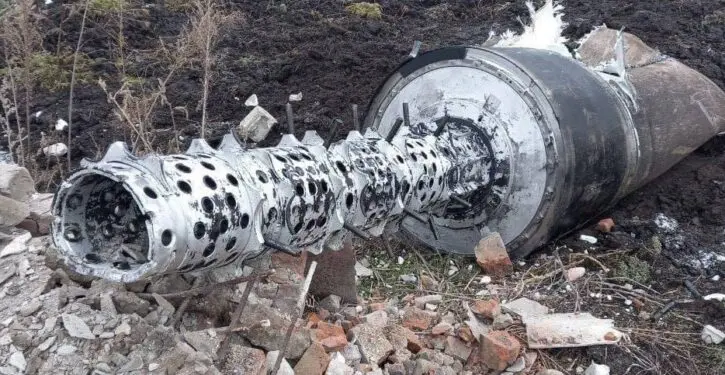
The nation of Mali signed an international treaty banning the use of cluster bombs. But it is now using cluster bombs against its own civilian population, dropping them on remote villages in the country’s north.
The cluster bombs are being used by Mali’s military and its Russian mercenaries “operating in northern Mali.” “Reports circulating in recent days” chronicle how “cluster munitions were dropped” repeatedly “in Tomboctou and Kidal regions of Mali. Images circulating online” show “Russian-made RBK-500 cluster bombs and ShOAB-0.5 submunitions.”
The Kidal region is inhabited by the Tuaregs, a partly white minority group in Mali, an overwhelmingly black African country. The Tuaregs have faced pervasive discrimination in Mali and the neighboring country of Niger. In neighboring Niger, soldiers have routinely killed Tuareg civilians, including old men. In May 1990, following an attack on a local police station, the military of Niger arrested, tortured, and killed several hundred Tuareg civilians in Tchin-Tabaradene, Gharo, and In-Gall.
Wikipedia notes that “because cluster bombs release many small bomblets over a wide area, they pose risks to civilians both during attacks and afterwards. Unexploded bomblets can kill or maim civilians and unintended targets long after a conflict has ended and are costly to locate and remove. This failure rate ranges from two percent to over 40 percent.”
The cluster-bomb attacks are occurring even though “Mali ratified the Convention on Cluster Munitions in 2010, making it legally bound never to use, produce, transfer, or stockpile these weapons. State Parties” like Mali “are also prohibited from assisting or inducing others to engage in any of these prohibited activities, meaning support for Russian use would also be a violation of the Convention. The Convention further requires States Parties to discourage States not party from using cluster munitions.”
“In addition to the comprehensive ban of cluster munitions under the Convention, international humanitarian law also requires all parties to an armed conflict to distinguish between the civilian population and combatants, and between civilian objects and military objectives. The use of cluster munitions violates these fundamental principles as their wide area impact means they kill, wound, and destroy indiscriminately. The use of cluster munitions also results in widespread contamination by dangerous cluster munition remnants that endanger civilians long after conflict ends.”