
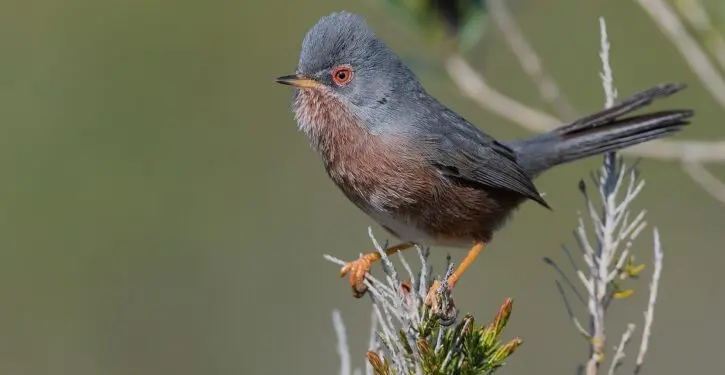
“Sixty years ago, the Dartford Warbler, a plump-looking, long-tailed songbird, had nearly vanished from the UK. Today, thanks to extensive habitat restoration, the population has risen to an estimated 4,100 breeding pairs,” reports The Doomslayer.
The Royal Society for the Protection of Birds notes that
The most recent national survey has now revealed the highest ever number of Dartford Warblers recorded on RSPB nature reserves, with 264 pairs counted in 2025 – that’s a 44% increase in just five years! The wider UK population estimate has also reached 4,100 pairs, up from 3,200 during the last national survey in 2006….Previously facing extinction in the UK, only a handful of pairs, limited to Dorset, remained just over 60 years ago…
A small, charismatic bird often seen perched on top of gorse singing a scratchy song, Dartford Warblers are found on lowland heathland in southern England. They are grey-brown in colour, with a distinctive red eye ring, russet breast and long tail. These birds are particularly sensitive to harsh winter weather and, as a ground-nesting species, heavily rely on dense gorse within areas of mature heathland for vital food, shelter and protection.
Gorse – a tightly packed, spiky shrub – provides a safe nesting place and hunting ground for Dartford Warblers, which specialise in picking spiders and caterpillars from their hiding places.
“Thanks to decades of improving water quality, otters are making a comeback in the UK, turning up in rivers all over the country and even wandering into urban waterways and backyard ponds,” reported The Doomslayer.
Artificial intelligence is being used to get rid of invasive species in Scotland’s Orkney Islands.
Puffins have returned to the Isle of Muck in Northern Ireland.
An endangered fish is recovering in Scotland.
Carnivorous plants have been reintroduced to English wetlands.
“Numbers of one of Scotland’s rarest plants have more than trebled on a hill in central Scotland,” reports the BBC.
Sticky catchfly is a nationally rare species with fewer than 18 populations scattered across Britain. Around 10,000 flowering stems of the plant were counted by volunteers during a three-day survey on Dumyat in the Ochil Hills – an increase from 3,000 in 2013.
In 2023, a baby beaver was born in London, the first beaver birth there in 400 years.