
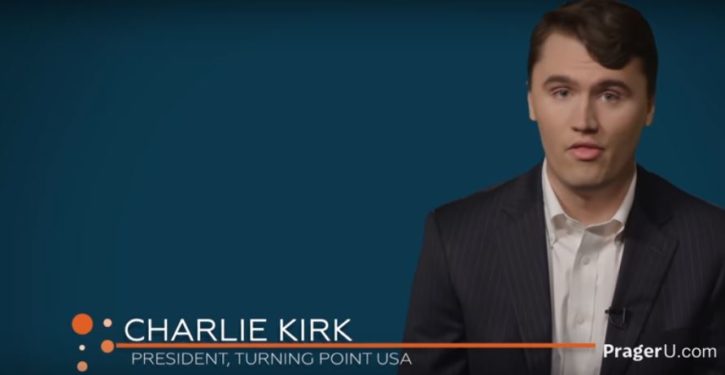
“A woman who was fired from Ball State University in Indiana over a private Facebook post critical of Charlie Kirk following his assassination will receive a $225,000 legal settlement,” reports Just the News:
The American Civil Liberties Union filed a lawsuit in federal court last year on behalf of Suzanne Swierc, who worked as director of health promotion and advocacy at Ball State.
The lawsuit named Ball State University President Geoffrey Mearns and argued her termination violated her constitutional rights because she was “a private citizen speaking on a matter of public concern.”
“The First Amendment does not allow government institutions to retaliate in those circumstances, and this settlement reflects that,” Stevie Pactor, senior staff attorney for the ACLU, said in a statement.
Swierc referred to Kirk’s killing as a “tragedy” in the Facebook post, but went on to say that his death was a “reflection of the violence, fear and hatred he sowed.”
“If you think Charlie Kirk was a wonderful person, we can’t be friends,” she said in the post.
Although the Facebook post was private, the ACLU said in its statement, a screenshot was shared publicly through Indiana Attorney General Todd Rokita’s “Eyes on Education” portal, as well as other social media accounts.
As a journalist notes, this woman was “an administrator, which means academic freedom doesn’t cover her. She probably would have won anyway, since the post was private, unconnected to the university and irrelevant to her position.”
The Supreme Court has said that the inappropriate or controversial nature of a public employee’s speech does not automatically strip it of First Amendment protection. For example, the Supreme Court voted 5-to-4 to find that the First Amendment was violated when a public employee was fired for hoping that a future assassination attempt on President Reagan would be successful, because that inappropriate speech did not offend the public employee’s immediate co-workers all that much, or otherwise cause a disruption. (See Rankin v. McPherson (1987)).
The courts have said that universities can fire administrators more easily than they can fire people who do hold a teaching position, due to the academic freedom enjoyed by people who have a teaching position but not by people who don’t. For example, the U.S. Court of Appeals in New York upheld the removal of a college administrator for racist remarks, shortly after it overturned the punishment of a professor for racist remarks made at the very same college. (Compare Jeffries v. Harleston (1995) with Levin v. Harleston (1992)).