
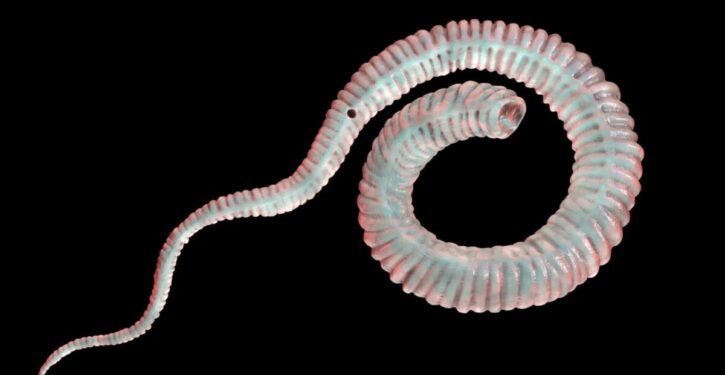
“Lowri Denman knew something was wrong was when she made the horrifying discovery of a meter-long tapeworm after going to the toilet,” reports the BBC.
“It looked absolutely disgusting, like Sellotape with like little ridges in it,” said the 42-year-old Welsh woman.
“It was the first symptom of neurocysticercosis, which left Lowri with 38 parasites in her brain causing extreme headaches, seizures and psychosis. She is one of only a handful of people” in the United Kingdom “who are diagnosed with the brain infection each year, which is caused by the larvae of the pork tapeworm.”
Lowri, who is employed by the media, went on a three-month trip around India in 2007. That is where she contracted the infection.
Lowri avoided knowingly eating meat on the trip, hoping it would help her to avoid food poisoning. But she inadvertently ate pork that contained microscopic tapeworm eggs.
It was not until three years later, in 2010, that Lowri discovered the tapeworm when in a restaurant toilet and flushed it down the loo. She went to the GP but stool tests came back satisfactory and she was feeling well so life continued as usual.
A hospital stay, CAT scan and MRI scan followed and Lowri was told to come in for the results.
“The doctor sat me down and said, ‘right, okay, we’ve looked at your scans and we’ve found 38 parasites on your brain’,” said Lowri….
Initially they thought it was toxoplasmosis, an infection spread through contact with infected cat feces.
But then Lowri’s mother asked if her seizure could be linked to the tapeworm she had discovered a year earlier.
After further investigations she was finally diagnosed with neurocysticercosis….Scans found huge swellings on Lowri’s brain around the parasites.
Following a seizure and collapse, she became confused and started experiencing numbness and tingling in her body.
“This paranoia and psychosis started kicking in… there was severe anxiety, panic attacks,” said Lowri, who spent six weeks in a psychiatric hospital.
India poses some risks to travelers, but less than in the past.
Annual rabies cases have fallen by 12,000 in India, down to about 6,000 cases. That’s due to sterilization of stray dogs, which has led to fewer dog bites.
Malaria cases have fallen 80 percent in India since 2015.
Chatbots are being developed for India’s many languages (700 languages are spoken in India).
India has some interesting scenery and wildlife. It has doubled its tiger population.
Parasites can take years for countries to eradicate. It took nearly 40 years for the world to largely eradicate Guinea worms, nasty parasites that caused tens of millions of people to scream with unbearable pain. But by 2023, Guinea worms had been eradicated in at least 17 countries, and “no guinea worm was reported” in 2024.
In 1947, India had an estimated 25 million cases of Guinea worm. But in a highly successful national eradication program launched in 1984, India actively targeted the parasite by filtering drinking water, treating contaminated water sources, and educating communities. India reported its last indigenous case in July 1996. Consequently, in February 2000, the World Health Organization (WHO) officially certified India as free of Guinea worm disease. Today, the disease is nearly eradicated worldwide.