
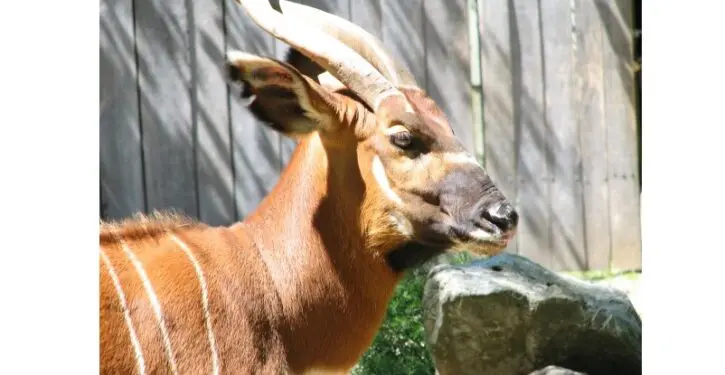
“Mountain bongo antelope are returning to Kenya’s forests after nearly disappearing from the wild. The Associated Press reports that fewer than 100 wild mountain bongos remain, but a breeding program at the Mount Kenya Wildlife Conservancy now maintains a large captive population that is gradually being reintroduced to protected forest habitat,” reports The Doomslayer.
The Associated Press explains:
The mountain bongo has become the ‘ghost of the forest,’ hard to spot amid the dense shrubs due to its ability to camouflage.
A critically endangered species, the animal is being slowly reintroduced into the wild by conservationists to increase the number of the rare antelope that are indigenous to Kenya’s forests.
The mountain bongo is a rare antelope known for its brown skin and distinct white stripes. With fewer than 100 individuals left in the wild, a conservancy based in Kenya is breeding them and slowly reintroducing them into the wild, with a target of 750 wild bongos by 2050.
Located on the misty slopes of Kenya’s highest mountain, Mount Kenya, and on the edge of the forest, the 1,250-acre Mount Kenya Wildlife Conservancy in the Nanyuki area has been restoring the survival instincts of zoo-bred bongos. They want to ensure the animals can feed without human assistance, escape from predators, and build a strong immunity against diseases in the wild.
Last week, the conservancy imported a new batch of four male bongos from the European Association of Zoos and Aquaria though the Czech Republic. These new arrivals will interbreed with descendants of 18 bongos that arrived at the conservancy in 2004 from the United States to ensure a more diverse genetic pool.
Bongos were historically found in Kenya’s Mount Kenya, Aberdare, Eburu and Mau forests. The Associated Press says those forests are vital to Kenya’s water supply. The last wild bongo was seen in the Mount Kenya forest in 1994. Not until 2022 were bongos reintroduced to Kenya’s forests in 2022, when 10 were released into the wild. Today, the bongos can be seen most often among the orange climber vines and shrubs that are their favorite plants.
In Kazakhstan, the saiga antelope has been brought back from the verge of extinction. The antelopes “live in the Golden Steppe, a huge grassland three times the size of the United Kingdom.” Their population has risen more than 100-fold in the grasslands of Kazakhstan, which is the 9th largest nation in the world.
The earless dragon is coming back from the verge of extinction in Australia. An endangered marsupial is also making a comeback in Australia.
Fish species rebounded off the coast of California due to their young finding a sanctuary in abandoned oil rigs.
Bobcats have returned to New Jersey after disappearing from the state in the 1970s. Now, there are between 200 and 400 bobcats in New Jersey.