
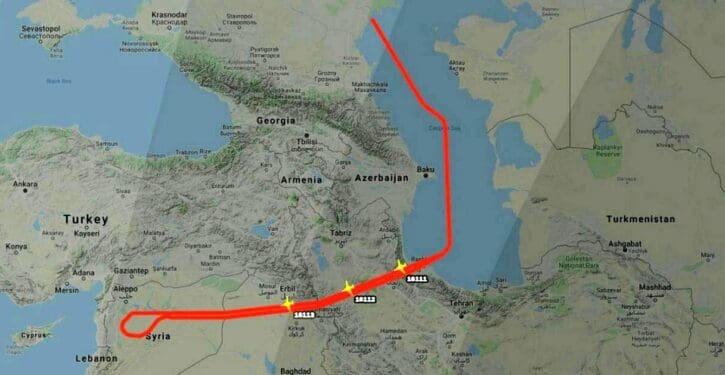
“The Caspian Sea, a huge body of water hundreds of miles north. Routinely overlooked, the Caspian has taken on new significance as a trade route linking Russia and Iran,” reports the New York Times:
the waterway provides a passageway for both overt and covert trade — shipments that have helped Iran persist as an adversary to the United States despite overwhelming American military superiority.
Russia is shipping drone components to Iran via the Caspian Sea, U.S. officials say, helping Iran rebuild its offensive abilities after losing roughly 60 percent of its drone arsenal during recent fighting. Russia also provides goods that would typically pass through the Strait of Hormuz, now blockaded by the U.S. Navy, as part of global trade.
Iranian officials have said that efforts to open alternative trade routes are progressing rapidly, with four Iranian ports along the Caspian working around the clock to bring in wheat, corn, animal feed, sunflower oil and other supplies…Iran is actively rerouting essential food imports through the Caspian.
Russian trade officials and port statistics also indicate a swift increase in Caspian shipping in recent months. Two million tons of Russian wheat that used to be shipped to Iran annually through the Black Sea — now under threat of Ukrainian attacks — is going via the Caspian…Caspian routes to Iran look much more attractive.
Cargo tonnage across the Caspian could double this year. Although Western sanctions made some major companies hesitant to ship through the Caspian, the Hormuz crisis might help overcome that.
The Iran War has driven up energy prices and resulted in daily blackouts in major cities in Pakistan. Pakistan used to get oil from Iran and the United Arab Emirates through ships that passed through the Persian Gulf, but it doesn’t now. Ships have stopped passing through the Persian Gulf’s Strait of Hormuz due to Iranian attacks and a U.S. blockade. Pakistan borders Iran, but there is no cross-border pipeline from Iran to Pakistan, and desert separates Iran’s oil-producing regions from Pakistan.
The Iran War has driven up the cost of fertilizer for farmers. “Nearly one-third of the world’s seaborne fertilizer trade passes through the Strait of Hormuz,” and that flow has been largely cut off by the war.
Egypt also has been deeply affected by the Iran War. Its capital, the great city of Cairo, goes dark early due because the Egyptian government has ordered businesses to close early to conserve fuel, which has become much more expensive due to the war. “Soaring fuel costs due to US-Israel war on Iran have pushed the Egyptian government to issue a month-long early-closing order. Small businesses are scrambling to adapt,” reported Africa News.