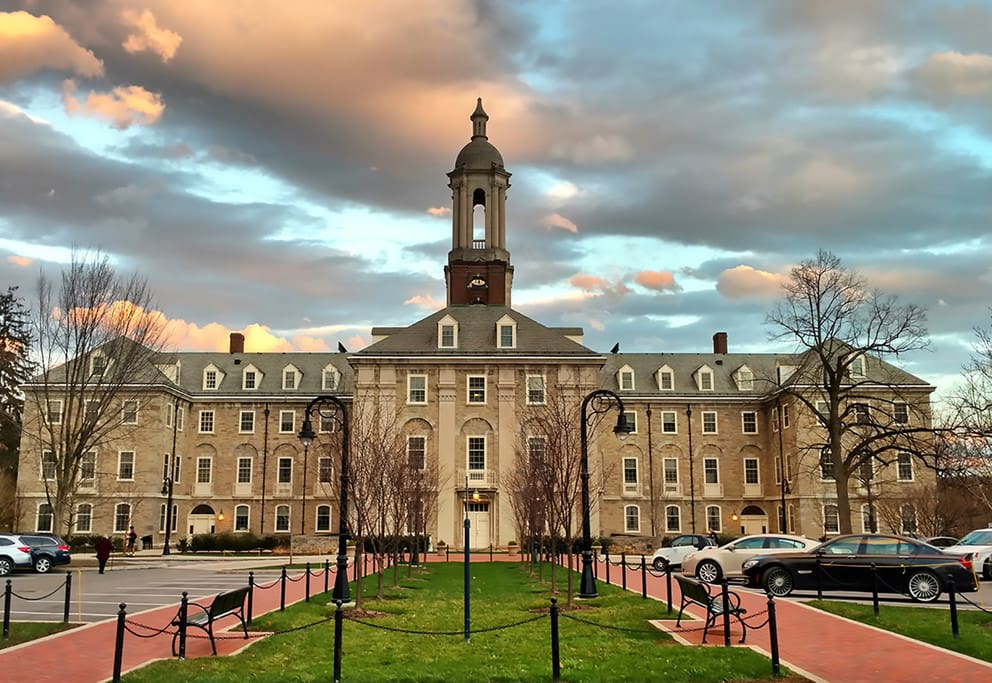
Penn State University may eliminate 49 of its undergraduate majors this fall, as a cost-cutting measure, reports The College Fix. Proposed cuts would phase out low enrollment majors, affecting at least 900 students.
“Higher education is changing, and we must rise to the occasion,” Provost Fotis Sotiropoulos said. “A full accounting of our academic offerings, and a commitment to an ongoing cycle of program reviews moving forward, are critical parts of the work we all must do to position our students, and Penn State, for long-term success,” Sotiropoulos added.
Examples of programs that could be cut are liberal arts, and earth science and mineral science majors:
Nine of the impacted programs currently enroll no students and 11 have already submitted formal teach-out proposals, enrollment holds or both. Twenty-six would continue to be offered but through another college. …
They would be cut for various reasons, including low student demand, combined employment opportunity and realignment. Demographic changes, enrollment declines, stagnant state funding and rising costs all played a role in the preliminary recommendation, Mr. Sotiropoulos said.
It isn’t clear how much money the university would save by ending these programs. Penn State is currently operating under a $9.9 billion budget.
“Higher education is in a complex environment, and we are not immune to the numerous challenges of the moment,” Mr. Sotiropoulos said.
For the next two weeks, campus administrators are asking for feedback on the proposal from the community, students, and faculty, according to a Penn State web page.
Meanwhile, artificial intelligence course and majors are multiplying nationally, amid surging employer demand.
Cato Institute researcher Stephen Rowe says “employer demand for AI skills has exploded.” He pointed to a recent study from the Atlanta Federal Reserve Bank finding that job postings requiring at least one AI skill have tripled in less than a decade. Job postings seeking generative AI engineers have multiplied, rising by 588 percent from about 1,600 in 2022 to over 11,000 in 2024. “AI-related programs have surged nationwide, with nearly 200 bachelor’s-level AI majors now offered” in this country, Rowe added.
Rowe says that studying AI is advantageous, because it now pervades most industries, from healthcare and technology to most business sectors. He says the safest path for students is to combine AI with a specific discipline, such as economics or biology. “That combination protects graduates even if the AI job market normalizes. I don’t see any oversupply challenges in the near future,” he adds.
A study reveals which majors pay off for students.
The average college student has an IQ of 102, compared to the average American IQ of about 98. The average college student used to have a much higher IQ (around 117), back when only the brightest people went to college. As science writer Rolf Degen notes, a recent study in Frontiers of Psychology shows “the average IQ of undergraduate students… declined by approximately 0.2 IQ points per year” since the mid-20th Century as more people enrolled in college.
The benefits of college are a combination of some students actually learning something useful, and others signaling to an employer that they at least were smart enough to get in to a selective college, or smart enough to graduate, even if they didn’t actually learn much of use in college. Many students learn little in college and can’t write coherently when they graduate. Nearly half of the nation’s undergraduates learned almost nothing in their first two years in college over a decade ago, according to a 2011 study by New York University’s Richard Arum and others. Thirty-six percent learned little even by graduation.



https://shorturl.fm/buTAW
https://shorturl.fm/NzeSr
https://shorturl.fm/CPmZA