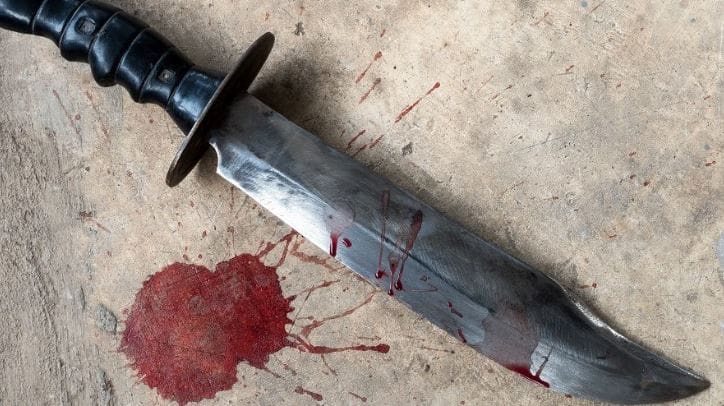
Thanks for joining us today. This topic is the result of a “ding ding” I received in church after hearing a passage about the blood of Christ. Immediately, I knew my heavenly “Assignment Editor” was working on Sunday. As I have written many times, I never take Divine guidance for granted and always feel blessed that the Lord uses me to touch someone or many readers through this study. If that is you, please email me or leave a comment.
In the Hebrew Bible (Old Testament), blood symbolizes life and death. Blood is also used as a sacrifice to God for the atonement of sin in one’s life or among His people.
Blood sacrifice, the slaughter of animals, is recorded numerous times in the Old Testament. Later, in the New Testament, after the death and resurrection of Jesus, those who followed Him believed, and we believe today, that His blood was shed as atonement for our sins and for all humankind. More on the “blood of Christ” next week. Today, we read how blood in the Old Testament lays the foundation for Christ’s sacrifice.
The first mention of blood in the Old Testament appears in Genesis, after Cain killed his brother Abel out of jealousy because God favored Abel’s offering. (Read Genesis 4.)
When God asked, “Where is your brother Abel?” Cain lied and, famously, answered, “I don’t know, am I my brother’s keeper?” And then:
“The Lord said, ‘What have you done? Listen! Your brother’s blood cries out to me from the ground’” (Genesis 4:10).
The second time blood is mentioned is in the passage my study Bible subtitles “God’s Covenant With Noah.” God says:
“Everything that lives and moves about will be food for you. Just as I gave you the green plants, I now give you everything. But you must not eat meat that has its lifeblood still in it. And for your lifeblood I will surely demand an accounting. I will demand an accounting from every animal. And from each human being, too, I will demand an accounting for the life of another human being. Whoever sheds human blood, by humans shall their blood be shed; for in the image of God has God made mankind” (Genesis 9:3-6).
That passage is a launching pad for much discussion, especially because killing in war and against one’s enemies is frequently recorded in the Old Testament. Read the rest of God’s covenant with Noah in Genesis 9:7-17.
The book of Genesis is followed by Exodus, in which God uses blood in the first and tenth plagues. Afterward, the Pharaoh frees God’s people from Egyptian bondage. To begin the plagues, God turns the Nile River into blood:
“Moses and Aaron did just as the Lord had commanded. He raised his staff in the presence of Pharaoh and his officials and struck the water of the Nile, and all the water was changed into blood. The fish in the Nile died, and the river smelled so bad that the Egyptians could not drink its water. Blood was everywhere in Egypt” (Exodus 7:20-21).
The tenth plague involved the slaughter of unblemished lambs. God commanded that their blood be spread on the doors of the Israelites to save their firstborn sons from the angel of death, whom God was sending to punish the Egyptians and to free His people:
“I am the Lord. The blood will be a sign for you on the houses where you are, and when I see the blood, I will pass over you…” (Exodus 12:12-13). That “pass over” is why the annual Jewish holiday commemorating Passover is so named. (More in Vol. 107 and Vol. 214.)
This final and most powerful plague is regarded as a Messianic prophecy. When John the Baptist first saw Jesus, he declared, “Behold, the lamb of God who takes away the sin of the world!” (John 1:29). Like the slaughtered Passover lamb, Jesus was without “blemish” (sin). He was sent by God to save His Jewish people and all humankind from sin and to offer eternal life. God’s plan for salvation led Jesus to the cross, where His death was followed by His resurrection.
Still in Exodus, 12 chapters later, animal blood was present at a powerful event that confirmed God’s Covenant with the people of ancient Israel:
“And Moses took half of the blood and put it in basins, and half of the blood he threw against the altar. Then he took the Book of the Covenant and read it in the hearing of the people. And they said, ‘All that the Lord has spoken we will do, and we will be obedient.’ And Moses took the blood and threw it on the people and said, ‘Behold the blood of the covenant that the Lord has made with you in accordance with all these words’” (Exodus 24:6-8).
Following Exodus, the Book of Leviticus records God’s ordinances regarding the use of animal blood in sacrificial offerings and forbids human consumption. It begins in Leviticus 3, which ends with God declaring:
“It shall be a statute forever throughout your generations, in all your dwelling places, that you eat neither fat nor blood” (Leviticus 3:17). God repeats Himself in Leviticus 7:26-27 and again, in case His people missed it:
“For the life of every creature is its blood: its blood is its life. Therefore I have said to the people of Israel, You shall not eat the blood of any creature for the life of every creature is its blood. Whoever eats it shall be cut off” (Leviticus 17:14). Next time I am tempted to order a juicy extra rare prime rib dinner, refer me back to Leviticus.
Our last passage concerns the blood ceremony for Yom Kippur, the Jewish calendar’s holiest day, known as the Day of Atonement. (See Vol. 28 and Vol. 287.) For extra credit, read Leviticus 16. For this study, the pertinent verses spoken by God to Moses:
“Then he [Chief Priest Aaron] shall come out to the altar that is before the Lord and make atonement for it. He shall take some of the bull’s blood and some of the goat’s blood and put it on all the horns of the altar. He shall sprinkle some of the blood on it with his finger seven times to cleanse it and to consecrate it from the uncleanness of the Israelites. When Aaron has finished making atonement for the Most Holy Place, the tent of meeting and the altar, he shall bring forward the live goat” (Leviticus 16:18-20).
Spoiler alert: That “live goat” is freed into the wilderness, “escaping” with all the sins and wickedness of the Israelites that Aaron placed on its head. Thus, the word “scapegoat” entered our lexicon (Leviticus 16:18-22). Again, see Vol. 287 since Jesus was the Passover “scapegoat,” who shed blood, was crucified on the cross for the sins of His people, and then freed us from sin for those who believe in Him.
See you next week for more about the blood of Christ. Amen!
Thanks to readers who send heartfelt emails. I try to respond to each one.
Myra Kahn Adams is a conservative political and religious writer. Her book “Bible Study For Those Who Don’t Read The Bible“ reprints the first 56 volumes of this popular study. “Part 2,” reprints Vols. 57 –113. Order it here.
Myra is also the Executive Director of the National Shroud of Turin Exhibit. You can help support our six-month exhibit at the Basilica in Orlando, Florida. Contact: Myraadams01@gmail.com
This article was originally posted at Townhall.com


https://shorturl.fm/Hg8ld
https://shorturl.fm/76T08