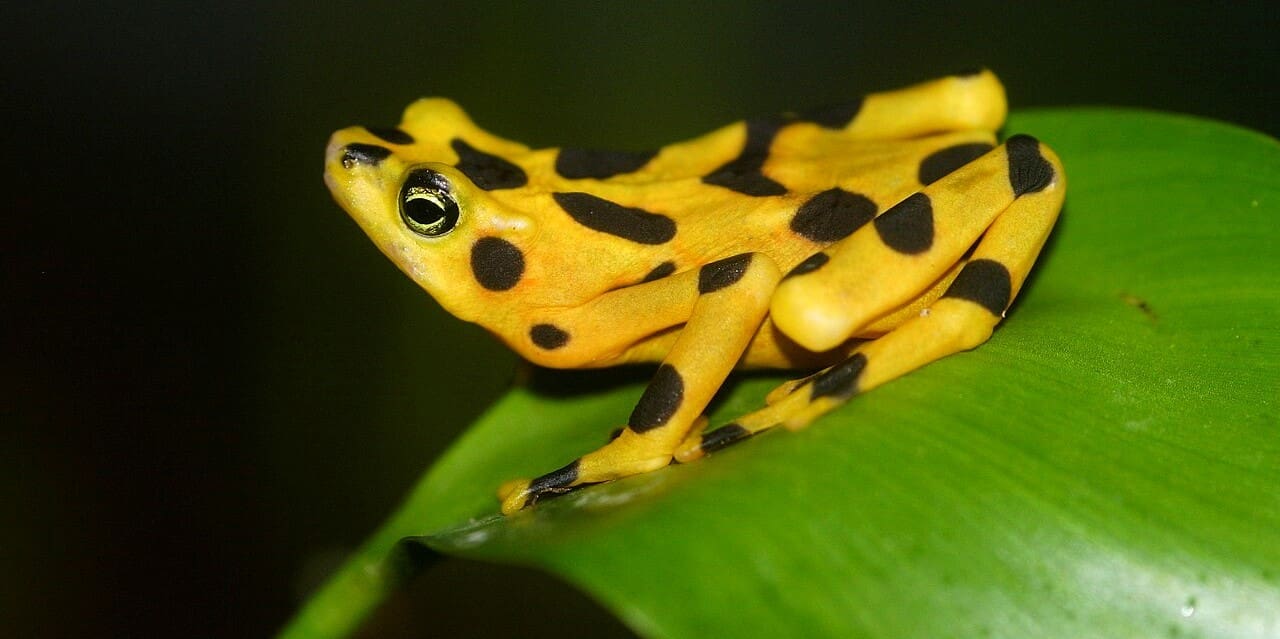
“Panama golden frogs are returning to the wild 17 years after they were wiped out by the deadly (to amphibians) Chytridiomycosis fungus,” reports The Doomslayer.
Popular Science explains:
After nearly two decades of hard work, conservationists are finally reintroducing a new generation of the tiny, fluorescent amphibians back into the tropical island’s ecosystem.
It wasn’t that long ago that golden frogs were staring down almost certain extinction. The saga began in the late 1980s, when an invasive fungus called Batrachochytrium dendrobatidis (Bd) arrived in lower Central America. Soon, Bd spores spread throughout Panama. The fungal spores had no difficulty traveling through water—and because golden frogs only live close to streams, they soon encountered the fungus themselves.
While Bd isn’t a problem for humans, it’s devastating to many amphibians like the golden frog. After infecting a host’s skin, the fungus disrupts the body’s electrolytes through a disease called chytridiomycosis. Before long, a frog’s salt and water imbalances result in heart failure and death. The chytridiomycosis crisis finally reached Panama’s last concentrated population of golden frogs at El Valle de Anton in 2004. By 2009, the animals had completely disappeared from the region.
But the species narrowly avoided going extinct. Biologists with the Panama Amphibian Rescue and Conservation Project (PARC) devoted years to breeding golden frogs in controlled facilities. Recently, lab populations were large and stable enough to move on to rewilding the frogs.
“We provide care for some of the most endangered amphibians in Panama, and now we are entering a new phase of our work to study the science of rewilding,” notes PARC director Roberto Ibañez.
Many of the frogs die soon after being released. Chytridiomycosis remains prevalent in multiple regions around Panama, and remains a problem for the frogs. 70 of the 100 released golden frogs died of the disease within 12 weeks of being released.
“Fortunately, many of the surviving frogs were eventually rewilded, and the new data allows conservationists to better understand how the disease works,” Popular Science says.
“These crucial data will inform our conservation strategy moving forward,” biologist Brian Gratwicke says. “Our earlier modeling suggested there may be release sites we can select that will be climatic refuges—places that are suitable for the frogs but too hot for the fungus.”
Promoting and defending liberty, as defined by the nation’s founders, requires both facts and philosophical thought, transcending all elements of our culture, from partisan politics to social issues, the workings of government, and entertainment and off-duty interests. Liberty Unyielding is committed to bringing together voices that will fuel the flame of liberty, with a dialogue that is lively and informative.




Your audience, your profits—become an affiliate today!
Start profiting from your traffic—sign up today!