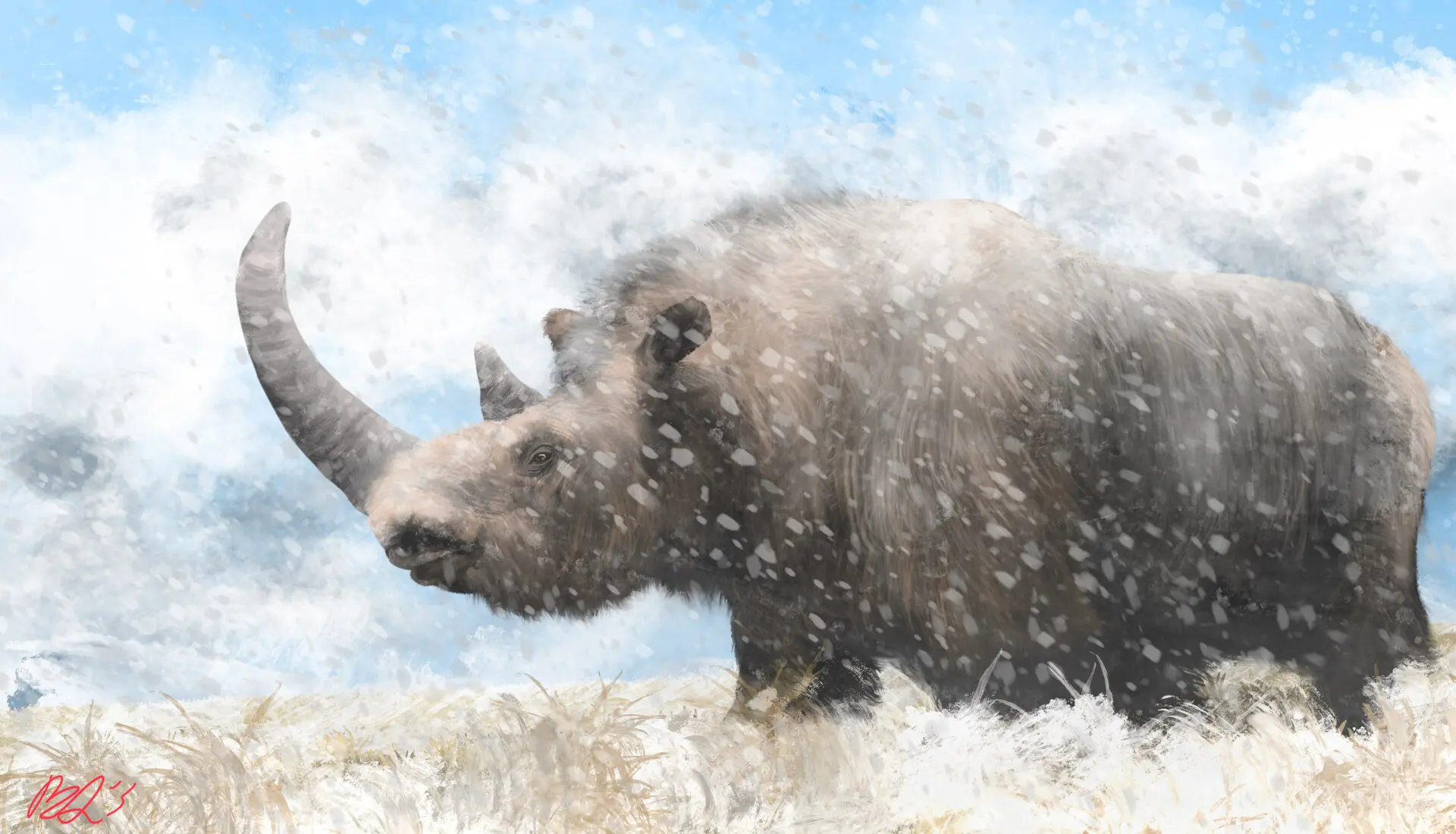
The woolly rhino genome has been recovered from meat in a frozen wolf pup’s stomach. “A piece of woolly rhinoceros flesh hidden inside a wolf that died 14,400 years ago has yielded genetic information that improves our understanding of why one of the most iconic megafauna species of the last glacial period went extinct,” reports New Scientist:
A genome reconstructed from a tiny piece of flesh found in the stomach of a wolf pup that died 14,400 years ago suggests that woolly rhinos were still genetically healthy even as they faced imminent extinction.
No one will ever know how a young female wolf pup died at a site near what is now the town of Tumat in northern Siberia, Russia. But it is most likely that she and her sister, together known as the Tumat Puppies, had just been fed the meat of a woolly rhinoceros by their mother when their den collapsed, entombing the siblings in permafrost for 14,400 years.
The woolly rhinoceros flesh looked “like a piece of jerky with a bit of fluff”. “It had the hair on it still, which was quite unusual.” It was found in “beautifully preserved mummified wolf puppies.”
Researchers say “the most likely cause of extinction” for the woolly rhino “was a rapid period of climatic warming between 14,700 and 12,900 years ago,” “which would have led to dramatic changes in the woolly rhino’s habitat.”
Scientists have used genetic engineering to create a woolly mouse, on their way to recreating the woolly mammoth.
Scientists created woolly mammoth meatballs, resurrecting the flesh of the long-extinct giant animals.
Genetic engineering recently produced pork and bacon that people who are allergic to pork can eat.
A genetically-modified chicken lays eggs that people allergic to eggs can eat. Scientists have genetically engineered a cow that produces human insulin in its milk.





每天都在战争,希望2026和平.
看不懂但大受震撼