
“In 1996, Travis Lewis broke into the Snowden family home in Arkansas during a burglary and murdered 75-year-old Sally Snowden McKay and her cousin. He was convicted and imprisoned. Years later, Sally’s daughter Martha McKay chose radical forgiveness. She visited Lewis in prison, advocated for his parole, and after his 2018 release, hired him to work at the same historic house she had converted into a bed and breakfast. In March 2020, after being confronted over suspected theft, Lewis attacked and killed Martha inside that very home.”
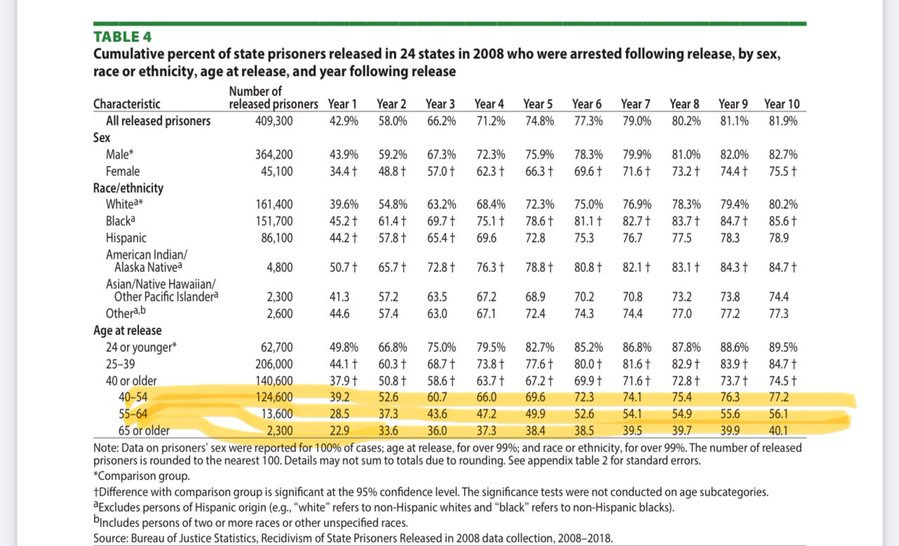
Criminals often commit more crimes after being released. Nationally, 81.9% of all state prisoners released in 2008 were subsequently arrested within a decade, including 74.5% of those 40 or older at the time of their release. (See Bureau of Justice Statistics, Recidivism of Prisoners in 24 States Released in 2008: A 10-Year Follow-Up Period (2008-2018), pg. 4, Table 4)).
Yet, the Virginia legislature is passing legislation to make it hard for the parole board to keep some dangerous inmates in prison, by telling the parole board not to deny parole based on factors outside an inmate’s “demonstrated ability to change” if the inmate committed his crime as a juvenile. But what if an inmate remains dangerous due to a personality disorder, and claims he lacks the ability to change that? How does the parole board “demonstrate” that the inmate has the ability to change the dangerous personality trait?
SB 60 provides that “The Board shall not deny parole for a juvenile offender based principally on factors outside of his demonstrated ability to change, such as the nature of the offense or any effects resulting from the commission of such offense.” SB60 recently passed the state senate along party lines, with Democrats supporting it and Republicans opposing it. It then passed the state House of Delegates in a slightly revised version, with Democrats supporting it and most Republicans opposing it. (The same language is also found in HB318).
The bill restricts the parole board’s ability to consider “the nature of the offense.” The nature of the offense can be very relevant, shedding light on whether an offender is persistently dangerous — such as if the offender is a serial killer or serial rapist. Yet SB 60 says that the parole board cannot deny parole “principally” based on “the nature of the offense.” Even though a serial killer may have a strong compulsion to kill people. If the inmate has a sadistic personality disorder, that may be a factor outside his “ability to change,” and thus might be impermissible for the parole board to rely on as a principal factor in denying parole, based on the way SB 60 is written. Even if the offender had the ability to change to become less dangerous, and did not do so, SB 60 might preclude the parole board from taking that failure to change into account as a primary reason for denying parole, if such ability to change was not somehow “demonstrated” by the parole board.
Serial killers do not lose their desire to kill people merely because they have spent some time in prison or followed prison rules. They go on to kill again after being released on parole. One example is Kenneth McDuff. At the age of 19, after being paroled, McDuff and an accomplice kidnapped three teenagers. He shot and killed two boys, then killed a girl after raping and torturing her. Later, after being paroled yet again, he murdered additional women — as many as 15 women in several different states.
The Virginia legislature seems to be exhibiting the same kind of suicidal empathy as the woman murdered by Travis Lewis.
Inmates who have spent many years in prison are less likely to commit crimes upon being released, but their recidivism rates are still substantial. 57.5% of federal inmates imprisoned for violence for ten years or more were arrested again within 8 years after being released, according to the U.S. Sentencing Commission. (See Recidivism of Federal Violent Offenders Released in 2010, pg. 33 (Feb. 2022)).
Even among inmates released at age 55 or over, some return to a life of crime. Of state prisoners released in 2008, 56.1% of those age 55 or over at the time of their release were subsequently arrested by 2018, as were 40.1% of those age 65 or over. (See Bureau of Justice Statistics, Recidivism of Prisoners in 24 States Released in 2008: A 10-Year Follow-Up Period (2008-2018), pg. 4, Table 4)).







Share your link and rake in rewards—join our affiliate team!
Join our affiliate program today and earn generous commissions!