When Virginia abolished the death penalty in 2021, Virginians were assured that it wasn’t needed, because the worst murderers could be given life sentences without the possibility of parole.
But soon, even the worst killers could be released. Legislation has been introduced to allow all prison inmates serving long sentences to seek release after specified periods — even serial killers, child killers, and other murderers who once would have been eligible for the death penalty. HB 853 and SB 634, known as the “second look” bills, have been amended to create three tiers for release. Some inmates could seek release after 15 years, while those who commit the most serious offenses would have to wait 20 years or 25 years, depending on their offense.
Most Virginia inmates already spend less than 15 years in prison. For example, manslaughter carries a sentence of one to ten years. Drug possession can lead to sentences of up to 6 months, 1 year, or 10 years, depending on the type of drug.
But some murderers, such as serial killers, are serving sentences of life without parole. This “second look” legislation could not only release them, but give them more freedom than they would get from parole. Inmates released on parole are subject to the supervision of a parole officer, and if they misbehave, they can be sent back to prison for a long time. But inmates released under HB 853 and SB 634 would be free as a bird, with no parole officer to keep tabs on them.
Similar legislation passed the Virginia senate and a committee of the House of Delegates in 2024, so this legislation has a good chance of becoming law.
The legislation expressly allows even the worst murderers to seek release. It includes inmates who have “any conviction” or “a combination of any convictions of (i) a Class 1 felony; (ii) aggravated murder in violation of § 18.2-31 or first degree murder or a second or subsequent conviction of second degree murder.” They would still be eligible to seek release, even if they tortured to death multiple victims — which would constitute a Class 1 felony — or otherwise killed large numbers of people.
To get Virginia to abolish the death penalty, anti-death-penalty activists claimed that it was unnecessary to keep killers off the streets, because they could just be given life without parole instead. Virginians for Alternatives to the Death Penalty said there was no reason to worry if the death penalty was abolished, because the worst criminals could be given “life in a Supermax prison with no possibility of parole.” To keep Virginians from worrying about dangerous killers being put back on the street, the Virginia legislature made the two remaining men on Virginia’s death row ineligible for parole when it abolished the death penalty in 2021.
But the second-look bills would allow even the worst killers to seek release. That includes Anthony Juniper, who “committed a quadruple murder in 2004, during which he shot a 2-year-old in her mother’s arms four times and her 4-year-old sister, along with their mother and uncle.” He could seek to be released soon under this second-look legislation, even though he was once sentenced to death for his crimes, a death sentence overturned by the 2021 law that abolished Virginia’s death penalty.
Offenders who are released could go on to commit more crimes. The Virginia second-law bills are modeled on Washington, DC’s existing “second look” law. Under DC’s law, many murderers, such as a criminal who killed two people, have been released, and some released offenders have reoffended and had to be arrested again even in the short time since they were released. In February 2023, the Washington Post reported that 135 out of the first 164 inmates who sought release were in fact released, of whom “the majority had been convicted of murder.” The Daily Caller reported in early 2023 that 28 of the 135 who were released had already been arrested again. In some ways, the Virginia legislation more expansive than DC’s law, because it does not require judges to find that an inmate “is not a danger to the safety of any person or the community” before releasing an inmate or reducing their sentence, the way DC’s law does.
In her remarks to a House committee that passed the same bill back in 2024, HB853’s sponsor, Delegate Rae Cousins, said that the legislation was needed because “long sentences” don’t make us safer. But long sentences can reduce crime, as studies and a comparison of Maryland and Virginia show. A 2014 study in the American Economic Journal found that early releases of prison inmates increased Italy’s crime rate.
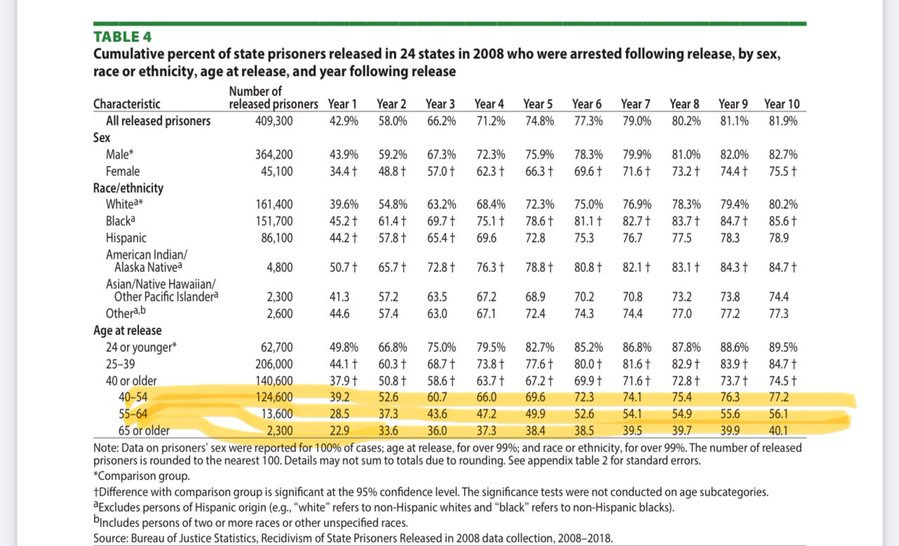
Inmates often commit more crimes after being released. According to the Bureau of Justice Statistics, 81.9% of all state prisoners released in 2008 were subsequently arrested by 2018, including 74.5% of those 40 or older at the time of their release. (See Bureau of Justice Statistics, Recidivism of Prisoners in 24 States Released in 2008: A 10-Year Follow-Up Period (2008-2018) (Sept. 2021), pg. 4, Table 4).
Even after a decade in prison, inmates are typically arrested again after being released. 57.5% of federal inmates imprisoned for violence for ten years or more were arrested yet again after being released, according to a 2022 report from the U.S. Sentencing Commission. (See Recidivism of Federal Violent Offenders Released in 2010, pg. 33 (Feb. 2022)).
Historically, Maryland had a higher crime rate than Virginia, which many observers attributed to its letting criminals out of prison sooner. In 2020, Maryland had a violent crime rate nearly twice Virginia’s. Observers attributed the higher crime in Maryland to its being softer on crime than Virginia — such as the the fact that “Virginia has stricter laws on the books” and “harsh sentences,” which are “a huge deterrent” to crime. “Criminals know if you commit crime in Virginia you might get whacked, while in Maryland, you might just get slapped on the wrist.” The differences in crime rates are especially large for offenses that Virginia punishes most severely compared to Maryland, like robbery. Maryland has a robbery rate more than three times Virginia’s robbery rate.
Think-tanks and law enforcement have long argued that Maryland’s crime rate was higher partly because it was softer on offenders than Virginia and gave criminals shorter sentences than Virginia. (See, e.g., Kevin Lewis, Why is Montgomery County’s violent crime rate twice as high as neighboring Fairfax County?, WJLA, Dec. 5, 2019; David D. Muhlhausen, Ph.D, ED120999: Crime in Two Counties, Heritage Foundation, Dec. 9, 1999).
Back when Virginia was tougher on crime compared to Maryland than it is today, the differences were even starker. In 2018, Maryland had an overall violent crime rate of 468.7 per 100,000 people, according to USA Today, compared to a violent crime rate of only 200 per 100,000 in Virginia. Maryland still has a much higher violent crime rate.
These “second look” bills would not require a judge to release all the inmates who seek release. But they would create a huge amount of work for judges ruling on inmates’ petitions for release, by making it unnecessarily complicated and time-consuming to rule on petitions for release, and by placing a cloud of uncertainty over some sensible rulings denying petitions.
The bills list 12 factors to be considered in deciding whether to release an inmate, most of which are the sort of factors inmate advocates cite for releasing inmates (such as the inmate’s growing “maturity” and whether the offender once had a “youth brain” but no longer does), and one of which (victim impact) typically weighs against release. The bill does not list most of the factors that justify a long sentence, such as the need to deter crimes and make the punishment fit the crime, although it does not explicitly bar judges from relying on such factors. The Supreme Court has said that deterrence, proportionality, and even retribution are all constitutionally valid reasons for punishment, but that does not mean a state has to rely on all such reasons in sentencing.
HB 853 and SB 634 would require judges to say how much weight they give each factor, even though the bills give them no guidance whatsoever about how much weight they actually should give each factor. The bills say that when a judge rules on an inmate’s petition for release, “the written explanation shall address each of the factors in subsection K and indicate the weight given to each factor.”
The bills would then let inmates appeal denials of their petition for release or resentencing, if “such decision was contrary to law.”
If an inmate believes that a judge gave too much weight to a factor in his decision, or that the judge misapplied any of the dozen factors, the inmate might file an appeal, and try to get the judge’s decision reversed. Inmates will likely do that when judges deny their petitions for release, even if there are factors that support the decision to deny their petition, and even if the inmate may still be dangerous.
Prosecutors will have to devote lots of valuable time responding to inmates’ petitions for release, and inmates’ appeals challenging the denial of their petitions. That will leave prosecutors with less time to prosecute dangerous criminals, and cost taxpayers a lot of money.
The bills’ requirement that judges “indicate the weight given to each factor” in ruling on an inmate’s petition for release, is not normal at all in judging. Virginia law is full of multi-factor tests, specifying multiple factors to consider in areas such as child custody and whether to award spousal support and how to distribute marital property, but judges need only consider and address the relevant factors, not specify the weight given to each.