
“India’s Parliament has passed a new law allowing private companies to build and operate nuclear reactors in the country, ending decades of tight state control over the industry,” notes The Doomslayer.
ABC News reports:
India’s Parliament approved new legislation Thursday that enables opening the tightly controlled civil nuclear power sector to private companies.
The government termed it a major policy shift to speed up clean energy expansion while the opposition political parties argued that it dilutes safety and liability safeguards.
The lower house of parliament passed the legislation Wednesday and the upper house on Thursday. It now needs the assent from the Indian president, which is a formality, to come into force.
The move carries global significance as India seeks to position itself as a major player in the next wave of nuclear energy, including with small modular reactors at a time many nations are reassessing nuclear power to meet climate targets and reduce dependence on fossil fuels.
Supporters argue the legislation marks a decisive break from decades of state dominance in nuclear energy.
In 2024, India doubled its solar-energy production capacity, but it is still setting up new coal power plants — coal power plants provide most of India’s electric power.
“Chinese scientists have used a molten-salt reactor to breed uranium from thorium for the first time. This process converts thorium—far more abundant on Earth than uranium—into a usable fuel, and could also make future reactors safer, cleaner, and more efficient.” The South China Morning Post reports that “An experimental reactor developed in the Gobi Desert by the Chinese Academy of Sciences’ Shanghai Institute of Applied Physics has achieved thorium-to-uranium fuel conversion, paving the way for an almost endless supply of nuclear energy.” Chinese researchers also hope to make nuclear power cheaper through a new process for extracting uranium from water.
This year, Belgium dropped its earlier plan to shut its nuclear plants. Worldwide nuclear energy production reached a record 2667 terawatt-hours in 2024, more than the previous annual record of 2660 terawatt-hours set in 2016. The Doomslayer notes that “over the past decade, almost all the growth in nuclear energy generation occurred in Asia—home to 59 of the 70 nuclear reactors currently under construction—while generation in Western Europe fell substantially.”
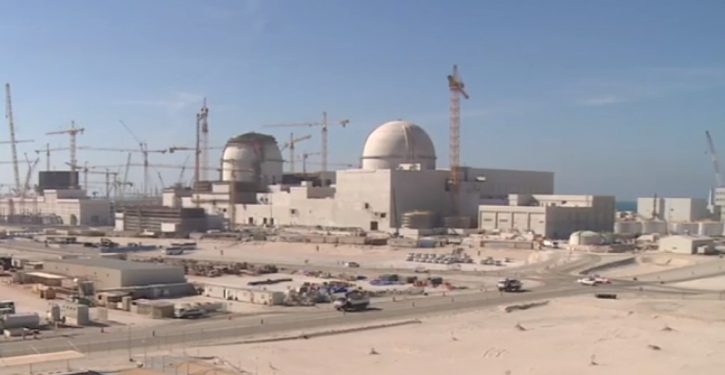
Despite having lots of oil, the United Arab Emirates (UAE) recently built four nuclear power reactors.
Nuclear power is already “the safest form of energy we have, if you consider deaths per megawatt of energy produced,” notes Yale University’s Steven Novella. “Wind turbines, surprisingly, kill more people than nuclear plants,” notes an environmentalist. And “solar panels require 17 times more materials in the form of cement, glass, concrete, and steel than do nuclear plants, and create over 200 times more waste,” such as “dust from toxic heavy metals including lead, cadmium, and chromium.”
Nuclear plants emit no air pollution, only harmless steam. Unlike wind farms, nuclear power plants don’t kill birds. The biggest utility that generates wind power pleaded guilty to federal crimes for killing 150 eagles.