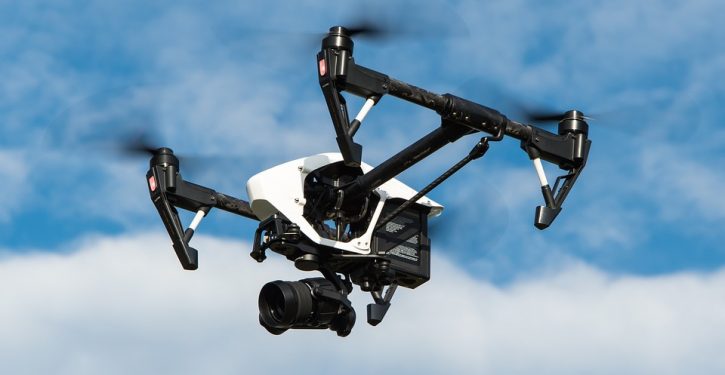
“Agricultural drones are spreading worldwide, especially across East and Southeast Asia. They’re mainly used to spray agrochemicals—a job that, in many poorer countries, is still carried out by hand,” reports The Doomslayer. Drones are common in Vietnam, even though Vietnam is much poorer than the United States — it has a per capita income of about $5,000, compared to over $70,000 in the U.S.:
We estimated the number of agricultural drones operating in some of the world’s leading agricultural countries by scouring online news and trade publications in many different languages. This effort revealed where agricultural drones have already taken off around the world.
Historically, most agricultural technology – tractors, for example – has spread from high-income countries to middle- and then lower-income ones over the course of many decades. Drones partially reversed and dramatically accelerated this pattern, diffusing first from East Asia to Southeast Asia, then to Latin America, and finally to North America and Europe. Their use in higher-income regions is more limited but is accelerating rapidly in the U.S.
China leads the world in agricultural drone manufacturing and adoption. In 2016, a Chinese company introduced the first agriculture-specific quadcopter model. There are now more than 250,000 agricultural drones reported to be in use there. Other middle-income countries have also been enthusiastic adopters. For instance, drones were used on 30% of Thailand’s farmland in 2023, up from almost none in 2019, mainly by spraying pesticides and spreading fertilizers.
In the U.S., the number of agricultural drones registered with the Federal Aviation Administration leaped from about 1,000 in January 2024 to around 5,500 in mid-2025. Industry reports suggest those numbers substantially underreport U.S. drone use because some owners seek to avoid the complex registration process. Agricultural drones in the U.S. are used mainly for spraying crops such as corn and soy, especially in areas that are difficult to reach with tractors or crop-dusting aircraft.
In countries such as China, Thailand and Vietnam, millions of smallholder farmers have upgraded from the dangerous and tiring job of applying agrochemicals by hand with backpack sprayers to using some of the most cutting-edge technology in the world, often using the same models that are popular in the U.S.
On some American farms, there are drones with artificial intelligence that spray fungicides to kill pests. As Bloomberg News notes, “These aerial acrobats use less than a tenth of the energy of ground tractors — and they don’t squash the crops, rut the earth or even touch the soil.”
Robots with artificial intelligence will reduce the need for weed-killer and pesticides by more precisely targeting weeds and pests. That will cut farmers’ costs, and radically reduce the size of the crop chemical industry, because robots will use up to 90% less spray to kill the same number of weeds and pests. Some robots using artificial intelligence can identify and kill 100,000 weeds per hour.
Walmart uses drones to deliver products to some customers. It recently expanded its use of drones to three more states.