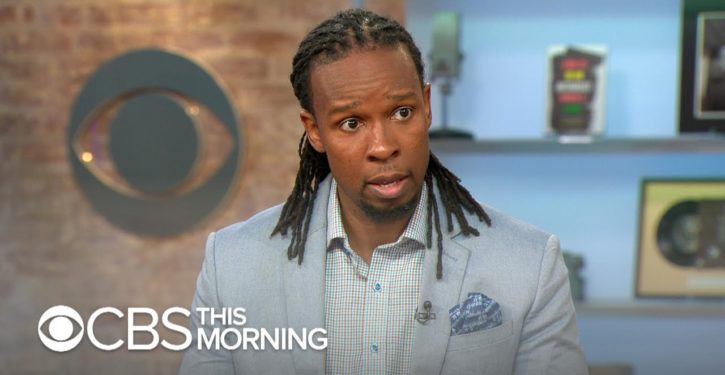
Howard University has appointed the racist crackpot Ibram X. Kendi as a history professor, and he “will serve as the inaugural holder of the Carter G. Woodson Endowed Chair in History, a position supported by $3 million in donor funding that honors its namesake historian, known as the ‘father of Black history’…In addition to his chair position, Kendi will direct the school’s new Institute for Advanced Study, which ‘is dedicated to interdisciplinary study advancing research of importance to the global African Diaspora, including inquiry into race, technology, racism, climate change, and disparities,'” reports Campus Reform.
Interim President Wayne A.I. Frederick said the appointment “affirms Howard University’s enduring responsibility to steward Black history with rigor, integrity, and purpose.”
Kendi supports racial discrimination against whites, and hates capitalism. “To love capitalism is to end up loving racism. To love racism is to end up loving capitalism…Capitalism is essentially racist; racism is essentially capitalist,” says Ibram X. Kendi’s best-selling book promoting race-based government policies, How to Be An Antiracist. The “key concept” in Ibram Kendi’s book How to Be an Antiracist was that discrimination against whites is the only way to achieve equality for black people: “The only remedy to past discrimination is present discrimination. The only remedy to present discrimination is future discrimination,” wrote Kendi in that book. Students in many school systems have been assigned a book by Kendi that is historically inaccurate. Kendi once wrote an op-ed suggesting that white people are aliens from outer space.
Previously, Kendi ran a center at Boston University that shut down after having produced virtually no academic output despite being showered with millions of dollars in funding, reported The College Fix: “For the last two years, representing 40 percent of his time there, the center did practically nothing, while Kendi wrote zero academic papers at least during the first three years he was there…..On a [2024] page titled ‘What We’re Working On,’ nothing is listed from this year. No policy reports or convenings have been published since 2022…[In 2024] The Antiracist Legal Education Project advertises an event from September 2023 as ‘upcoming,’ while the annual Antiracist Book Festival was not held in 2023 or 2024. A Vertex Symposium, which is also described as an annual event, has not occurred since 2022.”
As Campus Reform notes, “Before joining Howard, Kendi founded and led Boston University’s Center for Antiracist Research (CAR), which launched in 2020 following the death of George Floyd. The center aimed to promote policies and scholarship designed to build what Kendi described as an ‘antiracist society,’ but was shuttered by the university last June following reports of internal management issues and financial concerns…..Campus Reform reported on the closure and questions raised by staffers about the center’s operations, including former employee Yanique Redwood, who stated that employees felt ‘overwhelmed’ and that leadership made ‘too many promises’ to funders while delivering few tangible results.”
Kendi’s work has been criticized for being historically inaccurate:
As law professor David Bernstein notes, Kendi’s book Stamped contains a huge number of errors about historical facts. For example, Kendi falsely blames the conservative columnist Charles Krauthammer for the term crack baby, when it had been used by liberal newspapers such as the New York Times months earlier, and he falsely suggests that the term had a racist origin. Kendi claims that cop-killer Mumia Abu Jamal was a political prisoner, when Mumia was actually a murderer duly convicted by a jury after full due process.
Kendi peddles the baseless conspiracy theory that “the Bush administration directed FEMA to delay its response” to a devastating hurricane “in order to amplify the destructive reward for those who would benefit.” This claim has been debunked by people like former Democratic National Committee chairwoman Donna Brazile, who noted that the Bush administration sincerely tried to help the massive number of hurricane victims, and that the administration’s response became quite effective over time.
Kendi falsely claims that President Bush promoted “anti-Islamic” sentiments, when Bush actually said that Islam was a “religion of peace.” Kendi claims the bipartisan No Child Left Behind Law signed by President Bush and backed by Democratic leaders put the blame on black parents, and black teachers, for bad school performance, when the opposite was true: That law never blamed or singled out black teachers or parents, and sought to hold schools, not black parents, accountable for blacks passing standardized tests at lower rates than whites. In fact, as the Applied Research Center notes, the No Child Left Behind Law “was grounded” on the premise that “the achievement gap between children of color and white children (as well as between rich and poor) is not acceptable” and that “the educational system must be held accountable for closing this gap.”
Kendi also misrepresents what the Nation of Islam believes, omitting its racism; falsely claims that the 1964 Civil Rights Act caused a racist backlash; and implies black legislators were against the drug war when they weren’t — indeed, black legislators overwhelmingly voted to increase penalties for crack.
Kendi falsely claims that communist black activist Angela Davis rejected white influence when she was in fact a Communist Party member who faithfully followed the teachings of white communist leaders, and was influenced most heavily by the white communist Herbert Marcuse. He misleads readers about Davis in connection with a kidnapping and murder that was committed using guns she owned.
Kendi falsely claims that an anti-Trump scholar “rallied for Republicans” when he never did, and works for a non-partisan think-tank.
He also scapegoats white people for racial “disparities” they did not cause.
The “heroine” in Kendi’s book “is a notorious anti-Semite, Angela Davis,” notes Bernstein. “While Kendi disparages a host of American civil rights heroes, from Frederick Douglass to MLK as being too moderate, Davis is his odd choice as an antiracist exemplar. After a dubious acquittal from a charge of conspiracy to murder … she spent the most productive years of her career as an activist for the American Communist Party.” She disparaged jailed Jewish dissidents in the Soviet Union as “‘Zionist fascists and opponents of socialism’” who should “be kept in prison.”
Kendi’s books leave a false impression about people’s legal rights. His core teaching is that society needs to discriminate against whites to make up for past discrimination against blacks: “The only remedy to past discrimination is present discrimination. The only remedy to present discrimination is future discrimination.”
But that’s often illegal, because of its racism. For example, courts have ruled that it violates the Constitution and the Civil Rights Act to fire white teachers to “remedy” past discrimination or promote racial “diversity.” (See Wygant v. Jackson Board of Education (1986); Taxman v. Board of Education (1996)).
Kendi’s book wrongly claims that senator and 1964 presidential candidate’s Barry Goldwater’s opposition to federal spending was because it was going to black people for the first time (“This racist epiphany hit Goldwater once Black people were receiving government assistance, too.”). As Professor Bernstein notes, this is is untrue. There is no evidence that Goldwater’s views on government spending had anything to do with black people, and they reflect a longstanding American tradition of being in favor of limited government that has existed independently of whether black people were potential beneficiaries (or victims) of the government. Goldwater desegregated the Arizona National Guard before the national military was desegregated.
Kendi’s book claims that Nixon believed the segregationist approach was a good one. But it was Nixon’s education secretary, Robert Finch, who managed to desegregate many schools in the Deep South using the threat to cut off federal funds. Although Nixon personally harbored certain racial biases, it was his administration that first challenged white craft unions that excluded blacks (the Philadelphia Plan) and instituted the first major affirmative action programs, notes Professor Bernstein.