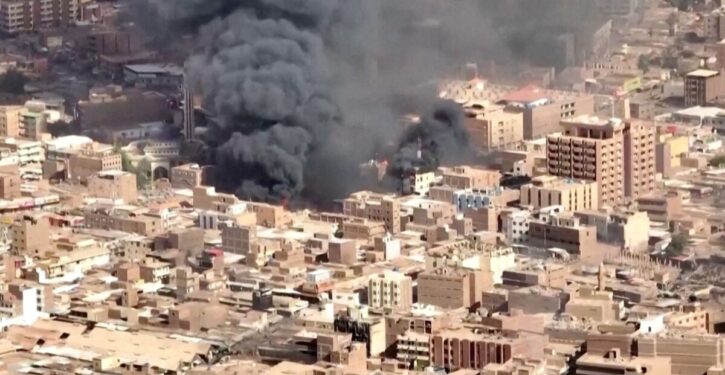
Seven million people once lived in and around the capital city of Sudan, Khartoum. But much of the population left due to widespread killing and looting.
First the city was looted by a violent militia, the Rapid Support Forces (RSF), that stole most of the city’s copper wiring, and seized inhabitants’ most valuable possessions. After the RSF was pushed out of the city by Sudan’s army, soldiers continued looting parts of the city, and stole whatever copper remained there:
widespread looting of factories continues in the industrial zone south of Khartoum….unnamed [soldiers are involved] in these violations….factories in the southern Khartoum industrial zone are still being subjected to armed robbery in broad daylight….the perpetrators hold military ranks and are seen loading looted goods from within the facilities.
the industrial sector is the most affected by the war…particularly industries in Khartoum and areas adjacent to the informal belts surrounding the capital….the industrial zone bordering the Mayo area in the “South Belt” has suffered the most. Originally planned as a hub for heavy industry, the zone houses iron smelting, electronics, and assembly plants built to modern standards over the last 15 years…approximately 450 factories in that area have been 100% looted. This includes raw materials, finished products, furniture, furnace fuel, vehicles, cash from safes, and heavy machinery.
The destruction has even extended to the factory structures themselves, with corrugated iron sheets and bricks being stripped. Concrete pillars have been smashed to extract rebar, turning factories into empty plots of land….the assault on the industrial sector has directly hindered the return of economic activity in Khartoum, Khartoum North (Bahri), and parts of Omdurman….Al-Sayed described the looting of Khartoum and Bahri’s electrical grid, specifically transformers, motors, and cables for copper extraction, as the “greatest economic crime” committed after the war. These practices have directly prevented the restoration of electricity and obstructed the resumption of industrial and production activities….
The looting operations involve a chain that starts with individuals stealing and burning components to extract copper, selling it by weight to small traders, who then pass it to larger dealers.
Because utilities can’t provide power due to the loss of copper wiring, some residents are using solar panels to power their light bulbs and TVs.
In Sudan, the Rapid Support Forces have committed genocide in the western Darfur region. Both they and their opponent — Sudan’s army — have routinely committed war crimes.
African countries often have unreliable power grids, and state-run electric utilities that are prone to blackouts and power outages. Citizens are now taking matters into their own hands by buying solar panels to power their TVs, light bulbs, and household appliances.
The most populous African country, Nigeria, “is importing record quantities of solar panels, which are helping its citizens cope with the country’s notoriously unreliable power grid,” reports The Doomslayer. Mini-grids made up of solar panels and batteries are being used to power some localities.
The Financial Times adds:
Imports of solar panels from China into Africa rose 60 per cent over the year to June, energy consultancy Ember estimates, with coal-heavy South Africa leading the way.
Nigeria has become the second-biggest importer in the past year by overtaking Egypt, with imports of 1.7 gigawatts of solar panels. It still lags behind nations with a similarly large population, such as Pakistan, which imported an estimated 17GW of solar panels last year, showing the room for growth.
‘It is a response to a problem . . . You can’t rely on a 24/7 grid in most parts of Nigeria at the moment,’ said Ashvin Dayal, senior vice-president of power at Rockefeller Foundation, which backed the mini-grid project….
Wealthier households, fed up with the country’s regular blackouts, have been the first to rush to install solar panels. “Practically anyone who can afford it has solar panels on their roofs right now in Nigeria,” said Muhammad Wakil at the Global Energy Alliance for People and Planet.
After a military coup in Niger — Nigeria’s northern neighbor — sanctions imposed on the country made it harder for the country’s inefficient electric utility to provide enough power. So residents of Niger’s capital city, Niamey, bought cheap Chinese solar panels and used them to power their light bulbs and TVs.
“Privately owned solar panels are taking over from the dysfunctional state utility in Niger, offering relief from frequent power shortages,” reported The Doomslayer. Niger is one of the five most backward nations on Earth, according to the Human Development Index. Its capital, Niamey, is the second hottest and third sunniest major capital city on Earth. With 3,066 sunshine hours per year, Niger’s capital city gets about twice as much sunshine as European cities like London, Berlin, and Brussels. So solar power is much more practical in Niger than in much of Europe. Parts of Nigeria are also very sunny: Kano, the chief city in Nigeria’s north, gets about 3100 hours of sunshine per year.