
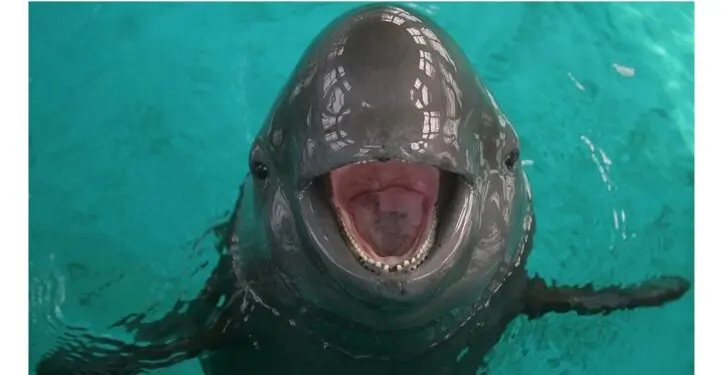
“China’s endangered Yangtze finless porpoise is recovering…The population is now estimated at 1,426 porpoises, up from 1,012 in 2017,” reports The Doomslayer.
China Daily says:
The population of the Yangtze finless porpoise, the only freshwater porpoise species in China’s longest river, has risen to 1,426 in 2025, indicating that the fishing ban and other conservation efforts are reviving the ecosystem of the Yangtze River.
The figure…shows an increase of 177 individuals from the previous assessment in 2022 and represents a continued recovery since the decade-long fishing ban launched in 2021…Once numbering about 2,700 in the early 1990s, the flagship species of the Yangtze River fell to just 1,012 by 2017 due to human activities….
Apart from the wild population, China has built a network of five conservation zones to protect porpoises relocated from severely degraded habitats. These protected waters now support more than 150 individuals, with more than 10 calves born annually, laying the foundation for replenishing wild populations in the future.
Meanwhile, researchers from the Chinese Academy of Sciences’ Institute of Hydrobiology have established a freshwater cetacean sperm bank, providing technical support for overcoming breeding challenges.
Commercial fishing was banned in the Yangtze River and its major tributaries, beginning January 1, 2021, to counteract 70 years of biodiversity decline.
The Yangtze River is the longest river in Asia, running 3,915 miles entirely within China, from the high-altitude Tibetan Plateau to the East China Sea. The Yangtze River basin is believed to be where rice cultivation originated in Asia, more than 10,000 years ago.
In 2025, 351 fish species were found across Yangtze River basin, 43 more than in 2020. The Chinese high fin banded shark, absent for more than 20 years, was found to be reproducing in the Yangtze in 2024 and 2025.
Snub-nosed monkeys are also making a comeback in China.
A giant fish believed to be extinct was found in the Mekong River, a 2,700 mile long river in Asia that flows from the Tibetan highlands to southern Vietnam.
The extinction rate is falling as fewer species are becoming extinct annually.
Bison have made a comeback in Europe. “In the 1920s, there were just 54 European bison, all in captive areas, after intense hunting over millennia, but thanks to rewilding efforts there are now around 10,000″ bison in Europe, “mostly in Russia and Belarus.”