
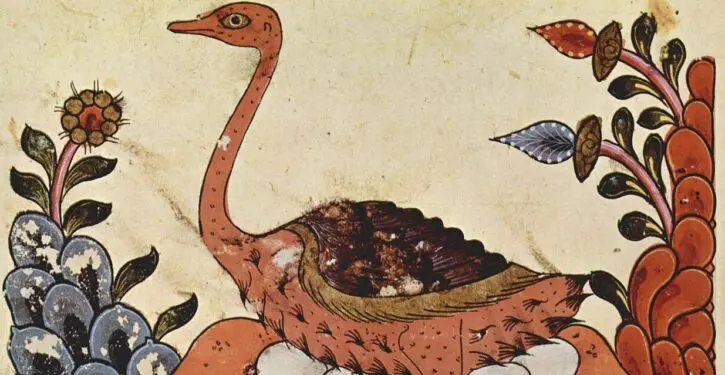
“Saudi Arabia’s Royal Natural Reserve is now home to endangered red-necked ostriches, a close relative of the native Arabian ostrich, which was driven to extinction in the early 20th century. The ostrich is the twelfth creature to be reintroduced to the reserve as part of a plan to reestablish 23 species in the country,” reports The Doomslayer.
Smithsonian Magazine explains:
Five red-necked ostriches have been released in a nature reserve in Saudi Arabia as part of an ambitious plan to ‘rewild’ the region.
In December, conservationists announced the release of the tall, leggy birds into Prince Mohammed bin Salman Royal Reserve, a 9,460-square-mile protected area in the northwest part of the country.
Red-necked ostriches, also known as North African or Barbary ostriches, are meant to serve as a biological replacement for Arabian ostriches, which used to inhabit the region but went extinct in 1941 because of overhunting and habitat loss. The wiped-out subspecies’ closest living relative is the red-necked ostrich, which has biological features that aid its survival in a harsh desert environment.
But red-necked ostriches are also on the brink of extinction, with fewer than 1,000 birds remaining in scattered pockets across Africa’s semi-arid region in the central north, per the announcement. Some experts consider the subspecies to be critically endangered. Biologists hope members of the recently introduced population will reproduce and help bolster the birds’ numbers.
The ostriches mark the 12th species to be reintroduced to the nature reserve, along with Arabian oryx, Persian onager, sand gazelle and mountain gazelle. Conservationists hope to eventually bring back a total of 23 historically occurring native species as part of a broader, long-term ecosystem restoration plan. The reserve is partnering on the initiative with the National Center for Wildlife, as well as Imam Turki bin Abdullah Royal Nature Reserve, Imam Saud bin Abdulaziz Royal Reserve, Aramco, NEOM and AlUla.
The extinction rate is falling as fewer species are becoming extinct annually.
Scientists recently found a coral they thought was extinct.
A rare flightless grasshopper was recently found in Virginia, where such grasshoppers had not been seen for 79 years.
Brazil’s rarest parrots have made a comeback, avoiding extinction.
Snub-nosed monkeys are making a comeback in China.
Amur leopards are making a comeback in Russia’s Far East, multiplying five-fold.