
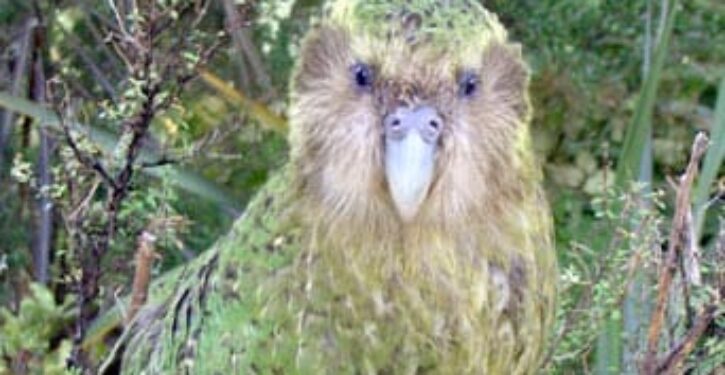
“The Kākāpō, a critically endangered, flightless, owl-faced parrot from New Zealand, is expected to have a very fruitful mating season this year,” reports The Doomslayer.
The Guardian adds:
Kākāpō, the world’s only nocturnal and flightless parrot, were once abundant across New Zealand. But their population plummeted after the introduction of predators such as cats and stoats, and by the 1900s they were nearly extinct.
A recovery program established in 1995 rebuilt the population from 51 to 236 birds, including 83 breeding-age females.
Kākāpō breed only every two to four years when the native rimu trees “mast” and produce large numbers of berries, so repopulation is slow.
This year a ‘mega-mast’ is expected, resulting in a bountiful harvest of rimu berries, which could prompt the birds to produce more eggs.
Deidre Vercoe, the Department of Conservation’s operations manager for kākāpō recovery, said it was an exciting moment for her team…
“I never like to count our chickens before they hatch, but we’re really hopeful that the majority of the females breed and we will get some good numbers of chicks through.”
An endangered flat-headed cat was recently discovered.
A rare flightless grasshopper was recently found in Virginia, where such grasshoppers had not been seen for 79 years.
Bison have made a comeback in Europe. “In the 1920s, there were just 54 European bison, all in captive areas, after intense hunting over millennia, but thanks to rewilding efforts there are now around 10,000″ bison in Europe, “mostly in Russia and Belarus.”
Snub-nosed monkeys are making a comeback in China.
Mountain gorillas are making a comeback in the African country of Rwanda.
The critically-endangered Siberian crane is growing more numerous.