
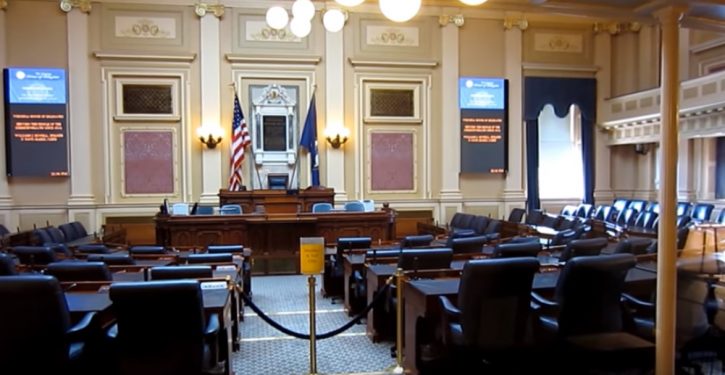
Does any other state do this? Let progressive legislators — rather than the governor — pick most of the members of its parole board? That’s what Virginia is about to do.
On January 23, a Virginia Senate committee voted to do just that. It approved a bill, SB60, to expand parole for juvenile offenders. The bill was amended to give two progressive legislators the ability to pick 6 of the 11 members of the Virginia Parole Board, expanding the parole board by 6 members. (4 members of the parole board must vote to release any offender serving life without parole, so expanding the parole board to 11 members makes it much easier to release murderers and other inmates serving a life sentence).
Under current law, the Virginia Parole Board has 5 members, all of whom are appointed by the governor, and confirmed by the legislature.
Parole board members picked by a governor are less likely to release dangerous inmates than parole board members picked by a progressive legislator. Virginia Governor Abigail Spanberger represents swing voters who could turn against her if her appointees to the parole board release dangerous inmates. So her appointees are unlikely to empty the state’s prisons or release high-risk inmates. If they did, she would be blamed, and so would they. (She can fire her own appointees to the parole board). Spanberger has been floated as a future possible presidential candidate, and may wish to become president or a U.S. senator. To win a statewide election in Virginia, Spanberger needs votes from independents and moderates, not just Democrats or progressives.
By contrast, the two legislators who will have the ability to pick 6 of the 11 members of the parole board represent very safe Democratic districts, and could win a general election even if their appointees to the parole board released many high-risk inmates with long rap sheets and a history of committing violent crimes like murder.
The bill, SB 60, gives the Speaker of the House of Delegates (Don Scott) the right to pick three of the expanded parole board’s 11 members, and gives the Chair of the Senate Committee on Rules, Mamie Locke, the right to pick three. The governor would pick the remaining 5, subject to legislative approval. The House Speaker, Don Scott, served seven years in prison as a young man, and seems very enthusiastic about releasing lots of inmates. In 2020, he proposed a bill, HB 431, that would compel the parole board to release all inmates 65 or over who had served at least 5 years, regardless of whether they had committed murder or were still dangerous. That bill failed even in a Democratic legislature.
SB 60 provides that
There shall be a Virginia Parole Board (the Board) that shall consist of up to five at least 11 members, five of whom shall be appointed by the Governor and within 60 days of inauguration, three of whom shall be appointed by the Speaker of the House of Delegates within 60 days of a new House being sworn in during a Senate election year, and three of whom shall be appointed by the Chair of the Senate Committee on Rules within 60 days of a new Senate being sworn in after an election…
The text in italics is a change from current law.
House Speaker Don Scott, who would pick three of the 11 members, represents a district that the Democrats usually carry by at least a 2-to-1 margin in state and federal elections. Senator Mamie Locke, who would pick another three of the 11 members, represents a district that Democrats usually carry by more than a 2-to-1 margin in state and federal elections. So they have no need to appeal to independent or conservative voters by keeping all dangerous inmates locked up. These progressive legislators’ six appointees to the parole board could release a dangerous inmate even if all of Governor Spanberger’s appointees voted against paroling that inmate.
Right now, only juvenile offenders are typically eligible for parole in Virginia, but another pending bill, SB 222, would expand parole to offenders (including serial killers and serial rapists) who committed their crime below age 21. It has not been approved yet, but the Virginia Senate’s Rehabilitation Committee will likely vote on it soon. So the changes in the parole board will likely affect a much larger fraction of Virginia’s inmate population in the future. The parole board also votes on whether to release inmates over the age of 60 who have served at least ten years in prison, by giving them a geriatric release.
SB 60 would also stack the deck in favor of parole, even when an inmate is dangerous, by providing that “The Board shall not deny parole for a juvenile offender based principally on factors outside of his demonstrated ability to change, such as the nature of the offense or any effects resulting from the commission of such offense.”
So even if “the nature of the offense” suggests an offender is unusually dangerous — such as the offender being a serial killer or serial rapist — SB 60 says the parole board cannot deny parole “principally” based on that. Even though a serial killer may have a strong compulsion to kill people. If the inmate has a sadistic personality disorder, that may be a factor outside his “ability to change,” and thus might be impermissible for the parole board to consider as a principal factor in denying parole, based on the way SB 60 is written. Even though such a disorder would make the inmate more dangerous and inappropriate to release. Even if the offender had the ability to change to become less dangerous, and did not do so, SB 60 might preclude the parole board from taking that failure into account as a primary reason for denying parole, if such ability to change was not “demonstrated” by the parole board.
Taking the nature of the offense into account makes sense. Even under Democratic governors such as Ralph Northam, the parole board has taken the nature of the offense into account as a factor. For example, the Northam-era parole board would sometimes deny parole based on its conclusion that given the gravity of the inmate’s crime, he should have to wait longer to be paroled. The parole board did not typically release inmates when they first became eligible for parole. Often, they had to wait years longer, even when they did not exhibit menacing or disruptive behavior in prison. For example, Jens Söring was paroled only after serving over 33 years for murdering his girlfriend’s parents.
Letting inmates out of prison is not risk-free. About 62% of state prison inmates are there for violent crimes. Most prison inmates are repeat offenders: Rafael Mangual of the Manhattan Institute says the typical state prison inmate has 5 prior convictions.
Large-scale prison releases increase the crime rate, according to a 2014 study. (See Alessandro Barbarino & Giovanni Mastrobuono, the Incapacitation Effect of Incarceration from Several Italian Collective Pardons, American Economic Journal, Vol. 6, No. 1, pp. 1-37 (2014)).
Criminals often commit more crimes after being released. Nationally, 81.9% of all state prisoners released in 2008 were subsequently arrested within a decade, including 74.5% of those 40 or older at the time of their release. (See Bureau of Justice Statistics, Recidivism of Prisoners in 24 States Released in 2008: A 10-Year Follow-Up Period (2008-2018), pg. 4, Table 4)).
Inmates who have spent many years in prison are less likely to commit crimes upon being released, but their recidivism rates are still substantial. 57.5% of federal inmates imprisoned for violence for ten years or more were arrested again within 8 years after being released, according to the U.S. Sentencing Commission. (See Recidivism of Federal Violent Offenders Released in 2010, pg. 33 (Feb. 2022)).