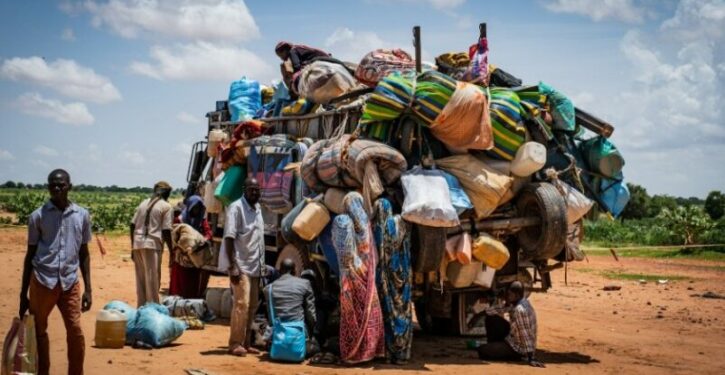
Chad is an African country so backward that people refer to it as the “dead heart of Africa.” Only 4% of the population has access to electric power from the grid. Even for those who have it, electric power is unreliable, in a country so remote and vulnerable to disasters that floods have cut off the internet for weeks at a time.
But now, Chad has hope, as Africa rapidly imports solar panels to provide off-grid power and transform people’s lives.
“Africa’s energy transformation is happening fast! In just 12 months, the continent imported 15GW of solar panels, a 60% increase from the previous year.”
“Chad is scaling up off-grid electricity access under a World Bank-backed program that is distributing 145,000 subsidized solar home kits nationwide as part of efforts to expand clean energy access and support livelihoods.”
The program “aims to rapidly increase electricity access across the country’s 23 provinces. Each solar kit, valued at $100, is sold to households for $20, providing basic home lighting and phone-charging services.”
It is estimated that the program will provide electricity to six million people, including in remote rural areas where there is no power from the grid.
In the Bébalem market in southwestern Chad, shopkeeper Denis Tarlembaye said access to solar lighting let him extend his trading hours and grow his income. “Since I acquired this kit, I stay longer at the market. This allows me to increase sales. Instead of an average” of $33 per day, “I make between” $50 and $58, he said.
Ferdinand Djeguemde, who runs a pharmacy, described how improved lighting let him serve more customers, including urgent cases, after dark.
At the Loumba Assonghor school in eastern Chad, school director Adjinei Mehram said solar power has radically improved learning conditions in an area where less than a fifth of the population can read or write. “The installation of an autonomous solar system enables students to learn in classrooms that are both ventilated and well-lit. The students even have the opportunity to come back in the evenings to review lessons thanks to the light.”
The most populous African country, Nigeria, “is importing record quantities of solar panels, which are helping its citizens cope with the country’s notoriously unreliable power grid,” reports The Doomslayer. Mini-grids made up of solar panels and batteries are being used to power some localities.
After a military coup in Niger — Nigeria’s northern neighbor — sanctions imposed on the country made it harder for the country’s inefficient electric utility to provide enough power. So residents of Niger’s capital city, Niamey, bought cheap Chinese solar panels and used them to power their light bulbs and TVs.
“Privately owned solar panels are taking over from the dysfunctional state utility in Niger, offering relief from frequent power shortages,” reported The Doomslayer. Like Chad, Niger is one of the five most backward nations on Earth, according to the Human Development Index. Its capital, Niamey, is the second hottest and third sunniest major capital city on Earth. With 3,200 sunshine hours per year, the capital cities of Niger and Chad get about twice as much sunshine as European cities like London, Berlin, and Brussels. So solar power is much more practical in Niger and Chad than in much of Europe. Parts of Nigeria are also very sunny: Kano, the chief city in Nigeria’s north, gets about 3100 hours of sunshine per year.
A violent militia occupied the great desert city of Khartoum (the capital of Sudan) and stole most of its electric cables, making it impossible for residents and businesses to obtain electric power from the electric power company. So some residents bought imported Chinese solar panels and used them to power their electric lights and TVs.