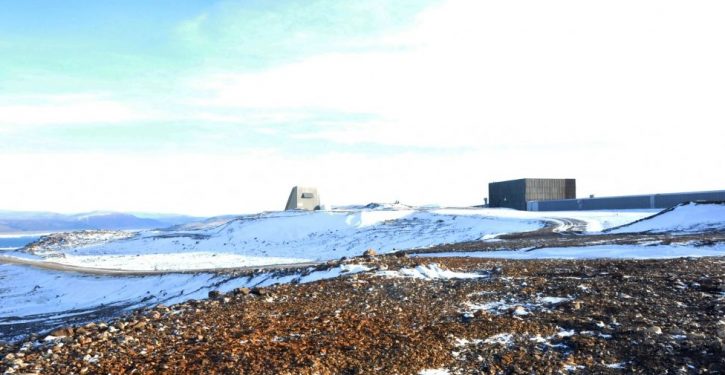
Most of the minerals in Greenland are too costly to access, even with advances in mining, because of how remote and icy Greenland is. “The idea of turning Greenland into America’s rare-earth factory is science fiction. It’s just completely bonkers,” said Malte Humpert, founder and senior fellow at The Arctic Institute. “You might as well mine on the moon.”
Defenders of President Trump’s push to acquire Greenland have cited the presence of minerals in Greenland as a reason to acquire Greenland. But experts see little potential profit in Greenland, compared to other places like Alaska and Siberia that had far more oil, and are not covered by ice (unlike Greenland, which is mostly covered by a thick ice cap). Yet Trump administration officials have mulled paying between $5.7 billion and $57 billion to acquire Greenland ($10,000 to $100,000 for each of the 57,000 people in Greenland). $57 billion would be far more than Greenland is worth. Indeed, Greenland would likely cost the U.S. more to administer than it would make from Greenland.
As CNN notes, even Trump has finally recognized the difficulty of accessing most of Greenland’s minerals: Recently, Trump “downplayed Greenland’s natural resources, including in his speech to the World Economic Forum in Davos, Switzerland, Wednesday, when he said acquiring rare-earth minerals wasn’t the reason America needed the territory.”
“Everyone talks about the minerals. There’s so many,” Trump said. But “to get to this rare earth, you got to go through hundreds of feet of ice. That’s not the reason we need it. We need it for strategic national security and international security.”
That was a departure from earlier, when former national security adviser Mike Waltz said Trump’s focus on Greenland was “about critical minerals” and “natural resources.”
As CNN notes,
The reality is that Denmark’s ownership of Greenland is not what’s stopping the United States from tapping the island’s treasure trove. It’s the punishing Arctic environment.
Researchers say it would be extremely difficult and expensive to extract Greenland’s minerals because many of the island’s mineral deposits are located in remote areas above the Arctic Circle, where there is a mile-thick polar ice sheet and darkness reigns much of the year….
Despite its name, approximately 80% of Greenland is covered with ice. And mineral extraction — or just about anything — in the Arctic can be five to 10 times more expensive than doing it elsewhere on the planet….
For years, if not decades, officials in Greenland have courted foreign direct investment. People in Greenland say they already are open to business opportunities without any belligerence.
Getting US businesses to take a chance on Greenland may be a fantasy, experts say.
“If there was a ‘pot of gold’ waiting at the end of the rainbow in Greenland, private businesses would have gone there already,” said Jacob Funk Kirkegaard, nonresident senior fellow at the Peterson Institute for International Economics…Funk Kirkegaard, who previously worked with the Danish Ministry of Defense, said it’s just “very difficult” to make a business case for the very large upfront investment that would be required.
Greenland is a costly white elephant that costs Denmark far more to maintain than it gets from Greenland in tax revenue.
Trump’s claim that “we need” Greenland “for national security” is odd, because we don’t need to acquire Greenland to put American bases or troops there. Denmark historically allowed the U.S. to operate as many bases on Greenland as it wanted.
The U.S. closed most of its bases on Greenland over the years because a U.S. presence on most of Greenland is so unnecessary. Denmark let the U.S. put bases wherever it wanted, but after the end of the Cold War, the U.S. realized it didn’t need most of its bases anymore.
As the New York Times notes,
Under a little-known Cold War agreement, the United States already enjoys sweeping military access in Greenland. Right now, the United States has one base in a very remote corner of the island. But the agreement allows it to “construct, install, maintain, and operate” military bases across Greenland, “house personnel” and “control landings, takeoffs, anchorages, moorings, movements, and operation of ships, aircraft, and waterborne craft.”
It was signed in 1951 by the United States and Denmark, which colonized Greenland more than 300 years ago and still controls some of its affairs.
“The U.S. has such a free hand in Greenland that it can pretty much do what it wants,” said Mikkel Runge Olesen, a researcher at the Danish Institute for International Studies in Copenhagen.
“I have a very hard time seeing that the U.S. couldn’t get pretty much everything it wanted,” he said, adding, “if it just asked nicely.”
Under 2 treaties with Denmark — in 1916 and 1951 — the United States agreed to recognize Denmark’s sovereignty over Greenland. When Trump demanded Greenland from Denmark, that showed a lack of respect for those treaties, and for our NATO ally, Denmark. 43 Danish soldiers died fighting on America’s side in Afghanistan.
Most Americans do not want the U.S. to acquire Greenland. And 85% of Greenlanders oppose becoming part of the United States.
Running Greenland costs money. Denmark recently helped finance three new airports in Greenland costing $800 million. It has spent billions and billions of dollars on Greenland, for little in return. Greenland is too cold and remote to profitably mine most of its minerals (although Greenland welcomes U.S. investment and Australians and others are involved in Greenland’s mining sector).
Greenland is mostly covered by ice and has fewer than 57,000 people. Most of Greenland is uninhabitable because it is covered by a massive ice sheet.
As a hedge fund investor notes, Greeland’s minerals are mostly inaccessible:
People are hallucinating on Greenland’s mineral wealth. Exploring and mining in the Arctic is a literal hellscape. The constraints are insane and the costs to overcome ’em are way past imagination.
Geologically, permafrost is a nightmare. Ground’s frozen solid—normal drilling hits a wall. Building stable foundations for gear is a massive money pit. Operations are cooked too.
Constant darkness for months in winter. Working 24/7 under floodlights craters efficiency and spikes accident risk. At -40°C to -50°C, metal gets brittle and just snaps.
You need custom alloy gear, and keeping fuel/lube from freezing is a constant battle. The diesel/power burn just to keep lights on and engines warm is eye-watering. Immediate Opex blow-up. Logistics? Absolute disaster. It’s not about digging it out; it’s about moving it.
Zero roads or rails. Everything moves by heli, light plane, or ship. Moving ore to a port costs multiples of what normal mines pay. Plus, zero local smelters.
You gotta ship it across oceans, burning time and cash. Shipping windows are tiny. Some coasts are only accessible a few months a year. You either pay for icebreakers or pray the 1-year supply/export window doesn’t get wrecked by bad weather. If the ship misses the slot, the whole year is a wash. Look at the Citronen Fjord Zn project at 83°N. It’s one of the world’s biggest undeveloped Zn-Pb deposits, but it’s 2,100km north of Nuuk. Total isolation. They get a 3-month window to move a year’s worth of cargo.
One bad storm and the project is bricked for the season. Ironbark Zinc tried for ages, but it just got flipped to Dubai-based Almeera Ventures. That’s a clear signal on how brutal the Capex and funding hurdles are.
The core issue: does the margin even justify the risk? Building a mine w/ zero infra is a Capex black hole. Think global warming helps? Think again. Thawing permafrost is actually trashing existing infra and roads. Extreme weather just jacks up Opex even more. We’re talking 10-15 years from discovery to first ore. If commodity prices crater in between, you’re left holding a stranded asset. This is the reality of mining. Arctic development is 10x harder than you think.