
A progressive Virginia legislator apparently thinks the parole board isn’t releasing enough inmates. So he has introduced a bill, HB318, that would let progressive legislators, rather than the governor, pick many of the parole board’s members. His bill would also make it much easier to parole inmates serving life sentences — which could result in the release of many killers — and hard not to parole inmates who committed crimes as juveniles, if their continuing dangerousness is due to “the nature of the offense” they committed or other factors beyond their “demonstrated ability to control.”
Right now, the Virginia Parole Board has five members, all picked by the governor and confirmed by the General Assembly. Delegate Patrick Hope’s HB318 would expand the parole board to 10 members, and let individual legislators pick 5 of them. “Three of” those five would “be appointed by the Speaker of the House of Delegates,” and “two of” them would “be appointed by the Chair of the Senate Committee on Rules.” (The Speaker of the House is Don Scott, who in 2020 proposed a failed bill that would have required the release of many inmates based on their age, leaving the parole board with no discretion to block their release even if they were still dangerous).
Letting individual legislators pick members of the parole board is a radical departure from existing Virginia law. As the Virginia Mercury notes, right now, the governor appoints the members of “Virginia’s governing boards and commissions. Virginia law gives governors the power to appoint people to these groups, and remove them.” HB 318 would eliminate the governor’s ability to remove members of the parole board, crossing out existing statutory language stating that the “members of the Board shall serve at the pleasure of the Governor.” That would reduce their political accountability, which could be a constitutional separation of powers violation. Under the Supreme Court’s ruling in Myers v. United States (1926), the president has the right to fire most high-ranking executive branch officials without cause, although not (for the time being) the ability to fire members of independent boards and commissions without cause (the Supreme Court is currently considering whether to overturn its 1935 ruling that members of independent agencies can’t be fired without cause).
Under the federal constitution, giving individual legislators the ability to pick members of a powerful board would be unconstitutional. Giving them that power would violate both the constitutional separation of powers — by mixing legislative and executive functions and aggrandizing the legislative branch at the expense of the executive — and also violate the federal constitution’s Appointments Clause, which lets the President appoint important federal officials, like the members of the Federal Election Commission or the Securities and Exchange Commission.
In Buckley v. Valeo (1976), the Supreme Court struck down the system by which members of Congress directly appointed Federal Election Commission commissioners. The Supreme Court ruled that only the President could pick members of a board or commission who have “substantial powers” as opposed to merely “investigative and informative” functions. “Legislative power, as distinguished from executive power, is the authority to make laws, but not to enforce them or appoint the agents charged with the duty of such enforcement. The latter are executive functions,” the Supreme Court said.
Later, a federal appeals court ruled that “Congress exceeded its legislative authority” and violated the separation of powers “when it placed its agents, the Secretary of the Senate and the Clerk of the House of Representatives, on [an] independent Commission as non-voting ex officio members.” (See Federal Election Commission v. National Rifle Association Political Victory Fund, 6 F.3d 821 (D.C. Cir. 1993)).
Having the legislature pick the members of the parole board — which has “substantial powers,” not just an advisory or “informative” role like some Virginia boards and commissions — seems similarly at odds with separation of powers principles. Like the federal constitution, the Virginia state constitution has a separation of powers provision, Article III, Section 1.
On the other hand, HB 318 might not violate the Virginia constitution’s Appointments Clause (Article V, Section 10), even though it generally gives the governor, not the legislature, the power to appoint state officials. The Virginia Appointments Clause is phrased differently than the federal constitution’s Appointments Clause (in Article II, Section 2, Clause 2). I don’t know whether the state Appointments Clause even applies to a multi-member body like a parole board, since the state constitution refers to “the head” of a division or department. The Virginia state constitution’s Appointments Clause says that “‘Except as may be otherwise provided in this Constitution, the Governor shall appoint each officer serving as the head of an administrative department or division of the executive branch of the government.” By contrast, the federal appointments clause treats the members of multi-member agencies as collectively the “Heads of Department” of their agency, according to the Supreme Court. (see Free Enterprise Fund v. PCAOB (2010)). The federal Appointments Clause gives the President, or “Heads of Departments”, respectively the ability to appoint “Officers of the United States.”
HB 318 would make it much easier to parole murderers and others serving life sentences. Under current law, four members of the parole board have to vote to release an inmate serving a life sentence. (See Va. Code § 53.1-134.1). That means a lot when there are only five parole board members — almost everyone on the parole board has to agree that an inmate is no longer dangerous. But requiring four votes to parole an inmate means nothing when there are ten parole board members. Under HB 318, many parole board members could view an inmate as dangerous, yet the inmate could still be released with the support of a few parole board members.
That problem is radically worsened by another provision of HB 318. It also bars the parole board from denying parole based on “the nature of the offense” committed by a juvenile offender, even if the inmate is a serial killer and rapist whose offense demonstrates a deep-seated compulsion to kill and rape, and a psychological inability to change his dangerousness to the community. For example, the bill states, “The Board shall not deny parole for a juvenile offender based on factors outside of his demonstrated ability to change, such as the nature of the offense or any effects resulting from the commission of such offense.” How do you “demonstrate” that a serial killer has the “ability to change” his compulsive desire to kill people? Why does his lack of “demonstrated ability to change” his dangerousness justify his release?
An inmate’s dangerousness is sometimes revealed by “the nature of the offense,” like when the inmate is a serial killer, who killed again and again after previously being released from prison. A classic example is Kenneth McDuff. At the age of 19, after being paroled, McDuff and an accomplice kidnapped three teenagers. He shot and killed two boys, then killed a girl after raping and torturing her. Later, after being paroled yet again, he murdered as many as 15 additional women.
To keep such killings from happening, a parole board needs to take into account “the nature of the offense” as one of many factors, in order to avoid releasing dangerous inmates. But HB318 would keep parole boards from taking that into account.
Juvenile offenders spend years in prison before being eligible for parole, so people may assume they have aged out of crime. But many inmates haven’t.
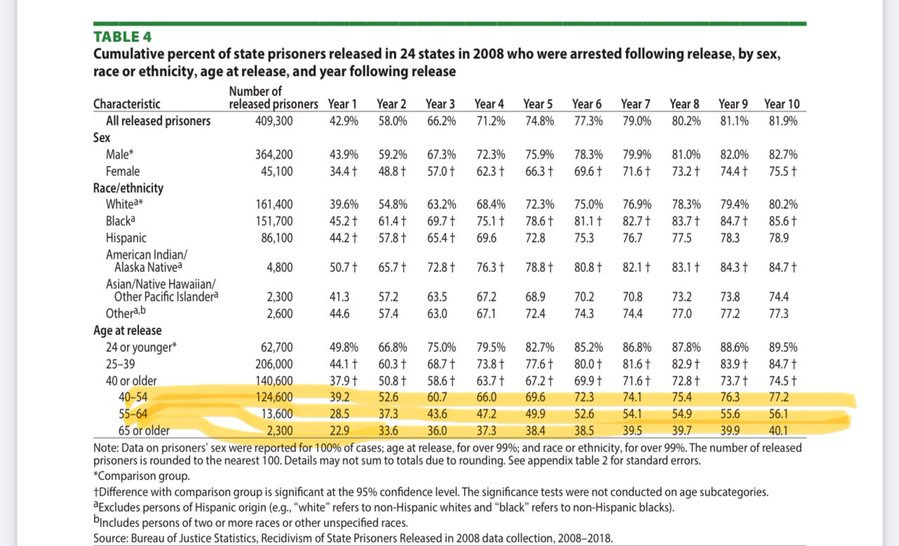
Most inmates commit more crimes after being released, even when they have already served over ten years in prison. 57.5% of federal inmates imprisoned for violence for ten years or more were arrested yet again after being released, according to a 2022 report from the U.S. Sentencing Commission. (See Recidivism of Federal Violent Offenders Released in 2010, pg. 33 (Feb. 2022)). Nationally, 81.9% of all state prisoners released in 2008 were subsequently arrested within a decade, including 74.5% of those 40 or older at the time of their release and 56.1% of those age 55 or over at the time of their release. (See Bureau of Justice Statistics, Recidivism of Prisoners in 24 States Released in 2008: A 10-Year Follow-Up Period (2008-2018), pg. 4, Table 4)).
These arrest figures understate the crime rate among released inmates, because most crimes never even lead to an arrest: the FBI says only 45.5% of violent crimes were cleared in 2019, and only 17.2% of property crimes.
NOTE: The Virginia legislature is subject to the state constitution’s separation of powers provision, but not the federal constitution’s separation of powers provision.