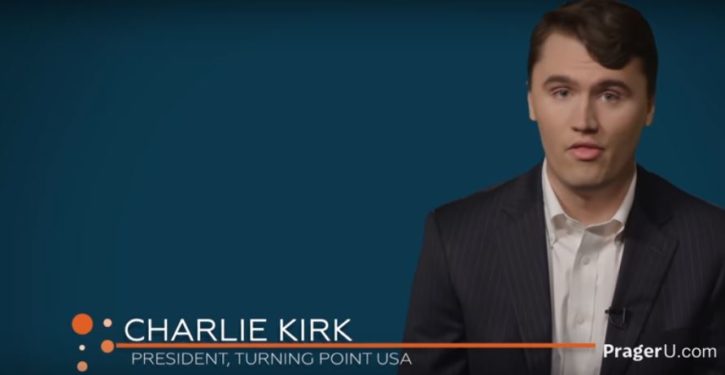
Violating free-speech rights can be costly for a public employer. “Darren Michael, associate professor at Austin Peay State University, has reportedly been reinstated and given $500,000 after being fired over posts about assassinated conservative activist Charlie Kirk,” reports Mediaite:
Tennessee’s WKRN News 2 obtained a copy of a settlement agreement between Michael and the university, showing the school will dish out $500,000 and reimburse “therapeutic counseling services.”
“APSU agrees to issue a statement acknowledging regret for not following the tenure termination process in connection with the Dispute,” the settlement reportedly reads. “The statement will be distributed via email through APSU’s reasonable communication channels to faculty, staff, and students.”
The university confirmed to WZTV in Nashville that Michael returned to his faculty position at the end of December.
Michael was fired on Sept. 12 (two days after the assassination of Kirk) after social media posts about Kirk spread far and wide on social media….
“Charlie Kirk says gun deaths are ‘unfortunately’ worth it to keep 2nd Amendment,” read the headline of an article Michael shared. He did not add any additional comment on it.
The school originally said Michael was fired over “insensitive comments” made on social media.
There is no “insensitive comments” exception to the First Amendment. School administrators in public-facing roles can sometimes be removed from their positions for insensitive comments that anger many members of the public, but college faculty usually cannot be punished for such speech. For example, courts ruled that a professor had the right to include a parody of land acknowledgments in his syllabus, even though it offended some Native American students (see Reges v. Cauce (2025)), and that a professor had the First Amendment right to publish writings about crime and other subjects that denigrated black people (see Levin v. Harleston (1992); see also Jorjani v. New Jersey Institute of Technology (2025))).
The Supreme Court said that even inappropriate speech by a public employee can be protected, in a 1987 ruling. In that case, the Supreme Court voted 5-to-4 to find that the First Amendment was violated when a public employee was fired for hoping that a future assassination attempt on President Reagan would be successful, because that inappropriate speech did not offend the public employee’s immediate co-workers all that much, or otherwise cause a disruption. (See Rankin v. McPherson (1987)).